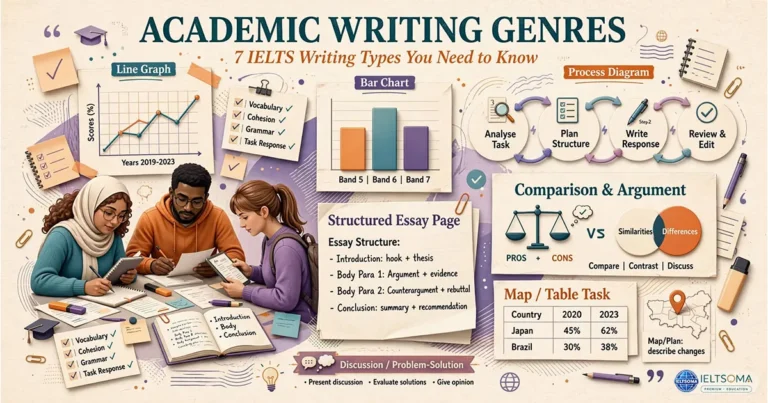
A strong IELTS essay conclusion can make your argument feel complete, clear and convincing. Yet many candidates weaken their essays in the final paragraph by repeating the introduction word for word, introducing a new argument or writing a vague sentence simply because they have run out of time.
The solution is not to use more complicated vocabulary. It is to understand what your conclusion needs to achieve and express your final position clearly.
The IELTS Essay Conclusion should bring your argument together, reinforce your answer to the question and leave the reader with a clear understanding of your position. For most IELTS Writing Task 2 essays, one concise paragraph containing two or three well-developed sentences is sufficient.
In this guide, you will learn how to write an IELTS essay conclusion, use a reliable IELTS Task 2 conclusion structure, adapt your ending to different question types, and avoid common mistakes that can weaken your writing.
Table of Contents
1. What Is an IELTS Essay Conclusion?
An IELTS essay conclusion is the final paragraph of your Writing Task 2 response. Its purpose is to summarise your main argument and reinforce your answer to the question.
It should not repeat your entire essay or introduce an unrelated idea. Instead, it brings together the position you established in your introduction and the reasons you developed in your body paragraphs.
Both IELTS Academic and General Training candidates complete Writing Task 2, which requires a formal essay of at least 250 words. Task 2 is assessed using four criteria: Task Response, Coherence and Cohesion, Lexical Resource, and Grammatical Range and Accuracy.
A well-written conclusion can support your performance by making your position clear and helping your essay maintain logical progression. However, a conclusion alone cannot guarantee a particular band score; the quality of the entire response matters.
What should your conclusion include?
A good conclusion usually contains these elements:
- A clear final position: Answer the question directly and consistently with your introduction and body paragraphs.
- A brief summary of the main reasons: Bring together the most important points without repeating every detail.
- A logical ending: Finish naturally, without adding a new argument or an unnecessary prediction.
You do not need to include all three elements as separate sentences. A short conclusion can combine your position and summary effectively.
For example, consider this question:
Some people believe that university education should be free for everyone. To what extent do you agree or disagree?
A weak conclusion might say:
In conclusion, university education is a very important topic in modern society, and people have different opinions about it.
This ending is vague. It does not reveal the writer’s position.
A stronger conclusion would be:
In conclusion, university education should be affordable for all capable students, although governments should prioritise financial assistance for those who cannot meet the costs themselves.
The second version answers the question directly and communicates a clear position.
2. How to Write an IELTS Essay Conclusion: A Simple Structure
The easiest way to improve your conclusion is to follow a repeatable structure. You do not need to memorise a complete paragraph; instead, learn the purpose of each sentence.
Sentence 1: Restate your answer
Begin by expressing your position in fresh words. Your conclusion should reflect the argument you have already developed.
For an agree-or-disagree essay, this means making your level of agreement clear. For a discussion essay, it means stating which view you support, if the question asks for your opinion.
Example:
Overall, I believe that governments should invest more heavily in public transport because it offers a practical way to reduce congestion and improve access to employment.
This sentence communicates a definite opinion and connects it to the main reasoning of the essay.
Sentence 2: Summarise your main supporting ideas
Briefly bring together the most important reasons from your body paragraphs. You can combine related ideas instead of listing them separately.
For example:
Reliable buses and rail services can reduce dependence on private cars, while affordable fares allow more people to travel to work and education.
This sentence summarises two connected benefits without introducing a completely new argument.
Sentence 3: Add a final implication when useful
A third sentence is optional. Use it only when it adds a meaningful final thought that follows naturally from your argument.
For example:
For these reasons, improving public transport should be a long-term priority for urban planners.
Do not add a third sentence simply to make your conclusion longer. A concise ending is better than unnecessary repetition.
The IELTS Task 2 conclusion structure
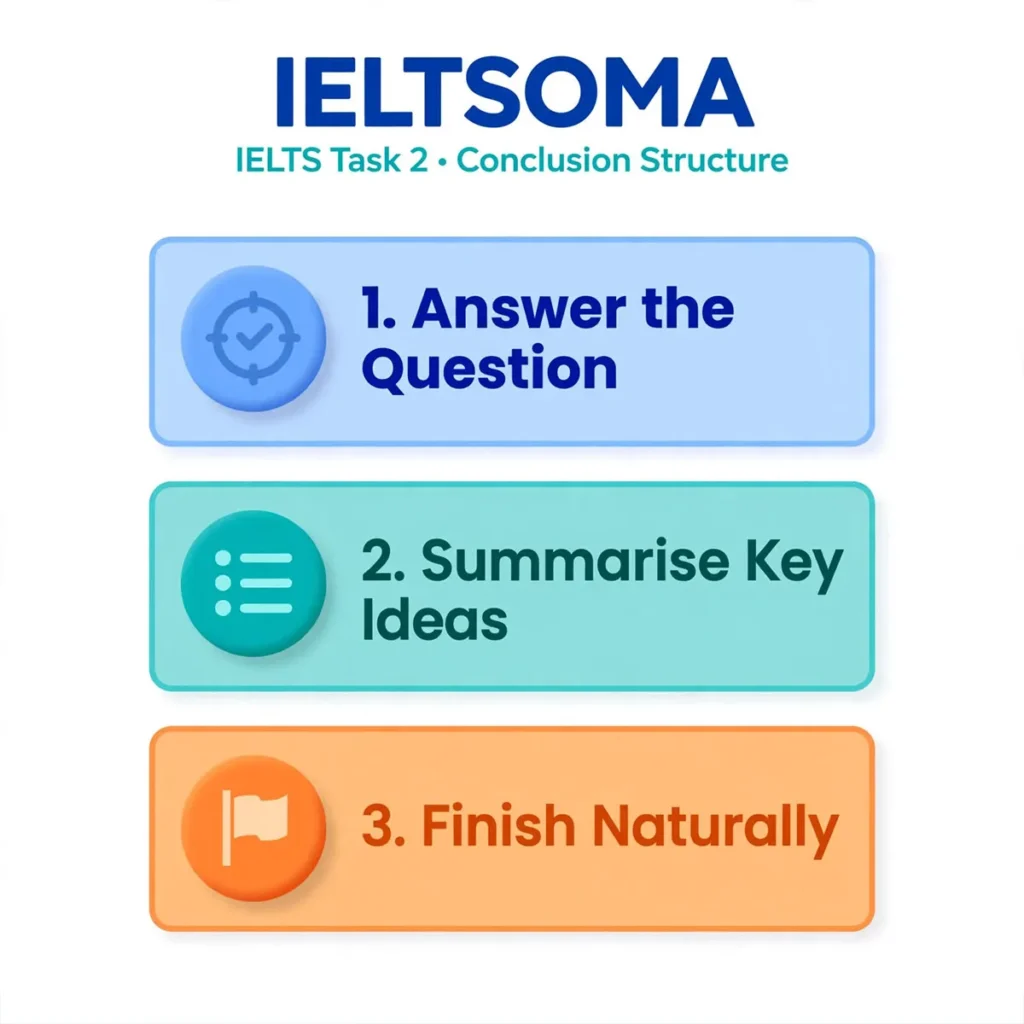
You can remember the structure as follows:
- Answer: Restate your position or overall judgement.
- Summarise: Bring together the main reasons supporting that position.
- Close: Add a brief implication only if it improves the ending.
This structure is flexible rather than compulsory. Some essays need only two sentences, while others benefit from three. The goal is to finish the argument clearly, not to follow a rigid formula.
3. Adapt Your IELTS Essay Conclusion to the Question Type
One of the most common IELTS conclusion mistakes is using the same approach for every essay. Although the basic purpose remains the same, the conclusion must reflect the specific instructions in the question.
A. Agree or disagree essays
These questions ask whether you agree or disagree with a statement, or to what extent you support an opinion.
Your conclusion must make your position unmistakable. If you partly agree, explain the qualification briefly without suddenly changing your stance.
Question:
Some people believe that working from home is more beneficial than working in an office. To what extent do you agree or disagree?
Effective conclusion:
In conclusion, I largely agree that working from home offers greater flexibility and saves commuting time, although office-based work remains valuable for collaboration and professional development.
Why it works:
- It clearly states the extent of agreement.
- It summarises the central benefits.
- It acknowledges a limitation without undermining the main position.
Avoid ending with Both options have advantages and disadvantages if your essay is supposed to establish a clear degree of agreement.
B. Discuss both views and give your opinion
These questions require you to examine two perspectives and, where requested, provide your own view.
Your conclusion should briefly acknowledge the competing perspectives before making your judgement clear.
Question:
Some people think that children should learn practical skills at school, while others believe that academic subjects are more important. Discuss both views and give your opinion.
Effective conclusion:
In conclusion, academic subjects provide essential knowledge, whereas practical skills prepare children for everyday responsibilities. In my view, schools should give appropriate attention to both, rather than treating them as competing priorities.
This ending recognises both sides and directly answers the request for an opinion.
A conclusion that only summarises the two views but omits your own position is incomplete when the question explicitly asks you to give one.
C. Advantages and disadvantages essays
First, check whether the question simply asks you to discuss advantages and disadvantages or asks whether the advantages outweigh the disadvantages.
The distinction matters because the latter requires an overall judgement.
Question:
More people are choosing to study online rather than attend classes in person. Do the advantages outweigh the disadvantages?
Effective conclusion:
Overall, I believe the advantages of online education outweigh its disadvantages because it offers greater flexibility and access to learning, provided that students have suitable technology and can study independently.
This conclusion answers the comparison directly rather than merely stating that online education has both benefits and drawbacks.
If the question does not ask you to decide which side is stronger, you can summarise both sides without forcing an opinion that your essay has not developed.
D. Problem and solution essays
These questions ask you to identify problems, suggest solutions, or do both.
Your conclusion should summarise the main problem and reinforce the solution you consider most effective. Avoid introducing a new solution at the last moment.
Question:
Traffic congestion is becoming a serious problem in many cities. What are the causes, and what measures can be taken to address it?
Effective conclusion:
In conclusion, rising car ownership and inadequate public transport contribute significantly to urban congestion. Expanding reliable public transport and improving traffic management would help cities reduce delays and make travel more efficient.
The conclusion brings together the causes and measures without repeating the explanations from the body paragraphs.
E. Two-part questions
Some Task 2 questions contain two separate questions, such as asking why a trend is occurring and whether it is positive or negative.
Your conclusion should reflect both parts.
Question:
More young people are choosing to live with their parents for longer. Why is this happening, and is it a positive or negative development?
Effective conclusion:
Overall, high housing costs and financial uncertainty help explain why young adults are remaining at home longer. Although this arrangement can allow them to save money, I believe that prolonged dependence may limit their independence if they have few opportunities to manage responsibilities themselves.
The conclusion addresses both the cause and the evaluation. It is consistent with an essay that has discussed these points in its body paragraphs.
4. Seven Powerful Ways to Improve Your IELTS Essay Conclusion
You do not need advanced expressions in every sentence to produce a strong ending. Focus on clarity, precision and consistency.
1. Answer the question directly
Before writing your conclusion, identify the exact task. Are you giving an opinion, comparing two views, weighing advantages against disadvantages, or proposing solutions?
Your final paragraph must reflect that task. A beautifully written conclusion that does not answer the question is still ineffective.
2. Paraphrase rather than copy
Repeating the introduction word for word makes your writing sound mechanical. Express the same position using a different sentence structure or more precise wording.
For example:
Introduction: I believe governments should prioritise public transport over the construction of additional roads.
Conclusion: Overall, greater investment in buses and railways is a more effective long-term response to urban transport problems than continually expanding road networks.
The meaning remains consistent, but the wording and structure differ.
3. Keep your main argument consistent
Your conclusion should not introduce a new opinion that contradicts the position established earlier.
If you argued that online learning is generally beneficial, do not suddenly conclude that traditional classrooms are clearly superior unless your essay has genuinely developed and justified that position.
Consistency helps the reader follow your reasoning from the introduction to the final paragraph.
4. Summarise ideas, not examples
Body paragraphs often contain explanations, evidence and illustrative examples. Your conclusion usually needs the main ideas, not every supporting detail.
For instance, if your essay discusses two cities that reduced traffic through better transport systems, you can summarise the lesson without naming both cities again.
This keeps your ending concise and prevents unnecessary repetition.
5. Use linking expressions naturally
Phrases such as In conclusion, Overall and For these reasons can help signal the end of your argument.
However, linking expressions are not a substitute for logical content. Repeatedly writing Firstly, Secondly, Moreover and In conclusion can make an essay feel formulaic.
Choose a phrase that suits the relationship between your ideas, and do not force a linking word into every sentence.
6. Prefer precise vocabulary to impressive-sounding phrases
Candidates sometimes use complicated expressions in an attempt to demonstrate a high level of English. This can lead to unnatural or inaccurate sentences.
Compare these examples:
Unnatural: To culminate this argumentative discourse, it is incontrovertibly evident that urbanisation constitutes a multifaceted phenomenon.
Clear and effective: Overall, cities need better planning to manage the challenges created by rapid urbanisation.
The second sentence communicates a specific judgement directly. Precision is more valuable than unnecessary complexity.
7. Reserve time to finish and check your essay
A strong conclusion is difficult to write if you reach the final minute without a plan.
For a 40-minute Task 2 response, a practical approach is to spend a few minutes planning, around 30 minutes drafting, and the remaining time completing and checking your work. Adjust the timing to your own writing speed, but avoid sacrificing the conclusion entirely.
Before moving on, check that you have answered every part of the question, maintained your position, and avoided grammatical errors.
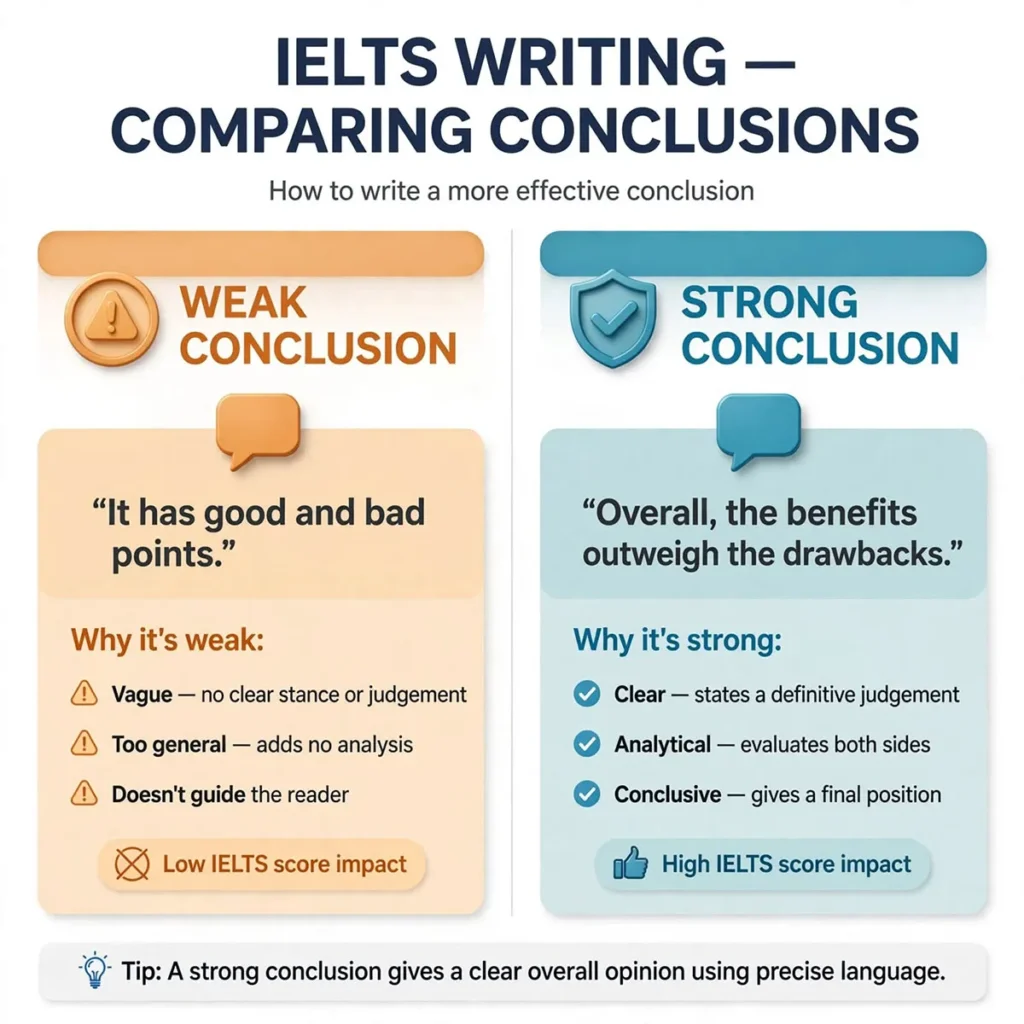
5. IELTS Conclusion Mistakes That Can Weaken Your Essay
Understanding common IELTS conclusion mistakes is just as important as learning a good structure.
| Mistake | Why it is ineffective | Better approach |
|---|---|---|
| Copying the introduction exactly | Makes the ending repetitive | Paraphrase the position |
| Introducing a new argument | Leaves an idea undeveloped | Use only points established in the essay |
| Giving a vague opinion | Does not answer the question clearly | State your judgement explicitly |
| Repeating every body paragraph | Wastes words and time | Summarise the central ideas |
| Changing your position | Creates inconsistency | Keep your final judgement aligned with the essay |
| Using memorised, unnatural phrases | Can reduce clarity and precision | Write in natural, accurate English |
| Ending with a rhetorical question | Can make the argument feel unfinished | State your conclusion directly |
| Writing only a generic final sentence | Fails to bring the argument together | Connect the answer to the main reasons |
Should you introduce a new idea in the conclusion?
Generally, no. The conclusion is not the place to develop a fresh argument, add new evidence or introduce an example that requires explanation.
A brief implication is acceptable when it follows directly from the argument already presented. For example, if your essay argues that cities need more public transport, saying that transport planning should be a long-term priority is a reasonable closing thought.
However, introducing an entirely new claim about taxation, environmental policy or economic growth would be unhelpful if the essay has not discussed it.
Is it necessary to write “In conclusion”?
No. In conclusion is a perfectly acceptable phrase, but it is not compulsory.
You can use Overall, For these reasons or another suitable expression. You can also begin directly with your final position if the transition is clear.
The quality of the conclusion depends on what you say and how logically you connect it to the essay, not on whether you use a particular opening phrase.
How long should an IELTS Task 2 conclusion be?
There is no official rule requiring a conclusion to contain a fixed number of words or sentences. As a practical guideline, aim for approximately 40–60 words, usually across two or three sentences.
The correct length depends on the essay and the question. A short conclusion can be effective if it answers the task clearly, while a longer one may become repetitive.
Remember that IELTS Writing Task 2 requires at least 250 words overall. Do not pad your conclusion with empty statements merely to increase your word count.
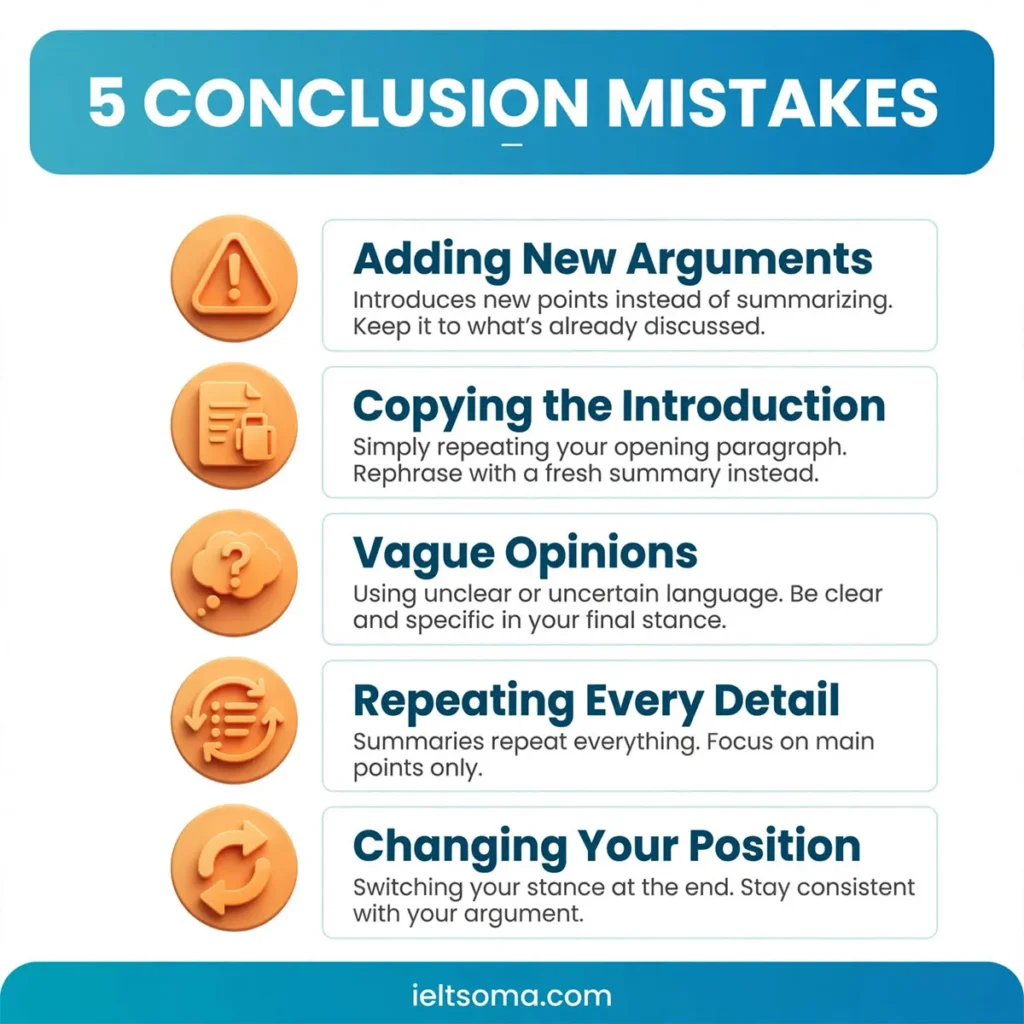
6. IELTS Essay Conclusion Examples: Weak vs Strong
The following examples show how small changes can make a conclusion more relevant and decisive.
Example 1: Technology in education
Question: Some people believe technology has improved education, while others think it has created more problems. Discuss both views and give your opinion.
Weak conclusion:
In conclusion, technology has advantages and disadvantages, and everyone has different opinions about it.
This is too general. It does not explain which view the writer supports or why.
Stronger conclusion:
Overall, although digital tools can distract students and increase inequality where access is limited, I believe technology has improved education by widening access to resources and supporting more flexible learning.
The stronger version acknowledges the opposing view while giving a clear, supported judgement.
Example 2: Public transport
Question: Governments should spend more money on public transport than on building new roads. To what extent do you agree or disagree?
Weak conclusion:
In conclusion, transport is very important for every country, and governments should make good decisions.
This could fit almost any transport essay. It does not answer the comparison.
Stronger conclusion:
In conclusion, I agree that public transport deserves greater investment because efficient bus and rail services can move more people while reducing dependence on private cars. Road improvements remain necessary, but they should not be the main solution to growing urban travel demand.
This ending directly addresses the proposal and explains the writer’s position.
Example 3: Working while studying
Question: Some people think university students should work part-time while studying. Do the advantages outweigh the disadvantages?
Weak conclusion:
To conclude, students should think carefully before working because it can be good or bad.
The statement is vague and does not decide whether the benefits outweigh the drawbacks.
Stronger conclusion:
Overall, I believe part-time employment offers more advantages than disadvantages when students limit their working hours. It can provide valuable experience and financial independence without seriously affecting academic performance, provided that study remains their priority.
This conclusion provides a clear judgement and a relevant qualification.
7. A Quick Checklist for Your IELTS Essay Conclusion
Before finishing your Writing Task 2 response, use this checklist to evaluate the final paragraph.
- Have I answered the exact question?
- Is my position clear and consistent with the introduction?
- Have I summarised the main arguments without repeating all the details?
- Have I avoided introducing a new argument or unsupported example?
- Is my wording natural and sufficiently precise?
- Have I checked grammar, spelling and punctuation?
- Does the conclusion finish the essay logically?
If you answer “no” to any of these questions, revise the paragraph before moving on.
A useful final test is to read your conclusion on its own. Could a reader identify your main answer to the essay question without guessing? If not, make your position more explicit.
Frequently Asked Questions About IELTS Essay Conclusions
1. How do I write an IELTS essay conclusion for Band 7 or higher?
Focus on answering the question fully, maintaining a consistent position and summarizing your reasoning clearly. Use accurate vocabulary and varied sentence structures where appropriate but avoid complicated language that you cannot control. A strong conclusion supports the whole essay; it does not guarantee a Band 7 score by itself.
2. Can I use “In conclusion” in every IELTS Task 2 essay?
Yes. It is an acceptable and clear way to introduce a final paragraph. However, you can vary your wording with expressions such as Overall or For these reasons. Do not sacrifice clarity simply to avoid repeating a familiar phrase.
3. Should I include my opinion in the conclusion?
Include your opinion when the question asks for it, or when your overall judgement is necessary to answer the task. For agree-or-disagree, discussion-and-opinion, and outweigh questions, your position should be clear. For other question types, ensure that the conclusion addresses the specific instructions without adding an unnecessary opinion.
4. Can an IELTS conclusion be only one sentence?
Yes, if one sentence clearly answers the question and summarises the main point. However, two sentences often make it easier to express your position and summarise the reasons without creating an overloaded sentence.
5. Should I add a recommendation or prediction to my conclusion?
Only when it follows naturally from the argument and helps answer the question. A recommendation may suit a problem-and-solution essay, but a dramatic prediction or a general statement about the future is rarely necessary.
6. What is the biggest IELTS conclusion mistake?
One of the most damaging mistakes is failing to answer the question directly. A vague ending, a contradictory opinion or a new argument can weaken the logical connection between the essay’s main ideas and its final position.
7. Do IELTS examiners mark the conclusion separately?
No. The conclusion does not receive a separate band score. Examiners assess the response using the published Writing Task 2 criteria, including Task Response and Coherence and Cohesion, alongside Lexical Resource and Grammatical Range and Accuracy. The conclusion contributes to the overall quality of the response.
Final Thoughts
An effective IELTS Essay Conclusion does not need to be dramatic, lengthy or filled with advanced vocabulary. It needs to complete the argument you have already built.
Restate your answer in fresh language, summarise your central reasons and finish naturally. Adapt the conclusion to the question type, maintain a consistent position and avoid adding new arguments at the last moment.
Practise writing conclusions for different Task 2 questions until the process becomes familiar. With a clear IELTS Task 2 conclusion structure and careful attention to the question, you can make your essays more coherent, focused and convincing.
For further preparation, consult the official IELTS Writing band descriptors to understand how examiners assess your writing, and explore the British Council’s IELTS writing preparation resources for additional guidance.
Further Reading: