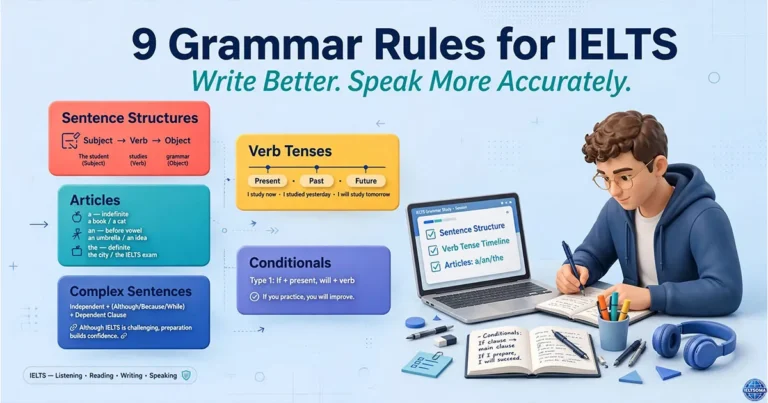
Getting IELTS Grammar for Band 7 is not about memorising hundreds of grammar rules or forcing complicated sentences into every paragraph. Band 7 grammar is about something much more practical: using a good range of structures accurately, flexibly and appropriately while keeping your meaning clear.
The official IELTS Writing Band 7 descriptor says that candidates use a variety of complex structures with some flexibility and accuracy, that grammar and punctuation are generally well controlled, and that error-free sentences are frequent. A few grammatical errors may remain, but they should not impede communication.
The Speaking Band 7 descriptor has a similar message. A Band 7 candidate uses a range of structures flexibly, produces frequent error-free sentences, and uses both simple and complex sentences effectively despite some errors.
So what does that mean for your preparation?
You do not need perfect grammar.
You need controlled grammar.
This guide explains the grammar for IELTS Band 7 that actually deserves your study time, the structures you should be able to use, the mistakes that commonly hold candidates back, and how to turn grammar knowledge into a higher IELTS score.
Table of Contents
What Does IELTS Grammar for Band 7 Actually Mean?
Grammar is assessed under the criterion Grammatical Range and Accuracy in both IELTS Writing and Speaking. In Writing, this criterion considers the range and appropriacy of structures, accuracy, grammatical errors and punctuation.
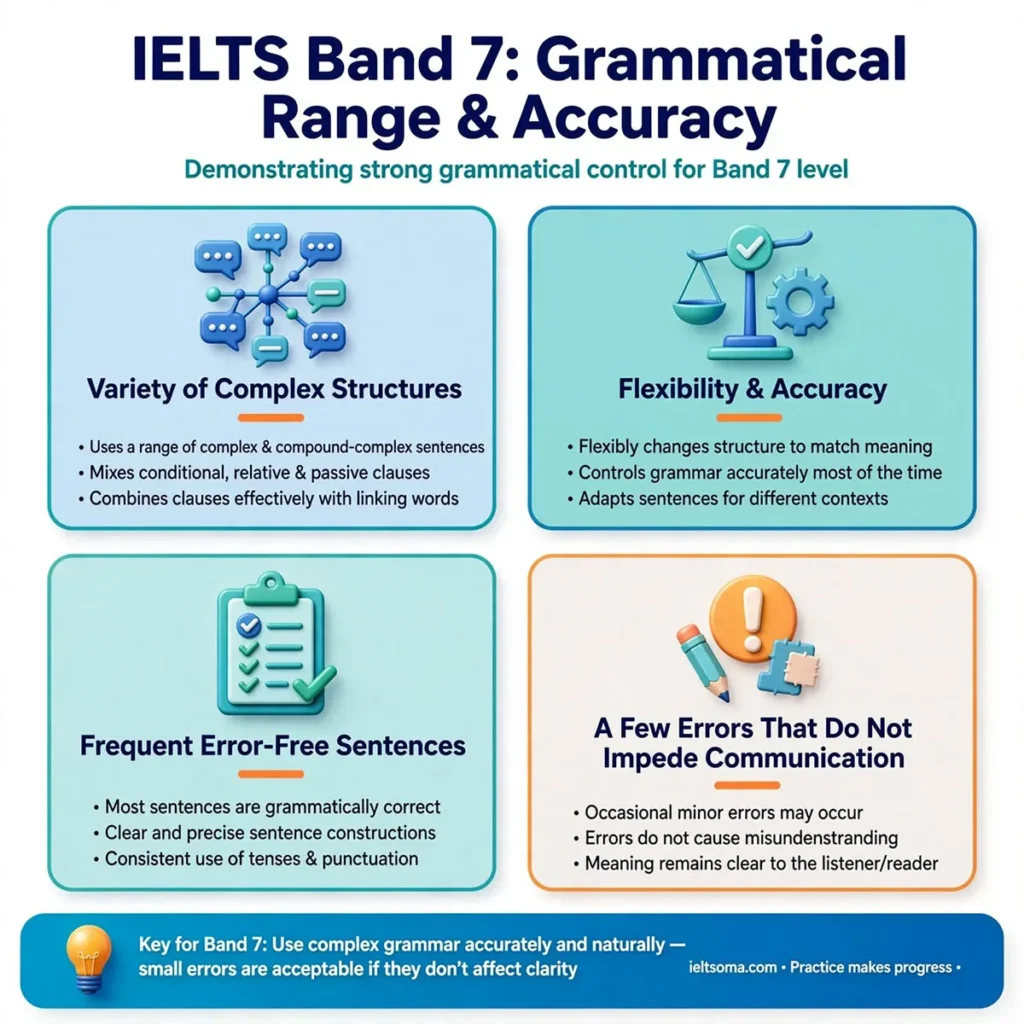
For Band 7 Writing, the official descriptor expects:
- A variety of complex structures
- Some flexibility and accuracy in using those structures
- Generally well-controlled grammar and punctuation
- Frequent error-free sentences
- Only a few errors that do not impede communication
For Band 7 Speaking, the expectation is slightly different because spoken language is produced in real time. You should be able to use a range of structures flexibly, with frequent error-free sentences, while using both simple and complex sentences effectively. A few basic errors may still persist.
This leads to an important point:
Band 7 is not a grammar perfection test. It is a test of grammatical control.
A candidate who attempts extremely advanced structures but makes frequent errors may demonstrate less control than a candidate who uses moderately complex structures accurately.
Band 6 vs Band 7 Grammar
The difference becomes clearer when you compare the descriptors.
| Area | Around Band 6 | Around Band 7 |
|---|---|---|
| Sentence variety | Mix of simple and complex forms | Variety of complex structures |
| Accuracy | Some errors | Generally well controlled |
| Error-free sentences | Less consistent | Frequent |
| Complex grammar | Used, sometimes inaccurately | Used with greater flexibility |
| Communication | Errors rarely reduce communication | A few errors may remain without impeding communication |
| Grammar strategy | Show what you know | Control what you use |
The official IELTS guidance also explains that Band 7 and above Writing requires complex structures, including structures such as passive forms, modal verbs, comparative structures and complex noun phrases.
That is the real target.
1. Master Simple Grammar Before Chasing Complex Grammar
The first requirement for IELTS grammar requirements Band 7 is surprisingly basic: your fundamental sentences must be reliable.
Consider this sentence:
Many people believe that governments should invest more money in public transport.
It is not grammatically spectacular. But it is accurate, clear and useful.
Now consider:
Many people believes that governments should invests more money in public transports.
The second sentence tries to communicate the same idea, but repeated basic errors weaken grammatical accuracy.
Before spending hours learning advanced structures, make sure you have strong control of:
- Subject–verb agreement
- Verb forms
- Basic tenses
- Articles
- Countable and uncountable nouns
- Singular and plural forms
- Pronouns
- Prepositions
- Word order
- Sentence boundaries
- Basic punctuation
These areas matter because errors in fundamental grammar can appear repeatedly throughout your writing and speaking.
For example:
Incorrect:
People is becoming more dependent on technology.
Correct:
People are becoming more dependent on technology.
Incorrect:
The government should invests more money.
Correct:
The government should invest more money.
Incorrect:
There are many advantage of public transport.
Correct:
There are many advantages to public transport.
The goal is not to eliminate every possible error before moving forward. It is to prevent basic mistakes from becoming a repeated pattern.
2. Learn to Use Complex Sentences Naturally
One of the clearest IELTS grammar requirements Band 7 is the ability to use a variety of complex structures.
A complex sentence contains a main clause and at least one subordinate clause.
For example:
Many people work from home because it allows them to avoid long daily commutes.
You can create complex sentences using structures such as:
- Because / since / as
- Although / even though / while
- If / unless
- When / whenever
- Whereas
- Relative clauses
- Conditional structures
- Participle clauses
- Noun clauses
Compare these sentences:
Basic:
Working from home is becoming popular. It saves commuting time.
More developed:
Working from home is becoming popular because it allows employees to save commuting time.
More sophisticated:
Although working from home can improve employees’ work-life balance, it may also reduce opportunities for face-to-face collaboration.
The final sentence demonstrates greater grammatical range because the writer can connect contrasting ideas within one controlled structure.
However, do not make every sentence complex.
A strong paragraph might look like this:
Public transport should receive greater investment because it can reduce congestion in major cities. It also provides an affordable alternative to private cars. However, governments must improve reliability and coverage if they want more people to use it.
This paragraph contains different sentence forms rather than four complicated sentences.
That variety is more useful than complexity for its own sake.
3. Make Relative Clauses Part of Your Toolkit
Relative clauses are particularly useful for IELTS because they allow you to add precise information without creating a series of short sentences.
Compare:
Students need access to reliable online resources. These resources can help them study independently.
With:
Students need access to reliable online resources, which can help them study independently.
Or:
Students who have access to reliable online resources may be able to study more independently.
Useful relative pronouns and structures include:
- who
- which
- that
- whose
- where
- when
For example:
Governments should support industries that create long-term employment.
Universities, which increasingly use digital learning platforms, must ensure that students receive adequate technical support.
Cities where public transport is reliable often have fewer cars on the road.
Relative clauses are valuable because they can help you express relationships between ideas more precisely.
But accuracy comes first.
Incorrect:
People which live in cities often experience higher levels of stress.
Correct:
People who live in cities often experience higher levels of stress.
A complex structure containing a clear grammatical error is not automatically better than a simpler correct sentence.
4. Use Conditionals to Express Real Relationships
Conditionals are another useful part of your grammar for IELTS Band 7 toolkit.
They allow you to discuss consequences, possibilities, hypothetical situations and recommendations.
First conditional
Used for realistic future possibilities:
If governments improve public transport, more people may choose to leave their cars at home.
Second conditional
Used for hypothetical or less likely situations:
If cities invested more heavily in cycling infrastructure, residents might become less dependent on cars.
Third conditional
Used to discuss hypothetical past situations:
If the government had invested earlier, the city might have avoided some of its current transport problems.
Mixed conditional
Useful when a past action has a present consequence:
If the company had invested in training earlier, its employees would now be better prepared for technological change.
You do not need to use every type of conditional in one essay.
Instead, choose the structure that accurately expresses the relationship between your ideas.
That is an important principle throughout IELTS:
Grammar should serve meaning.
5. Use Modals for More Precise Arguments
Modal verbs are particularly useful in Writing Task 2 and Speaking because they allow you to express degrees of certainty, obligation, possibility and advice.
Compare:
Governments should improve public transport.
with:
Governments must improve public transport.
These statements are not identical. Should expresses recommendation, while must expresses stronger obligation.
Other useful modal structures include:
- may
- might
- could
- can
- should
- must
- would
For example:
Governments could provide financial incentives for companies that adopt environmentally friendly practices.
Excessive screen time may have negative effects on children’s sleep.
Schools should teach students how to evaluate information critically.
If these measures were introduced, they could reduce the pressure on public services.
The important issue is not how many modal verbs you use. It is whether you use them accurately and appropriately.
6. Understand Tenses as a Meaning System
Many candidates study tenses as isolated grammar rules:
Present simple = something that happens regularly.
Past simple = something that happened before.
That is useful at the beginning, but Band 7 requires more control over tense choices in context.
For IELTS Writing Task 1, tense selection can directly affect accuracy.
For example:
The number of visitors increased between 2010 and 2015.
This is appropriate for a completed period.
But:
The number of visitors has increased since 2010.
Here, the present perfect connects a past change with the present.
In Speaking, accurate tense control is equally important.
If the examiner asks:
What did you do last weekend?
You need to establish a clear past-time frame:
I visited my cousin on Saturday. We went to a new restaurant and spent most of the afternoon talking.
If you move to general habits, the tense can change:
I usually visit my family at weekends because we live relatively close to each other.
The key is consistency and control.
Tenses Worth Prioritising
For most IELTS candidates aiming for Band 7, give particular attention to:
- Present simple
- Present continuous
- Past simple
- Present perfect
- Past perfect
- Future forms
- Conditional structures
You do not need to force every tense into your answer.
Use the tense that communicates your intended meaning accurately.
7. Learn Complex Noun Phrases
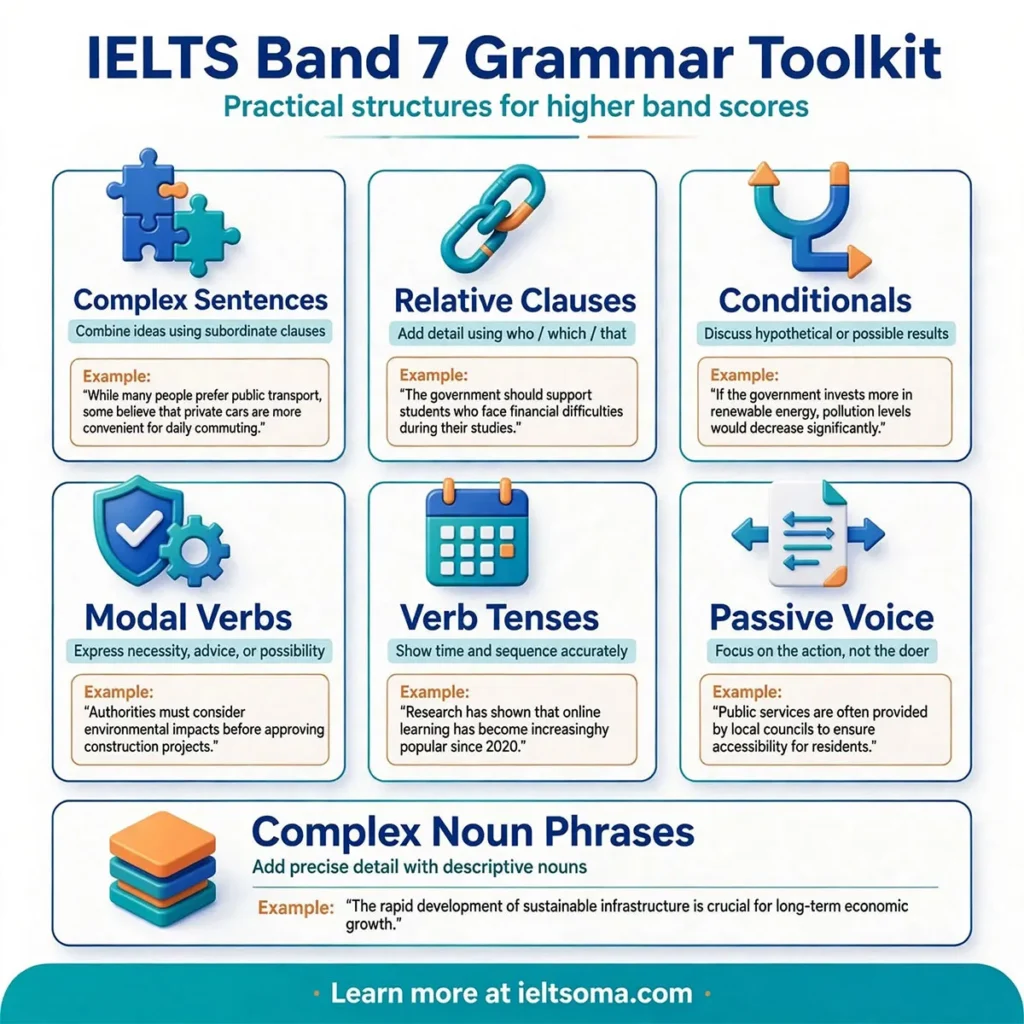
Complex noun phrases are often overlooked by candidates who focus only on verb tenses and conditionals.
Yet they can make your academic writing more precise.
Compare:
Many people live in cities.
with:
A growing proportion of the global population lives in rapidly expanding urban centres.
Or:
Governments should solve environmental problems.
with:
Governments should address the increasingly serious environmental problems associated with rapid industrialisation.
The second examples contain more detailed noun phrases.
Useful elements include:
- Adjectives
- Participles
- Prepositional phrases
- Relative clauses
- Noun modifiers
For example:
the rapid expansion of online education
government-funded healthcare programmes
the increasing demand for affordable housing
policies designed to reduce carbon emissions
These structures can help you express complex ideas efficiently.
However, do not make every noun phrase excessively long.
Clarity still matters.
Grammar for IELTS Band 7: What About Passive Voice?
Passive structures are useful, particularly in Academic Writing Task 1 and when describing processes, systems or actions where the actor is less important.
Active:
The company introduced the new policy in 2025.
Passive:
The new policy was introduced in 2025.
The passive can be useful when the action is more important than the person or organisation responsible.
In Task 1 process descriptions, it can be especially natural:
The raw materials are transported to the factory before they are processed.
In Task 2, however, do not use passive structures simply to appear advanced.
Use them when they improve the sentence.
Grammar and Speaking: Accuracy Under Pressure
Grammar is not only a Writing issue.
Speaking is also assessed for Grammatical Range and Accuracy, and the Band 7 descriptor expects a range of structures used flexibly, with frequent error-free sentences.
The challenge is that you have less time to plan.
For example, instead of memorising:
If I were given the opportunity to…
learn to use the pattern naturally:
If I were given the opportunity to study abroad, I would probably choose Canada because…
You can then adapt it to different questions.
Similarly:
One reason why I think this is important is that…
can help you introduce an explanation naturally.
But memorised sentences should not become rigid scripts. IELTS Speaking requires you to respond to the questions and develop your own ideas.
The Most Important Grammar Mistakes to Fix
If your target is Band 7, do not treat every grammar mistake as equally important.
Start with repeated errors that affect clarity or occur throughout your answer.
1. Subject–verb agreement
People believe…
not:
People believes…
2. Articles
The government should invest in education.
Education plays an important role in society.
The use of a, an, the and the zero article deserves systematic practice.
3. Verb tense
I visited London last year.
not:
I visit London last year.
4. Countable and uncountable nouns
Many people have access to information.
not:
Many people have access to informations.
5. Prepositions
interested in
responsible for
dependent on
access to
These combinations need to become familiar rather than being translated word-for-word from your first language.
6. Sentence boundaries
Avoid joining independent sentences incorrectly.
Incorrect:
Technology is developing rapidly, people need to adapt.
Better:
Technology is developing rapidly, so people need to adapt.
Or:
Technology is developing rapidly. People therefore need to adapt.
Do You Need “Advanced Grammar” to Get Band 7?
Not in the way many candidates imagine.
There is no official list saying that you must use exactly five conditionals, three passive sentences and two inversion structures to receive Band 7.
The official descriptors focus on the quality, range, flexibility and accuracy of your grammatical performance.
That means this sentence:
Had governments invested more heavily in public transport, congestion might have been reduced.
can be useful when the meaning requires it.
But this sentence:
Had the aforementioned governmental authorities strategically implemented substantially increased investment…
is not automatically better.
It may simply be unnecessarily complicated.
A Better Band 7 Principle
Use this rule:
Choose the most sophisticated structure that you can control accurately.
If you can use a second conditional accurately, use it.
If you cannot, do not force one into your essay because you have been told that Band 7 requires “advanced grammar”.
A correct, natural sentence is more valuable than an impressive-looking sentence full of errors.
A Practical Grammar Checklist for Band 7
Before submitting a Writing answer, check your grammar systematically rather than reading the whole essay randomly.
Pass 1: Verbs
Check:
- Subject–verb agreement
- Tense
- Verb forms
- Modal verbs
- Auxiliary verbs
Pass 2: Nouns and articles
Check:
- Singular/plural
- a/an/the
- Countable/uncountable nouns
- Possessives
Pass 3: Sentence structure
Check:
- Sentence boundaries
- Subordinate clauses
- Relative clauses
- Conjunctions
- Word order
Pass 4: Punctuation
Check:
- Full stops
- Commas
- Apostrophes
- Capital letters
Pass 5: Range
Finally, ask:
- Have I used both simple and complex sentences?
- Have I used complex structures naturally?
- Is my grammar varied rather than repetitive?
- Are my more ambitious structures accurate?
This approach is much more useful than simply searching for “advanced grammar”.
A Band 7 Grammar Upgrade: From Basic to Better
Here is a practical example.
Basic:
Many people use cars because cars are convenient. Cars cause pollution. Governments should encourage public transport.
Improved:
Many people rely on cars because they are convenient, particularly for those who live far from their workplaces. However, widespread car use contributes significantly to air pollution, so governments should encourage people to use public transport.
Notice what changed.
The improved version uses:
- A reason clause
- A relative clause
- A contrast marker
- A more precise verb
- A cause-and-effect relationship
- A complex sentence structure
But it remains readable.
That is the kind of development you should aim for.
How to Practice Grammar for IELTS Band 7
Grammar study becomes much more effective when it is connected directly to IELTS tasks.
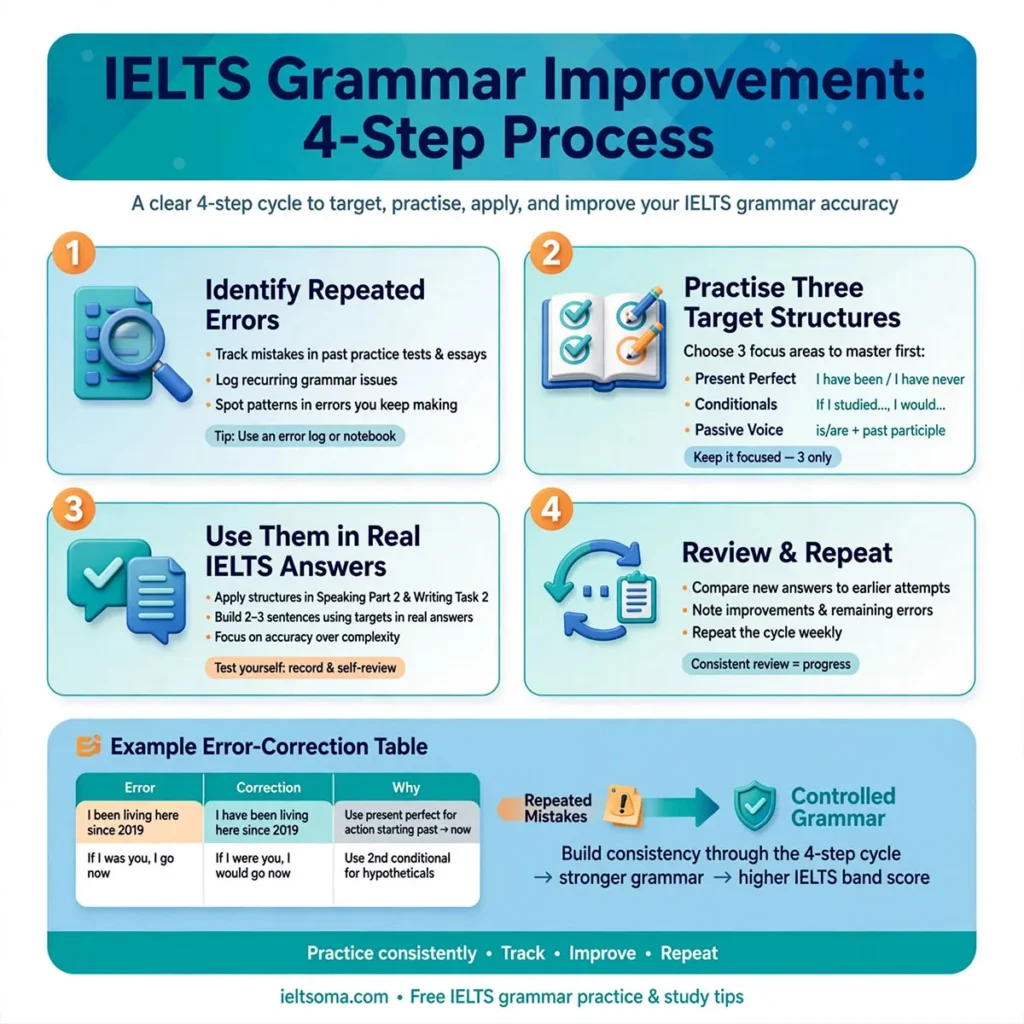
Step 1: Identify your repeated errors
Take three recent Writing or Speaking answers.
Create a list of your recurring mistakes.
For example:
| Error | Your sentence | Correct form |
|---|---|---|
| Agreement | People believes | People believe |
| Article | Government should invest in the education | Government should invest in education |
| Tense | I have visited it last year | I visited it last year |
| Preposition | depend of | depend on |
Your personal error list is more valuable than memorising random grammar rules.
Step 2: Choose three structures
For one week, practise only three structures.
For example:
- Relative clauses
- Conditionals
- Concession clauses with although
Write five IELTS-style sentences using each.
Step 3: Use them in a real answer
Write one Task 2 paragraph or record a Speaking Part 3 answer.
Do not deliberately insert every grammar structure.
Use them where they naturally fit.
Step 4: Review accuracy
Underline every complex sentence.
Ask:
Is the structure actually correct?
If not, simplify it.
Step 5: Repeat
The goal is to move grammar from conscious rule knowledge towards automatic use.
Research published by IELTS also indicates that grammatical features develop differently across proficiency levels and that attempts at more complex structures increase at higher levels, although such attempts can also have higher failure rates.
That finding supports a sensible preparation principle: increase complexity while simultaneously improving control.
Common Grammar Mistakes That Can Hold You Below Band 7
Avoid these common strategies:
Trying to use an advanced structure in every sentence
This often creates unnecessary errors.
Memorising “Band 7 sentences”
Examiners are assessing your language performance, not your ability to reproduce a collection of memorised sentences.
Using difficult grammar you cannot control
A sophisticated error is still an error.
Ignoring basic mistakes
Repeated errors with articles, agreement or tense can undermine the impression of grammatical control.
Writing extremely long sentences
Longer does not automatically mean more complex or more accurate.
Studying grammar without producing language
Knowing the rule is different from being able to use it under exam conditions.
Frequently Asked Questions
What grammar do I need for IELTS Band 7?
You need to demonstrate a variety of grammatical structures, including complex structures, while maintaining generally good control. In Writing, the official Band 7 descriptor expects frequent error-free sentences and only a few errors that do not impede communication.
Is perfect grammar required for Band 7 IELTS?
No. The official Band 7 descriptors explicitly allow some grammatical errors. The important issue is that grammar is generally well controlled and remaining errors do not impede communication.
What are the main IELTS grammar requirements Band 7?
The central requirements are grammatical range, flexibility, accuracy and appropriate use. For Writing, candidates should use a variety of complex structures and produce frequent error-free sentences.
Which grammar topics should I study for IELTS Band 7?
Prioritize sentence structure, complex sentences, relative clauses, conditionals, modal verbs, verb tenses, articles, subject–verb agreement, countable and uncountable nouns, prepositions, passive structures and complex noun phrases.
Do I need advanced grammar for IELTS Speaking Band 7?
You need a range of structures used flexibly and accurately. The Band 7 Speaking descriptor specifically refers to effective use of both simple and complex sentences, with frequent error-free sentences.
How can I improve my grammatical range and accuracy in IELTS?
First identify your recurring errors. Then practise a small number of useful structures, apply them in real IELTS answers, review the accuracy of those structures and repeat the process. Do not measure progress simply by counting how many advanced structures you know.
Can I get Band 7 with some grammar mistakes?
Yes. Band 7 does not require perfect grammar. A few errors may persist, provided they do not impede communication and your overall grammar is well controlled.
Final Takeaway: Control Beats Complexity
If you are aiming for Band 7, stop thinking of grammar as a competition to see who can use the most complicated sentence.
The real goal is controlled variety.
You should be able to:
- Write accurate basic sentences
- Combine ideas using complex structures
- Use conditionals appropriately
- Control important verb tenses
- Use relative clauses accurately
- Use modal verbs to express precise meanings
- Build more sophisticated noun phrases
- Use passive structures when appropriate
- Maintain grammatical accuracy while developing ideas
- Recognise and correct your recurring errors
The official IELTS guidance makes the principle clear: for Band 7 and above, complex structures matter, but grammar does not need to be perfect. Errors become a problem when their frequency or seriousness affects communication.
So if your current grammar is around Band 6, do not try to learn every grammar rule in English.
Find the mistakes you repeatedly make.
Fix those first.
Then expand your range gradually and practise using more complex structures until they become natural.
That is what IELTS Grammar for Band 7 really requires: not perfect English, but flexible, accurate and controlled English.
Further Reading: