Building a strong vocabulary for IELTS does not mean memorising thousands of difficult words.
The real challenge is being able to find the right word quickly, understand how it is used, and use it naturally in a sentence.
That is why learning IELTS topic vocabulary can be much more effective than studying long, disconnected word lists. When you organise vocabulary around familiar IELTS topics such as education, health, technology, the environment, work and transport, related words become easier to remember and retrieve during the test.
However, there is an important difference between knowing a word and being able to use it accurately.
A student might memorise sustainable, innovation and infrastructure, but that does not automatically mean they can use those words effectively in an IELTS Writing Task 2 essay or Speaking discussion.
The goal is therefore not to collect impressive words. It is to build a flexible vocabulary system that helps you understand questions, develop ideas, paraphrase information and express your meaning precisely.
This guide explains how to build topic vocabulary for IELTS, how to organise an IELTS topic vocabulary list, and how to learn vocabulary by topic in a way that transfers into real IELTS answers.
Table of Contents
What Is IELTS Topic Vocabulary?
IELTS topic vocabulary is a group of words and expressions connected to a particular subject commonly discussed in the IELTS test.
For example, an education topic might include:
- curriculum
- tuition fees
- academic performance
- vocational training
- higher education
- educational facilities
- distance learning
- practical skills
An environment topic might include:
- carbon emissions
- renewable energy
- climate change
- fossil fuels
- biodiversity
- environmental damage
- conservation
- sustainable development
The purpose is not to memorise every possible word about a topic.
Instead, you want a usable vocabulary network: nouns, verbs, adjectives, collocations and useful expressions that allow you to discuss the topic from different angles.
This matters because IELTS Writing and Speaking assess Lexical Resource. In Writing, this includes the range, accuracy and appropriacy of vocabulary used for the task.
In Speaking, Lexical Resource includes the range and precision of vocabulary and the ability to use appropriate vocabulary for expressing meaning and attitude.
Why Learn Vocabulary by Topic for IELTS?
Learning words by topic gives your memory a meaningful structure.
Compare these two study methods.
Method 1: Random vocabulary
achieve → pollution → convenient → scholarship → elderly → manufacture → commute
There is no obvious connection between the words.
Method 2: Topic-based vocabulary
Education: scholarship → tuition fees → higher education → academic performance → vocational training
The second group creates connections between words. When you see or hear one word, it can help you remember related vocabulary.
Topic-based learning can also help you prepare for several IELTS skills simultaneously.
For example, vocabulary connected with technology might be useful when:
- reading an article about artificial intelligence
- listening to a discussion about online learning
- answering a Speaking Part 3 question
- writing an essay about technology and employment
This does not mean the same words should be forced into every answer. The vocabulary must remain relevant to the specific question.
Official IELTS guidance also emphasises relevance and appropriacy. In Writing Task 2, for example, candidates need to address the specific topic rather than simply write generally about a broader subject.
How to Build Topic Vocabulary for IELTS
The most effective approach is to build each topic as a small vocabulary system, rather than creating a huge dictionary-style list.
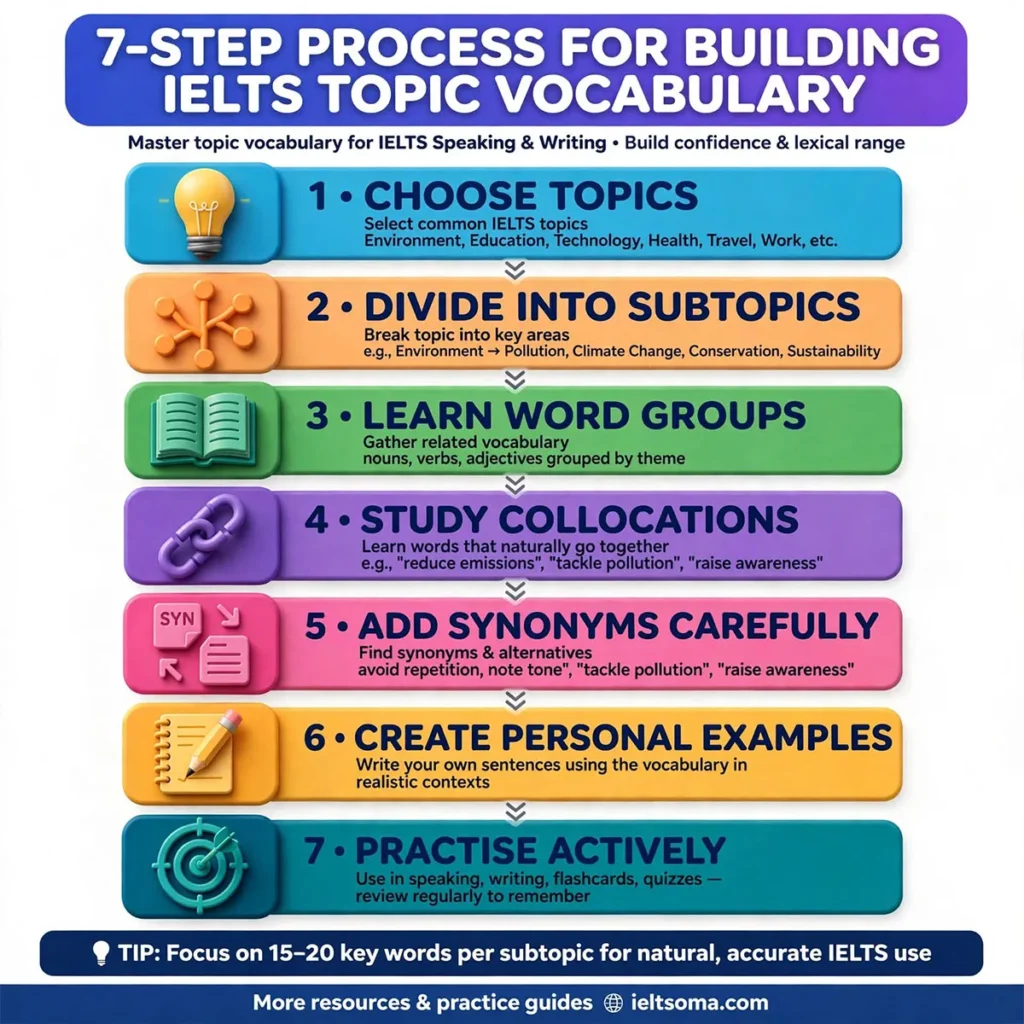
Here is a practical seven-step method.
1. Start With High-Frequency IELTS Topics
You do not need to begin with obscure subjects.
Start with topics that frequently provide useful vocabulary across IELTS tasks.
A practical IELTS topic vocabulary list could include:
| Topic | Useful vocabulary areas |
|---|---|
| Education | schools, universities, learning, assessment |
| Health | exercise, diet, healthcare, disease prevention |
| Environment | pollution, conservation, climate, energy |
| Technology | artificial intelligence, internet, automation |
| Work | employment, careers, salaries, workplace |
| Transport | public transport, congestion, infrastructure |
| Crime | punishment, prevention, law enforcement |
| Society | communities, inequality, social change |
| Government | public services, policy, taxation |
| Media | journalism, advertising, social media |
| Cities | housing, population, urban development |
| Globalisation | international trade, culture, migration |
These topics overlap, which is useful.
For example, technology vocabulary can support discussions about education, employment, healthcare and communication.
That means one well-developed vocabulary set can become useful in many different IELTS questions.
2. Divide Each Topic Into Subtopics
A broad topic such as health is too large to memorise efficiently.
Break it into smaller areas.
Health
Lifestyle
- balanced diet
- regular exercise
- sedentary lifestyle
- healthy habits
Healthcare
- medical treatment
- healthcare system
- access to healthcare
- healthcare professionals
Prevention
- disease prevention
- public health campaigns
- early diagnosis
- health screening
Problems
- obesity
- chronic disease
- mental health problems
- substance abuse
Now the vocabulary has structure.
If the IELTS question asks about childhood obesity, you can immediately connect the topic with diet, exercise, lifestyle, prevention and public health.
3. Learn Words in Groups, Not Isolation
One of the biggest vocabulary mistakes is learning individual words without learning how they behave.
For example, learning:
pollution
is useful.
But learning:
air pollution
reduce pollution
severe pollution
pollution levels
sources of pollution
pollution-related health problems
is much more powerful.
The second approach teaches you collocation as well as vocabulary.
Consider another example:
Verb: address
Noun: problem
Collocation: address a serious problem
Instead of memorising address as an impressive synonym for deal with, you learn how it naturally fits into an IELTS sentence.
For example:
Governments should introduce stricter regulations to address the problem of air pollution.
That is much more useful than simply knowing the definition of address.
IELTS guidance specifically identifies collocation, precision and appropriate vocabulary use as relevant aspects of Lexical Resource.
4. Include Nouns, Verbs, Adjectives and Adverbs
A strong topic vocabulary set should not consist entirely of nouns.
For example, consider environment.
Nouns
- pollution
- conservation
- emissions
- biodiversity
- deforestation
Verbs
- conserve
- reduce
- protect
- contaminate
- regulate
Adjectives
- sustainable
- environmentally friendly
- renewable
- harmful
- biodegradable
Adverbs
- sustainably
- environmentally
- significantly
- increasingly
This gives you more flexibility when constructing sentences.
Compare:
Pollution is a problem.
with:
Governments need to significantly reduce industrial emissions to limit environmental damage.
The second sentence gives you much greater control over meaning.
5. Learn Useful Collocations
If you want to improve your IELTS topic vocabulary, collocations should be a central part of your study.
A collocation is a combination of words that naturally occur together.
For example:
Education
- academic performance
- higher education
- vocational training
- educational achievement
- tuition fees
Technology
- technological advancement
- digital technology
- artificial intelligence
- technological innovation
- online platform
Environment
- renewable energy
- carbon emissions
- environmental protection
- climate change
- natural resources
Work
- job satisfaction
- career progression
- employment opportunities
- workplace conditions
- professional development
Instead of asking:
“What is another difficult word I can use?”
ask:
“What natural combination of words can express my idea precisely?”
That question leads to better vocabulary use.
6. Add Synonyms Carefully
Synonyms can help you avoid unnecessary repetition, but they should not be treated as interchangeable words.
For example:
important
significant
crucial
essential
These words overlap in meaning, but their use depends on context.
Similarly:
children
youngsters
adolescents
minors
do not always refer to exactly the same group.
A common IELTS mistake is replacing a simple word with a supposedly more advanced synonym that does not fit the sentence.
For example:
Governments should ameliorate traffic congestion.
The word may technically be associated with improvement, but it is unnatural in this context.
A clearer sentence would be:
Governments should reduce traffic congestion by improving public transport.
Precision is more valuable than complexity.
7. Use Every New Word in Your Own Sentence
This is where passive vocabulary becomes active vocabulary.
Suppose you learn:
vocational training
Do not simply read the definition and move on.
Create a sentence:
Vocational training can help young people develop practical skills for the workplace.
Then create another:
Governments could expand vocational training programmes to improve employment opportunities.
Finally, connect it to an IELTS-style idea:
Expanding vocational training could reduce youth unemployment because students would acquire practical skills that are directly relevant to local industries.
Now the word has become part of an argument.
That is exactly what you need for IELTS Writing and Speaking.
IELTS Topic Vocabulary List: A Practical Starter Set
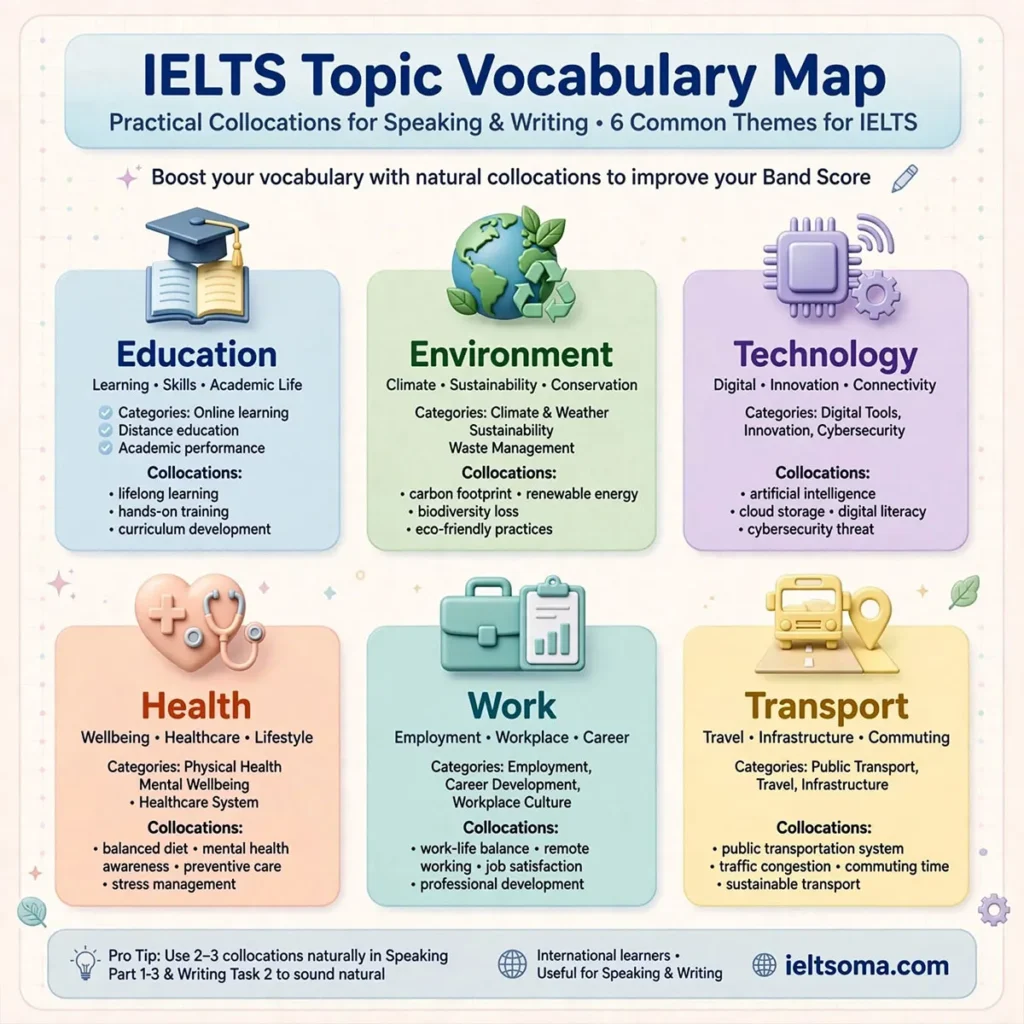
The following compact IELTS topic vocabulary list can serve as a starting point for your study.
Education
- academic performance
- higher education
- tuition fees
- educational facilities
- vocational training
- distance learning
- practical skills
- lifelong learning
Environment
- climate change
- carbon emissions
- renewable energy
- fossil fuels
- environmental protection
- natural resources
- biodiversity
- sustainable development
Technology
- artificial intelligence
- technological advancement
- digital communication
- online platforms
- technological innovation
- data privacy
- automation
- digital literacy
Health
- balanced diet
- regular exercise
- sedentary lifestyle
- public healthcare
- disease prevention
- medical treatment
- health awareness
- chronic illness
Work
- employment opportunities
- job satisfaction
- career progression
- workplace conditions
- professional development
- work-life balance
- job security
- flexible working
Transport
- public transport
- traffic congestion
- road infrastructure
- carbon emissions
- commuting time
- transport network
- pedestrian facilities
- sustainable transport
The important point is that you should expand these groups gradually rather than attempting to memorise hundreds of words in one sitting.
How to Learn Vocabulary by Topic IELTS Students Can Actually Remember
If you want to learn vocabulary by topic for IELTS, use a cycle rather than a one-time memorisation session.
Day 1: Build
Choose one topic and learn 10–15 useful words or collocations.
Day 2: Recall
Close your notes and write down as many words as you can remember.
Day 3: Use
Write five original sentences using the vocabulary.
Day 4: Speak
Talk about the topic for two minutes without reading your notes.
Day 5: Apply
Answer an IELTS-style question using the vocabulary naturally.
Day 7: Review
Test yourself again.
This process forces vocabulary through several stages:
recognition → recall → sentence formation → speaking → application
That is much more useful than repeatedly rereading the same word list.
How to Use Topic Vocabulary in IELTS Speaking
Topic vocabulary is particularly useful when you need to discuss familiar or abstract subjects.
In IELTS Speaking, Lexical Resource is one of the four assessment criteria, alongside Fluency and Coherence, Grammatical Range and Accuracy, and Pronunciation.
Suppose the topic is technology.
Instead of giving a basic answer:
I use technology every day. It is very useful because it makes life easier.
you could naturally develop the idea:
I rely heavily on digital technology, particularly online communication tools. They make it much easier to stay in touch with people and access information, although I think excessive screen time can have negative effects on our health.
Notice that the vocabulary is not complicated for the sake of sounding impressive.
The expressions are simply specific and relevant:
- digital technology
- online communication tools
- access information
- excessive screen time
- negative effects
That is the kind of vocabulary you should aim to produce naturally.
Use Topic Vocabulary to Extend Answers
Topic vocabulary can also help you develop answers.
Question:
Do you think public transport is important?
Weak:
Yes, definitely. It is important because many people use it.
Stronger:
Yes, absolutely. An efficient public transport system can reduce traffic congestion and give people a more affordable alternative to private cars. This is particularly important in large cities where road networks are already under considerable pressure.
The vocabulary gives you ideas to develop, rather than simply making the answer sound more advanced.
How to Use Topic Vocabulary in IELTS Writing
The same principle applies to Writing.
Official IELTS guidance states that Lexical Resource assesses the range of vocabulary and how accurately and appropriately it is used.
Imagine the question:
Some people believe governments should invest more money in public transport rather than building new roads. To what extent do you agree?
A basic vocabulary set might produce:
Governments should spend more money on public transport because there are too many cars on the roads.
A more developed vocabulary network allows you to write:
Greater investment in public transport could reduce traffic congestion by encouraging commuters to use buses and rail services rather than private vehicles.
Useful expressions include:
- investment in public transport
- traffic congestion
- commuters
- rail services
- private vehicles
The vocabulary supports the argument rather than replacing it.
Do Not Force Topic Vocabulary Into Every Sentence
This is critical.
Suppose the question is about whether children should spend less time using digital devices.
You do not need to include every technology-related word you have memorised.
A sentence such as:
The proliferation of cutting-edge technological innovations has revolutionised the digital landscape of contemporary society…
may sound sophisticated, but it does not necessarily answer the question.
A better sentence might be:
Excessive screen time can reduce children’s opportunities for physical activity and face-to-face interaction.
It is direct, natural and relevant.
Good IELTS vocabulary serves the idea. It should never become the idea.
Common IELTS Topic Vocabulary Mistakes
Memorising Huge Word Lists
A 500-word list is not automatically better than a 50-word list.
If you cannot recall or use the words, the list has limited value.
Focus on vocabulary you can actually activate.
Learning Words Without Collocations
Knowing emission is less useful than knowing:
carbon emissions
reduce emissions
greenhouse gas emissions
Learn words with their natural partners.
Using Unfamiliar Synonyms
Do not replace every simple word with a complicated alternative.
If you are not sure how a word behaves grammatically or which contexts it fits, choose a word you can use accurately.
Repeating Memorised Sentences
Memorised phrases can become awkward when the question changes.
Build flexible vocabulary instead.
For example, learn:
play a significant role in
Then practise using it in different contexts:
Education plays a significant role in economic development.
Parents play a significant role in children’s development.
Public transport plays a significant role in reducing urban congestion.
You are learning a reusable structure rather than a single memorised answer.
Ignoring Word Forms
Learn related forms where useful:
educate → education → educational → educator
employ → employment → employer → employee → unemployed
develop → development → developmental
This gives you greater flexibility when speaking and writing.
A Simple IELTS Topic Vocabulary Notebook System
Create one page for each major IELTS topic.
Use these six sections:
1. Core words
10–15 essential words.
2. Collocations
5–10 natural word combinations.
3. Word families
Useful noun, verb and adjective forms.
4. Synonyms
Only reliable alternatives that you understand.
5. Example sentences
Your own sentences, not copied definitions.
6. IELTS questions
Two or three questions where you can apply the vocabulary.
For example:
Topic: Environment
Core words
- pollution
- conservation
- emissions
- biodiversity
Collocations
- reduce carbon emissions
- protect biodiversity
- environmental damage
- renewable energy
Word family
- pollute → pollution → polluted
- conserve → conservation → conservationist
Example
Governments need to reduce carbon emissions to limit long-term environmental damage.
Practice question
What can governments do to protect the environment?
This creates a practical revision resource rather than a dictionary.
A 15-Minute Daily Vocabulary Routine
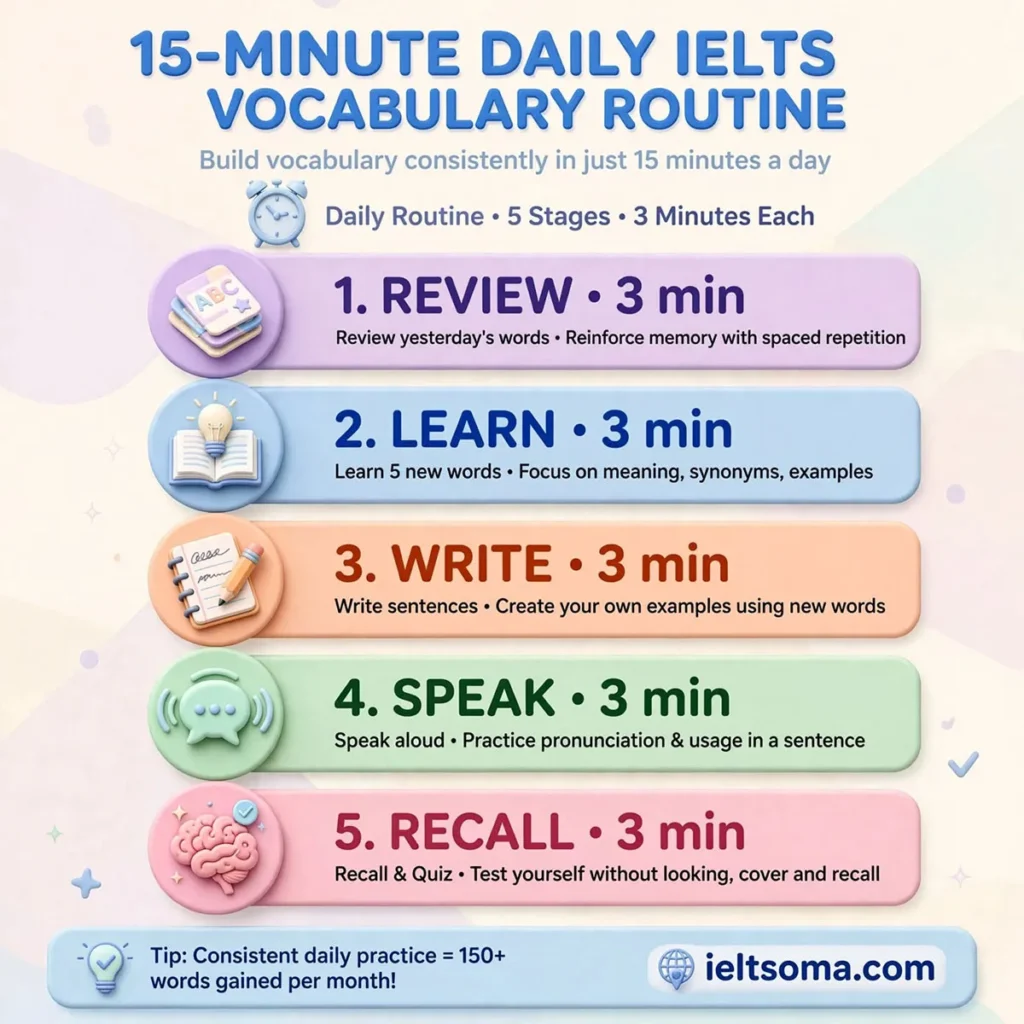
You do not need to spend an hour every day memorising words.
Try this routine:
Minutes 1–3: Review yesterday’s vocabulary.
Minutes 4–7: Learn five new topic-related words or collocations.
Minutes 8–10: Write three sentences.
Minutes 11–13: Speak about the topic using the new vocabulary.
Minutes 14–15: Recall the words without looking at your notes.
Repeat this consistently.
After several weeks, you will have a much more useful vocabulary bank.
Final Checklist: Is Your IELTS Topic Vocabulary Useful?
Before adding a word to your vocabulary list, ask:
- Do I understand its exact meaning?
- Can I pronounce it correctly?
- Do I know its common collocations?
- Do I know its grammatical form?
- Can I use it in my own sentence?
- Is it appropriate for IELTS Speaking, Writing, or both?
- Do I know when not to use it?
- Can I use it without sounding memorised?
If the answer to most of these questions is yes, the word is worth keeping.
Frequently Asked Questions About IELTS Topic Vocabulary
What is the best way to learn IELTS topic vocabulary?
Organize vocabulary around common IELTS topics and learn words together with collocations, word forms, example sentences and questions. Then practice recalling and using the vocabulary in speaking and writing rather than simply rereading a list.
How many IELTS topic vocabulary words should I learn each day?
There is no fixed number that guarantees improvement. A manageable target such as five to fifteen useful words or collocations can work well if you actively recall and use them. Quality and usable knowledge are more important than the size of your vocabulary list.
Should I memorize an IELTS topic vocabulary list?
Use an IELTS topic vocabulary list as a starting point, not as something to memorize mechanically. Choose useful vocabulary, learn how each expression works, and practice using it in different contexts.
Can topic vocabulary improve IELTS Speaking?
Yes, topic vocabulary can help you express ideas more precisely and discuss a wider range of subjects. However, IELTS Speaking also assesses fluency and coherence, grammatical range and accuracy, and pronunciation, so vocabulary alone does not determine the Speaking score.
Should I use difficult words to get a higher IELTS score?
No. Difficult vocabulary is not automatically better vocabulary. IELTS assesses the range, accuracy and appropriacy of vocabulary. A precise, natural word is usually more useful than an unfamiliar word used incorrectly.
Should I learn separate vocabulary for IELTS Academic and General Training?
There is substantial overlap, particularly for Speaking and Writing Task 2. However, some vocabulary needs depend on the task. Academic Writing Task 1 involves describing visual information, whereas General Training Writing Task 1 involves responding to a situation, such as writing a letter.
How can I remember IELTS vocabulary for a long time?
Use spaced review and active recall. Learn a word, test yourself later without looking at your notes, use it in an original sentence, and then apply it in an IELTS-style speaking or writing task.
Is learning vocabulary by topic better than learning random words?
For IELTS preparation, topic-based learning can make vocabulary easier to organize and apply because related words and collocations reinforce one another. It should still be combined with reading, listening and practice using vocabulary in realistic contexts.
How can I avoid sounding like I memorized vocabulary?
Learn flexible expressions rather than complete model answers. Practice using the same vocabulary in several different sentences and adapt your language to the exact question you are answering.
Final Takeaway
Building IELTS topic vocabulary is not about collecting the longest possible list of advanced words.
It is about creating a vocabulary system you can actually use.
Start with common IELTS topics. Divide them into subtopics. Learn nouns, verbs, adjectives and collocations together. Add useful word families. Write your own examples. Then practise using the vocabulary in Speaking and Writing.
Most importantly, learn vocabulary for communication, not decoration.
When you can understand a topic, retrieve relevant words quickly, combine them naturally and use them accurately, your vocabulary becomes a genuine IELTS skill rather than a memorisation exercise.
For official guidance on how vocabulary is assessed, IELTS provides its assessment criteria and preparation resources on its website.
Useful Links: