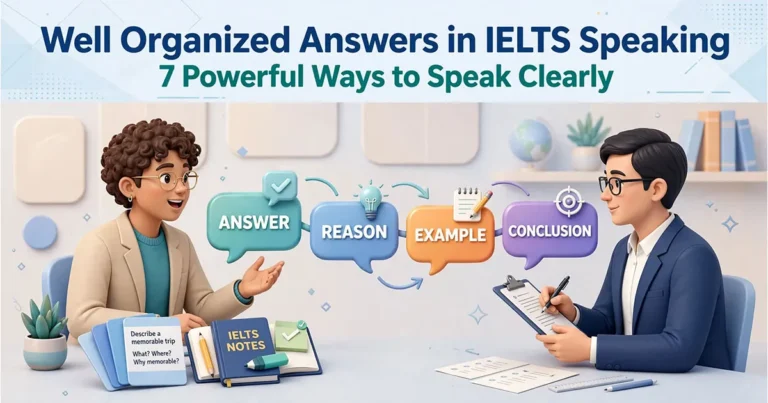
Hesitating in the IELTS Speaking test can be frustrating. You understand the question, know what you want to say, and yet the words do not come out smoothly. You pause, repeat yourself, say “um” several times, or abandon a sentence halfway through.
The good news is that you do not need to speak like a native English speaker to achieve a strong IELTS Speaking score. You need to communicate your ideas clearly, maintain a natural flow, and avoid unnecessary interruptions that make your answers difficult to follow.
IELTS Speaking hesitation becomes a problem when you frequently stop to search for vocabulary, construct basic sentences, or correct mistakes. Occasional pauses are normal, and a short pause to organise your thoughts can actually help you give a better answer.
In this guide, you will learn how to stop hesitating in IELTS Speaking, reduce unnecessary fillers, develop answers more naturally, and practise specific techniques for all three parts of the test.
Table of Contents
Why Does Hesitation Matter in IELTS Speaking?
IELTS Speaking is assessed using four criteria:
- Fluency and Coherence: How smoothly you speak, organise your ideas, and connect information.
- Lexical Resource: How effectively you use vocabulary to express your meaning.
- Grammatical Range and Accuracy: How accurately and flexibly you construct sentences.
- Pronunciation: How clearly you communicate through sounds, stress, rhythm, and intonation.
These four criteria contribute equally to your Speaking score. However, hesitation is particularly relevant to Fluency and Coherence.
According to the official IELTS Speaking Band Descriptors, candidates at higher bands can sustain longer turns without losing coherence. Some hesitation, repetition, and self-correction can still occur, but these should not regularly interrupt the development of ideas.
This means that speaking quickly is not the goal. Speaking at a natural pace while keeping your message clear is much more important.
For example:
Hesitant response:
“I think… um… public transport is… is good because… because, you know, it is… it can be… cheaper than cars.”
More fluent response:
“I think public transport is a good option because it is usually cheaper than driving. It can also reduce traffic congestion, especially in busy cities.”
The second response is not impressive because it uses complicated vocabulary. It is stronger because the ideas are expressed directly and logically.
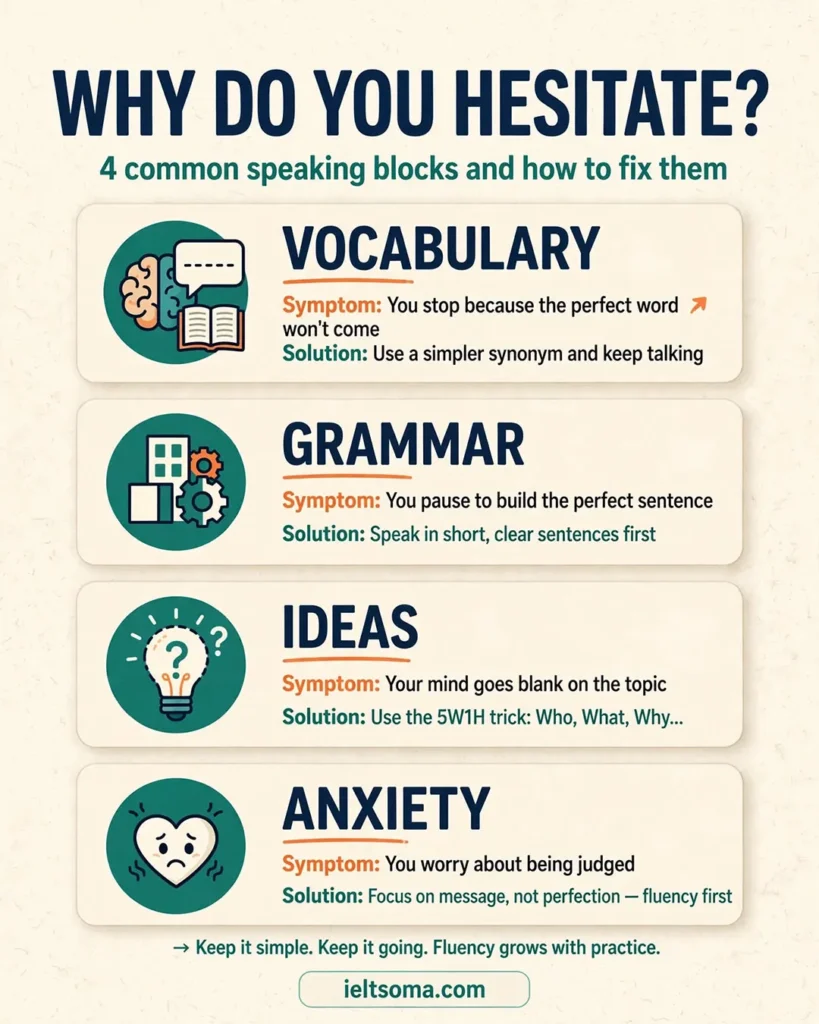
1. Identify the Real Cause of Your IELTS Speaking Hesitation
Before trying to eliminate pauses, identify why they happen. Different causes require different solutions.
Vocabulary hesitation
You know what you want to communicate but cannot remember the exact English word.
Example: You want to describe a place where people borrow books but cannot remember the word “library”.
Solution: Practise paraphrasing. Instead of stopping, say, “the place where people can borrow books and study quietly.”
You do not need to remember every word to communicate successfully.
Grammar hesitation
You spend too much time deciding whether to use a particular tense, article, or sentence structure.
Example: “My family… um… we… I mean, my family has… have lived there…”
Solution: Use sentence patterns that you can produce confidently. Simple, accurate sentences are better than complicated sentences that you repeatedly abandon.
Idea hesitation
You understand the question but cannot think of a relevant answer or supporting example.
Example: The examiner asks whether technology has improved education, and you cannot think of a reason.
Solution: Practise generating ideas using familiar categories such as convenience, cost, time, accessibility, health, education, and the environment.
Anxiety-related hesitation
You know enough English but become nervous when someone evaluates your performance.
Solution: Gradually practise under realistic conditions. Start by recording yourself, then practise with a partner, and finally complete timed mock tests.
Expert tip: Record a two-minute answer and identify which type of hesitation occurs most often. Focus your practice on that specific problem instead of trying to improve everything simultaneously.
2. Replace Unnecessary Fillers with Natural Thinking Pauses
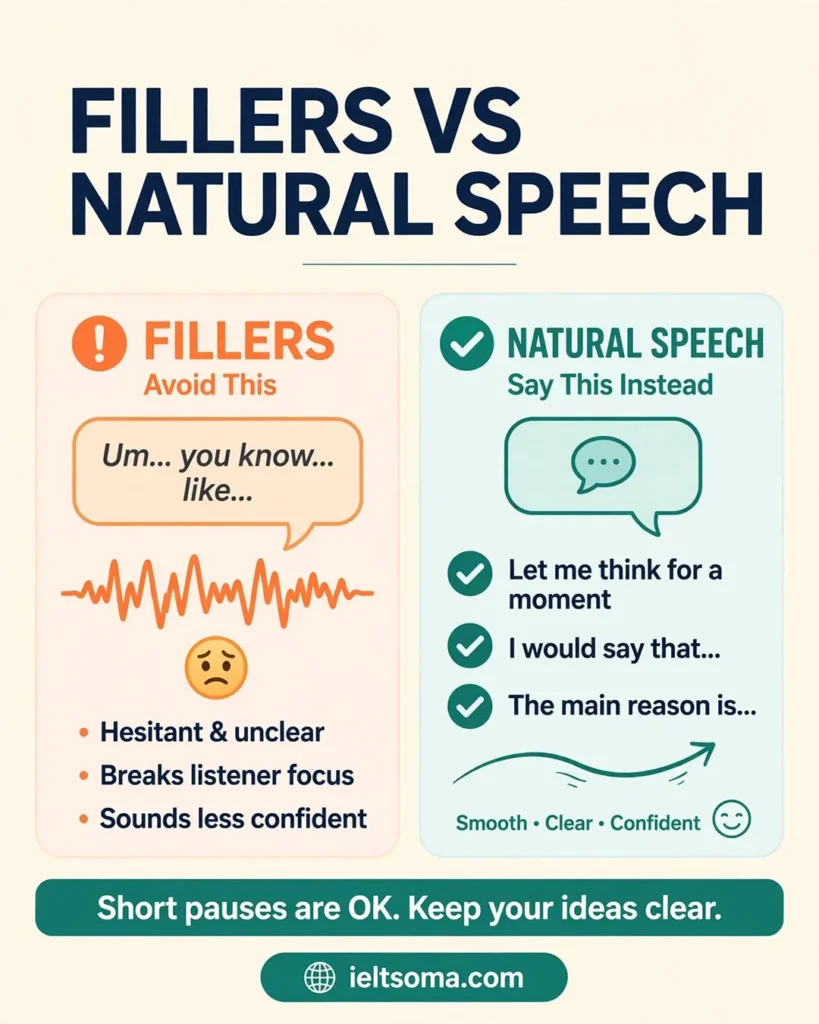
IELTS Speaking fillers are words and expressions that speakers use while thinking or maintaining their turn. Common examples include:
- Um
- Uh
- Er
- You know
- Like
- Well
- Actually
These expressions are not automatically wrong. Fluent speakers also use fillers in everyday conversation. The problem arises when you depend on them so frequently that they distract from your message.
Compare these responses.
Overuse of fillers:
“Um, I think, you know, reading is, like, very useful because, um, it helps people, you know, learn things.”
More natural response:
“I think reading is very useful because it helps people gain knowledge and understand different perspectives.”
The second answer is direct and easier to follow.
Useful phrases for buying thinking time
You can occasionally use a short, natural expression when you need to organise your thoughts.
| Situation | Natural expression |
|---|---|
| You need a moment to think | “Let me think about that for a moment.” |
| You have not considered the question before | “I’ve never really thought about that before, but…” |
| You want to give an opinion | “I would say that…” |
| You want to introduce a reason | “I think the main reason is that…” |
| You want to make a comparison | “It depends on the situation, but…” |
Use these expressions when they genuinely fit the question. Do not begin every answer with the same phrase, and do not memorise long introductory sentences.
A brief silent pause is also perfectly acceptable. You do not need to fill every second with speech.
3. Use the Direct-Answer Technique
One common reason candidates hesitate is that they try to plan an entire answer before saying anything.
Instead, begin with a direct response and develop it one step at a time.
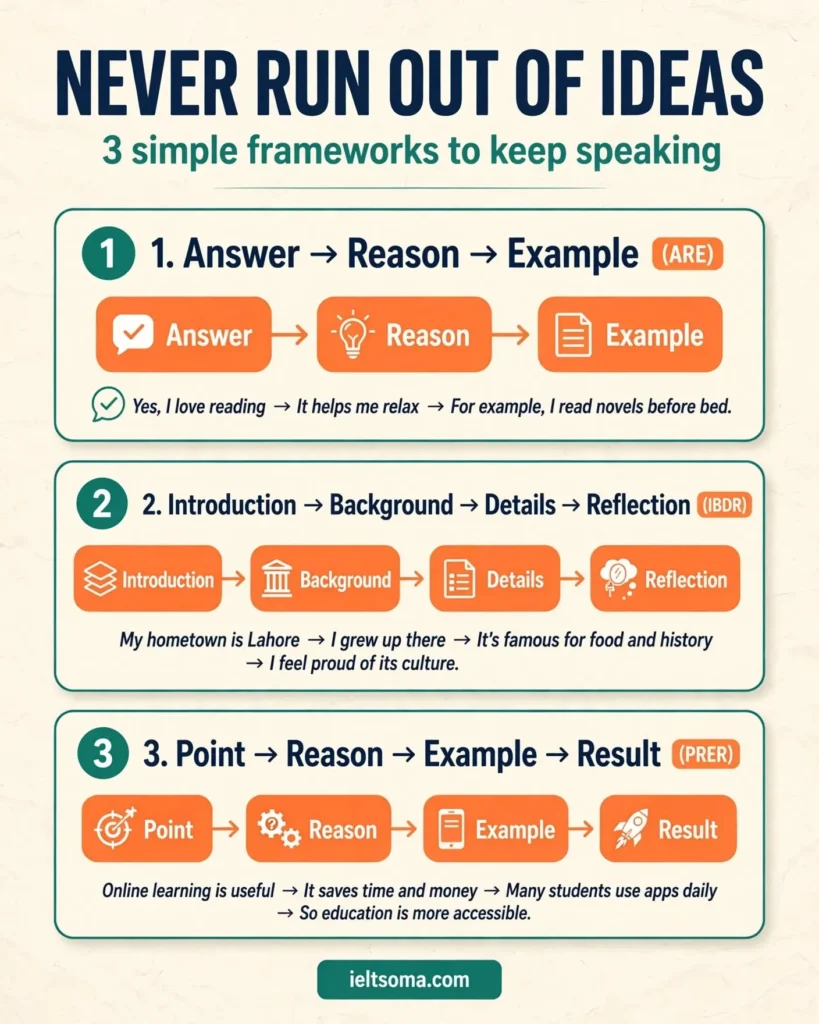
A useful structure is:
Answer → Reason → Example or Detail
Consider this IELTS Speaking Part 1 question:
Do you enjoy cooking?
Hesitant approach:
“Um… cooking… yes, I think… because… there are many reasons, actually…”
Improved approach:
“Yes, I enjoy cooking because it allows me to experiment with different flavours. For example, I often try new recipes at the weekend when I have more free time.”
Notice that the answer starts immediately. Once you have given your opinion, the reason and example are easier to develop.
Try this technique with familiar Part 1 topics:
- Work or studies
- Hometown
- Hobbies
- Food
- Music
- Travel
- Daily routines
You do not need to prepare complete scripts. Practise generating a direct answer and adding one or two relevant details.
4. Practise Paraphrasing Instead of Searching for the Perfect Word
Searching for one exact word can interrupt your fluency. Effective speakers can explain an idea in different ways when the ideal word is unavailable.
This skill is called paraphrasing, and it is useful for both Fluency and Coherence and Lexical Resource.
| Word you cannot remember | Alternative explanation |
|---|---|
| Thermometer | A device used to measure temperature |
| Architect | A person who designs buildings |
| Exhausted | Extremely tired |
| Generous | Willing to give or share with others |
| Pedestrian | A person who is walking rather than travelling in a vehicle |
For example, suppose you are describing a person who repairs electrical systems but cannot remember “electrician”.
Instead of stopping, say:
“He is a professional who installs and repairs electrical equipment in houses and offices.”
The explanation communicates your meaning without requiring the exact word.
The 10-second paraphrasing drill
- Choose five everyday objects, occupations, or activities.
- Describe each one without saying its name.
- Speak for at least 10 seconds about each item.
- Repeat the exercise with a different set of words.
This trains you to keep speaking when your vocabulary fails you temporarily.
Avoid spending several seconds silently searching for an advanced word when a familiar expression would communicate the idea clearly.
5. Use a Simple Structure for IELTS Speaking Part 2
Part 2 can create considerable hesitation because you must speak for one to two minutes about a topic. Candidates sometimes begin confidently but run out of ideas after 20 or 30 seconds.
The solution is to organise your response during the one-minute preparation period.
Use this four-part structure:
- Introduction: Identify the person, place, event, or object.
- Background: Explain when, where, or how it became relevant.
- Main details: Describe two or three specific features or experiences.
- Reflection: Explain why it was memorable or how you felt about it.
Suppose your cue card asks you to describe a memorable journey.
Your notes might contain:
- Journey: trip to northern Pakistan
- When: last summer
- With whom: family
- Details: mountains, long drive, local food
- Why memorable: scenery and time together
These short notes provide a route through the answer without forcing you to memorise complete sentences.
Example opening
“One journey I remember particularly well was a family trip to northern Pakistan last summer. We travelled by road, which took longer than expected, but the scenery made the journey worthwhile.”
From there, explain the journey, describe an interesting experience, and finish by discussing why you remember it.
If you forget a detail, move to the next point on your notes. You do not need to remember every sentence you intended to say.
Practice tip: Complete one cue card each day. Use exactly one minute for planning, then speak for up to two minutes. Record yourself and identify where your answer loses momentum.
6. Develop Ideas Quickly in IELTS Speaking Part 3
Part 3 questions often require you to discuss abstract issues, explain causes, compare situations, or predict future developments. This can make candidates hesitate because they try to find the perfect opinion.
You do not need a perfect opinion. You need a relevant answer that you can explain.
Use the Point–Reason–Example–Result structure:
- Point: State your main view.
- Reason: Explain why you think this.
- Example: Give a relevant illustration.
- Result: Explain the consequence, if useful.
Consider this question:
Why do some people prefer living in large cities?
Model answer:
“I think many people prefer large cities because they offer better employment opportunities. For example, major cities often have a wider range of companies, universities, and professional services. As a result, people may find it easier to develop their careers or change jobs without relocating to another region.”
This answer develops one idea logically rather than introducing several unrelated points.
If the question is difficult, use a simple thinking framework:
- Causes: Why does something happen?
- Benefits and drawbacks: What are its advantages and disadvantages?
- Past and present: How has it changed?
- Individuals and society: Who is affected?
- Future: What might happen next?
For example, if asked whether technology will change education in the future, consider accessibility, cost, teacher support, and student engagement.
These categories help you generate ideas without memorizing model answers.
7. Stop Translating Every Sentence from Your First Language
Many IELTS candidates first construct a complete sentence in their native language and then translate it into English. This process can create long pauses, especially when the grammar differs between the two languages.
You can gradually reduce this habit by practising with short English thought groups.
Instead of planning a long sentence such as:
“Although many people believe that online education is convenient because students do not have to travel, I think it also requires considerable self-discipline…”
Build the answer in manageable units:
“Online education is convenient because students do not have to travel. However, it also requires considerable self-discipline.”
Both versions express a similar idea. The second may be easier to produce spontaneously.
How to practise thinking in English
- Narrate simple activities in English: “I’m preparing breakfast,” or “I need to leave in ten minutes.”
- Describe what you see around you without translating a prepared sentence.
- Answer everyday questions aloud in English.
- Learn common word combinations, such as “make a decision”, “take responsibility”, and “gain experience”.
- Practise speaking in meaningful phrases rather than selecting every word individually.
The goal is not to stop thinking in your first language instantly. It is to make frequently used English expressions more automatic through repeated use.
8. Reduce Self-Correction and Build Confidence
Some candidates interrupt themselves because they are constantly checking their grammar while speaking.
For example:
“I went to… I mean, I have gone to… no, I went to the museum last week.”
Repeated corrections can break the flow of an otherwise understandable answer.
A better approach is to correct only when an error significantly changes your meaning or causes genuine confusion. If you make a minor mistake and the message remains clear, continue speaking.
Use these principles:
- Prioritise communicating your idea over monitoring every word.
- Choose sentence structures you can use accurately.
- Avoid restarting an entire answer because of one small error.
- Practise common tenses through spoken examples.
- Review recordings after you finish speaking, rather than analysing every sentence during the answer.
This does not mean grammar is unimportant. Grammatical Range and Accuracy remains one of the four assessment criteria. The aim is to improve accuracy without allowing constant self-monitoring to disrupt communication.
Confidence also improves when you become familiar with the test format. Practise with realistic questions, a timer, and occasional mock interviews so that speaking under pressure becomes less unfamiliar.
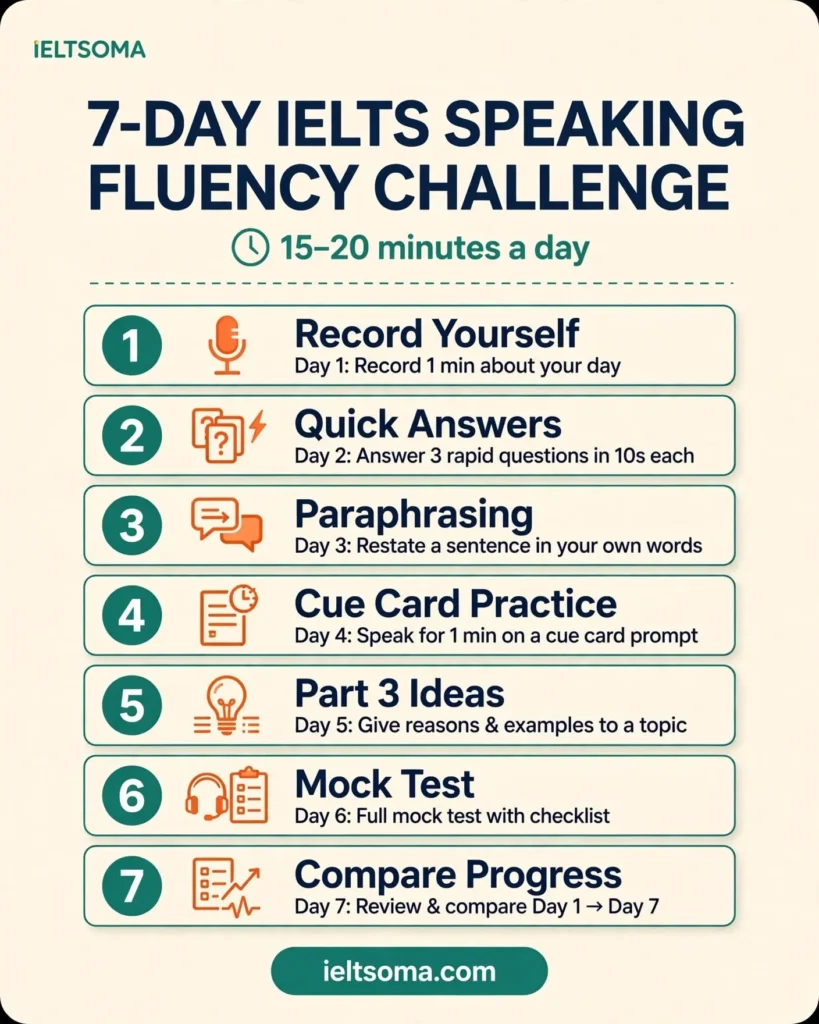
9. Follow a 7-Day Plan to Reduce Pauses in IELTS Speaking
Use this short practice plan to build more fluent speaking habits. Spend approximately 15–20 minutes each day.
| Day | Main activity | What to measure |
|---|---|---|
| 1 | Record a two-minute answer on a familiar topic | Count fillers and long pauses |
| 2 | Practise direct answers to 10 Part 1 questions | Notice how quickly you begin |
| 3 | Complete five paraphrasing exercises | Count how often you keep speaking without the exact word |
| 4 | Prepare and deliver one Part 2 cue card | Identify where your answer stops developing |
| 5 | Answer five Part 3 questions using Point–Reason–Example–Result | Check whether each answer has a clear explanation |
| 6 | Complete a mock Speaking test | Review fluency, coherence, and repeated corrections |
| 7 | Record a new two-minute answer and compare it with Day 1 | Look for measurable improvement |
When reviewing a recording, listen for:
- Repeated “um”, “uh”, “like”, and “you know”.
- Pauses caused by missing vocabulary.
- Sentences abandoned halfway through.
- Repeated attempts to correct minor grammar mistakes.
- Ideas that are introduced but never explained.
You can track progress using a simple table:
| Practice measure | Day 1 | Day 7 |
|---|---|---|
| Fillers per minute | Record your result | Record your result |
| Pauses longer than two seconds | Record your result | Record your result |
| Abandoned sentences | Record your result | Record your result |
| Answer development | Note your observations | Note your observations |
Do not treat these figures as official IELTS scoring measures. They are personal practice indicators that help you identify patterns and monitor improvement.
A seven-day plan can help you notice unhelpful habits, but lasting fluency usually requires continued practice.
Common Mistakes That Make IELTS Speaking Hesitation Worse
Avoid these habits when preparing for the test.
1. Speaking faster to appear fluent
Rushing often creates unclear pronunciation, grammatical errors, and more restarts. Aim for a comfortable, steady pace.
2. Memorising complete answers
Prepared scripts may not fit the examiner’s actual questions. Learn ideas, vocabulary, and flexible structures instead of memorising paragraphs.
3. Using too many linking expressions
Words such as “moreover”, “furthermore”, and “in addition” can be useful, but forcing them into every answer makes speech sound unnatural. Simple spoken connections are often better.
4. Trying to eliminate every pause
Natural pauses give you time to think and help listeners process your ideas. Focus on unnecessary pauses, not every silence.
5. Learning advanced vocabulary without practising it aloud
Recognising a word does not mean you can use it spontaneously. Practise new vocabulary in complete spoken sentences and familiar contexts.
6. Practising only by reading model answers
Reading develops recognition, but spontaneous speaking requires active retrieval. Answer questions without looking at a prepared response, then review your performance.
Frequently Asked Questions
1. How can I stop hesitating in IELTS Speaking?
Identify whether your hesitation comes from vocabulary, grammar, idea generation, or anxiety. Practice direct answers, paraphrasing, timed speaking, and recording yourself. Focus on maintaining a clear train of thought rather than speaking as quickly as possible.
2. Do fillers lower your IELTS Speaking score?
Fillers are not automatically penalized as individual words. However, excessive and repetitive fillers can disrupt fluency and coherence. Occasional natural expressions are acceptable when they help you organize your thoughts.
3. Is it bad to pause while answering an IELTS Speaking question?
No. Brief pauses are normal, particularly when considering an unfamiliar question. The concern is frequent or prolonged hesitation that makes it difficult to develop ideas or maintain a coherent answer.
4. What should I say when I need time to think?
You can briefly say, “Let me think about that for a moment,” or “I’ve never really considered that before, but I would say…” You can also pause silently for a moment. Avoid repeating the same expression before every answer.
5. How can I reduce pauses caused by a lack of vocabulary?
Practice paraphrasing and explaining words in simpler English. Build vocabulary around common IELTS topics, learn useful collocations, and use new words in spoken sentences. The ability to explain an idea without its exact name is particularly valuable.
6. How can I speak for two minutes in IELTS Speaking Part 2 without hesitation?
Use your preparation minute to note keywords for the background, main details, an example, and your feelings or reflections. Follow these notes in order and move to the next point if you forget a detail.
7. Can I achieve Band 7 if I sometimes hesitate?
Yes, occasional hesitation is compatible with Band 7 performance. The official descriptors emphasize the ability to speak at length without noticeable effort or loss of coherence. Your overall score also depends on vocabulary, grammar, and pronunciation.
8. How long does it take to improve speaking fluency?
There is no fixed timetable. Your progress depends on your current English level, the cause of your hesitation, and the consistency of your practice. Regular speaking exercises and recordings can help you identify improvement over time.
Final Advice: Aim for Clear, Natural Speech
Reducing IELTS Speaking hesitation is not about eliminating every pause or filling every second with words. It is about expressing your ideas without repeatedly getting stuck while searching for language.
Start by identifying your most common hesitation pattern. Practise answering directly, paraphrasing unfamiliar words, organising longer answers, and reducing unnecessary self-correction. Record your responses regularly and compare your progress.
Remember that fluency is the ability to communicate smoothly and coherently, not simply to speak quickly. With focused practice, you can develop more natural answers and approach the IELTS Speaking test with greater confidence.
Further Reading: