
An IELTS result can do more than help you enter a university or apply for a visa. For many professionals, it can also become part of the journey towards international employment, career progression or professional registration.
But there is a common mistake: assuming that there is one IELTS score that is accepted for every job.
There isn’t.
The IELTS score for jobs depends on the employer, profession, country and purpose for which you need to demonstrate English. A multinational company may have its own language requirement, while a professional regulator may specify minimum scores in individual skills such as Speaking or Writing.
That is why understanding IELTS for work and employment means looking beyond the overall band score.
You need to know which IELTS test you need, what score is required, whether each individual skill has a minimum requirement, and whether the organisation accepts your particular test result.
This guide explains how IELTS can be used for employment and professional registration and how to prepare strategically when your career depends on your English test result.
Table of Contents
What Is IELTS for Work and Employment?
IELTS for Work and Employment refers to using an IELTS result to demonstrate English-language ability for employment, workplace purposes or professional opportunities.
IELTS is accepted by thousands of organisations worldwide, including employers and professional associations. Official IELTS information states that employers can use IELTS to assess whether candidates have the English-language skills needed for their organisation.
This can matter particularly when:
- You are applying for a job in an English-speaking country.
- An international employer asks for evidence of English proficiency.
- You are applying for a profession regulated by a professional body.
- You need English-language evidence before receiving professional registration.
- You are moving into a role where communication in English is essential.
- You are applying for employment overseas and English ability forms part of the eligibility process.
However, IELTS is not a universal employment certificate.
An employer decides whether it accepts IELTS and, if so, what score it requires. Professional regulators similarly establish their own requirements.
The official IELTS organisation database allows candidates to check organisations that accept IELTS and investigate their requirements.
Is IELTS Required for Jobs?
Not necessarily.
Many jobs do not require an IELTS test at all. An employer might assess your English through an interview, application process, previous education or professional experience.
Other employers may specifically request an IELTS result.
This is particularly relevant for international recruitment, organisations operating in English, and positions where effective communication is an important part of the job.
For example, imagine two candidates applying for an international customer-support position.
Candidate A has five years of relevant experience but cannot provide evidence of English proficiency.
Candidate B has similar professional experience and has an IELTS result demonstrating their English ability.
If the employer has requested IELTS, Candidate B has provided the specific evidence requested by that employer.
However, an IELTS certificate does not automatically guarantee employment.
Your:
- qualifications,
- professional experience,
- technical skills,
- interview performance,
- references,
- communication ability,
- work authorisation,
and other requirements may also be considered.
IELTS is evidence of English proficiency—not a replacement for professional qualifications.
Does IELTS improve your chances of getting a job?
It can help when an employer specifically values or requires documented English proficiency.
Official IELTS information says employers around the world use IELTS to help assess English-language ability.
The practical question is therefore not:
“Will IELTS get me a job?”
A better question is:
“Does my target employer or profession require or recognise IELTS, and what score does it require?”
That distinction can save you considerable time and money.
What IELTS Score Is Needed for Jobs?
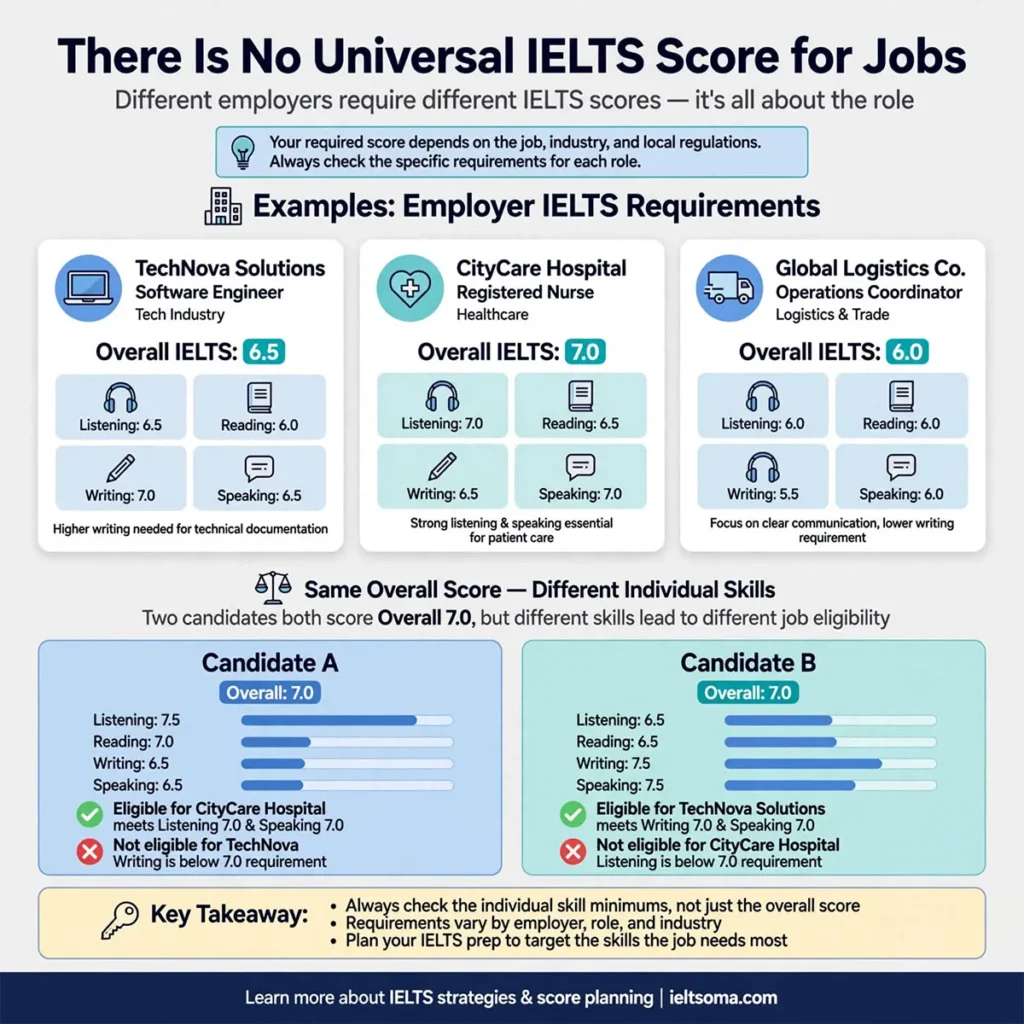
There is no single IELTS score for jobs worldwide.
This is one of the most important facts to understand before booking your test.
Employers can establish their own entry requirements. Official IELTS guidance specifically states that organisations can set their own IELTS score requirements according to their needs.
For example, one employer might accept an overall Band 6.0, while another might require Band 7.0. A different organisation might specify minimum scores for individual skills as well.
Consider this example:
| Requirement | Candidate A | Candidate B |
|---|---|---|
| Overall IELTS | 7.0 | 7.0 |
| Listening | 7.5 | 6.5 |
| Reading | 7.0 | 7.0 |
| Writing | 6.5 | 7.0 |
| Speaking | 7.0 | 6.0 |
Both candidates have the same overall band score.
But if an organisation requires at least 6.5 in every skill, Candidate B would not meet that particular requirement.
This is why you should never look only at the overall IELTS band.
Overall band score vs individual skill scores
IELTS provides scores for:
- Listening
- Reading
- Writing
- Speaking
as well as an overall band score.
An employer or professional organisation may focus on the overall result, individual skills, or both.
Before preparing for IELTS for work and employment, write down the exact requirement of your target organisation.
For example:
Required: Overall 7.0
Minimum in each skill: 6.5
That is very different from:
Required: Overall 7.0
No individual minimum specified
Your preparation strategy should reflect the actual requirement.
IELTS for Professional Registration
For some careers, getting a job is not the first step.
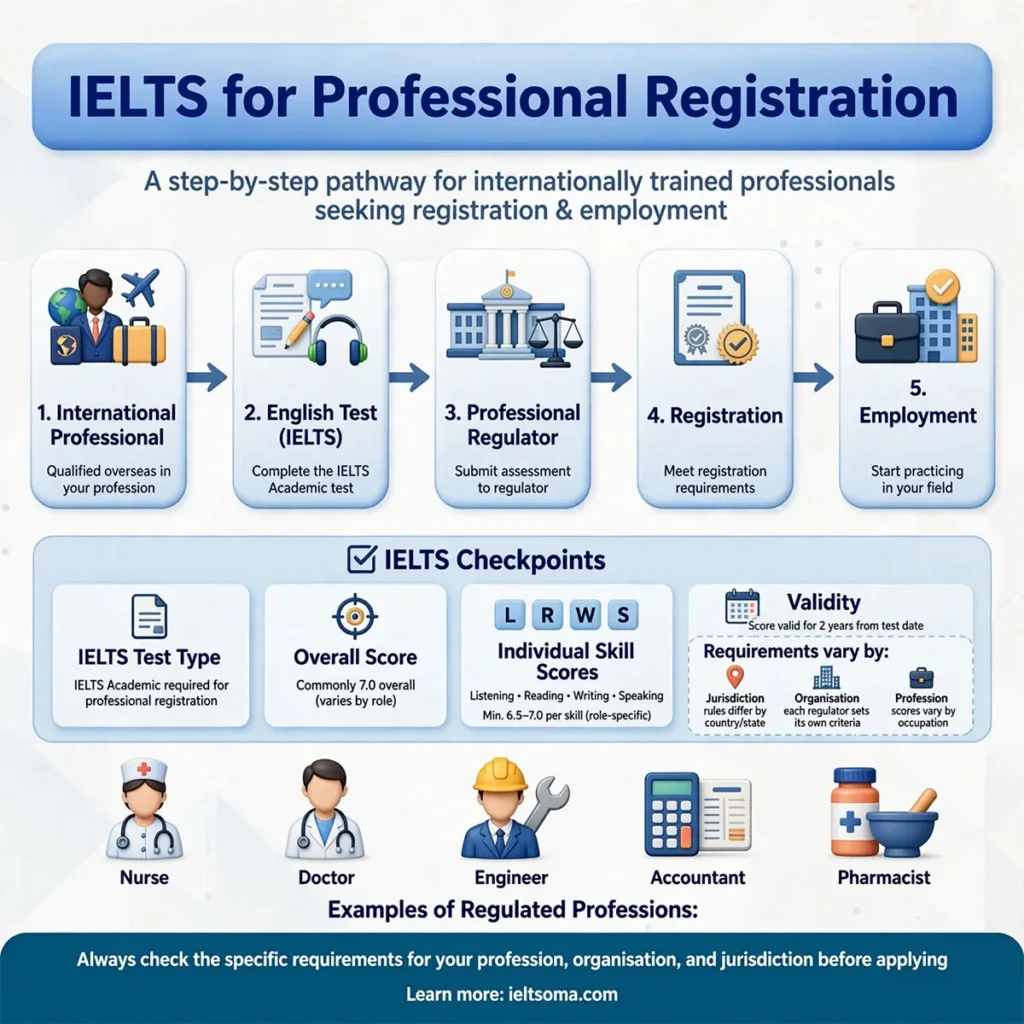
You may first need to demonstrate English proficiency to a professional registration body or regulator.
This is particularly relevant to internationally trained professionals.
Official IELTS information identifies areas such as healthcare, accounting, engineering, law and veterinary practice among professions where professional bodies may require IELTS results. Requirements vary by profession, organisation and jurisdiction.
Healthcare is a particularly important example.
A nurse, doctor or pharmacist moving to another country may need to satisfy the English-language requirements of the relevant professional organisation before being permitted to practise.
This is where IELTS for professional registration becomes different from simply having an IELTS score for a job application.
Professional registration is not the same as employment
Suppose you are a qualified nurse applying to work overseas.
You might need to complete several stages:
- Meet the immigration or visa requirements.
- Meet the professional regulator’s English-language requirements.
- Complete the registration process.
- Meet the employer’s recruitment requirements.
- Receive an employment offer.
These requirements may overlap, but they are not necessarily identical.
A score sufficient for one purpose may not automatically satisfy another.
That is why candidates should check the professional regulator, rather than relying on information from a general IELTS preparation website, recruitment advertisement or social-media post.
Which IELTS Test Should You Take for Work?
This is another area where candidates can make an expensive mistake.
IELTS currently offers different test options for different purposes. Official IELTS information describes IELTS Academic as particularly relevant to higher education and professional bodies, while IELTS General Training is designed around everyday English and is used by employers, professional associations and immigration bodies.
However, the correct choice depends on the organisation you are applying to.
Do not assume:
“I’m applying for a job, so I must take General Training.”
That may be wrong for your particular profession.
Likewise, do not assume:
“I’m a professional, so I must take Academic.”
The organisation’s published requirement should determine your choice.
A simple decision process
Before booking IELTS, check these four things:
1. Who needs your result?
Is it:
- an employer?
- a professional regulator?
- an immigration authority?
- a university?
- several organisations?
2. Which IELTS test do they accept?
Check whether they specify:
- IELTS Academic
- IELTS General Training
- IELTS for UKVI
- another approved English-language test
3. What score do they require?
Check:
- overall band
- minimum Listening
- minimum Reading
- minimum Writing
- minimum Speaking
4. Are there additional conditions?
For example, the organisation may have rules concerning test validity, test delivery method or how results must be submitted.
This four-step check should happen before you book your test.
IELTS for Work and Employment: A Practical Example
Imagine that Maria is an engineer who wants to work overseas.
She finds a job advertisement that says English proficiency is required.
Maria immediately searches for:
“IELTS score for jobs”
She finds websites suggesting that Band 6.5 is a common requirement.
She books IELTS, obtains an overall 6.5 and assumes she is ready.
But then she discovers that her professional registration body requires a different IELTS test and specific minimum scores in each component.
Her overall score alone is not enough.
Maria’s mistake was not necessarily poor IELTS preparation.
Her mistake happened before preparation began.
She prepared for a score without first identifying the exact requirement.
A better approach would have been:
Target profession → regulator → employer → exact English requirement → correct IELTS test → preparation plan → test
This sequence is much safer.
How to Prepare for IELTS for Professional Purposes
Once you know your exact requirement, your preparation becomes much more focused.
1. Set a target for every skill
Don’t prepare only for the overall band.
If your target is:
- Listening 7.0
- Reading 7.0
- Writing 7.0
- Speaking 7.0
then your preparation should address all four areas.
If one skill is significantly weaker, identify it early.
2. Practise workplace-related English
IELTS itself is not simply a test of professional jargon.
You do not need to memorise hundreds of technical words just because you are an engineer, nurse, accountant or lawyer.
Instead, develop transferable English skills:
- explaining ideas clearly,
- describing problems,
- comparing information,
- giving reasons,
- expressing opinions,
- understanding detailed information,
- following discussions,
- writing logically organised responses.
These abilities can help both inside the IELTS test and in professional communication.
3. Build accuracy before chasing difficult vocabulary
Many candidates preparing for employment-related IELTS requirements focus heavily on advanced vocabulary.
That can be counterproductive.
A clear sentence with accurate grammar is often more useful than an unnecessarily complicated sentence containing mistakes.
For example:
Unclear:
“The implementation of multifaceted methodologies facilitates the optimisation of occupational communicational procedures.”
Clearer:
“Better communication procedures can improve workplace efficiency.”
For IELTS Writing and Speaking, clarity, organisation, vocabulary, grammar and task fulfilment all matter.
4. Practise under realistic time limits
If you need IELTS for a professional registration deadline, you cannot afford to discover your time-management problems on test day.
Practise complete sections under realistic conditions.
Then analyse your errors.
Don’t simply count your correct answers.
Ask:
- Why did I choose the wrong answer?
- Did I misunderstand the question?
- Did I miss a keyword?
- Did I lose concentration?
- Did I make a spelling mistake?
- Did I run out of time?
Error analysis is often more valuable than simply completing another practice test.
Common Mistakes When Taking IELTS for Work
Mistake 1: Assuming every job requires the same score
There is no universal IELTS score for jobs.
Always check the organisation’s own requirement.
Mistake 2: Choosing Academic or General Training based on a friend’s advice
Your friend’s requirement may be completely different from yours.
Check the organisation or regulator directly.
Mistake 3: Looking only at the overall band
A 7.0 overall does not necessarily satisfy a requirement for 7.0 in every skill.
Check the complete requirement.
Mistake 4: Preparing before checking the deadline
If professional registration is your goal, find out when your result must be available.
Give yourself enough time for:
- preparation,
- the test,
- results,
- possible retesting,
- document submission.
Mistake 5: Assuming an old result will always be accepted
IELTS partners recommend that an IELTS result demonstrates English ability for a maximum period of two years, although the final acceptance policy belongs to the relevant organisation.
Always check the current policy of the organisation receiving your result.
Mistake 6: Assuming IELTS Online is accepted everywhere
IELTS states that IELTS Online is not accepted by governments and organisations for immigration or professional registration purposes. Candidates should check directly with their intended organisation before choosing this option.
This is especially important if your IELTS is being taken for professional registration.
How to Check Your IELTS Requirement Before Booking
Use this checklist.
If you need IELTS for a job
Check:
- Employer name
- Job title
- Country
- Required IELTS test
- Overall score
- Individual skill requirements
- Result validity requirements
- Whether IELTS is mandatory or simply accepted
If you need IELTS for professional registration
Check:
- Professional regulator
- Profession
- Registration category
- Approved test
- Overall band requirement
- Individual skill requirements
- Test validity rules
- Whether test delivery method matters
- Whether results must be sent directly
For professional registration, the regulator’s own website should be your primary source.
The official IELTS organisation directory can also help you identify organisations that accept IELTS.
IELTS for Work and Employment: Your Action Plan
If your career depends on IELTS, don’t start with a practice test.
Start with research.
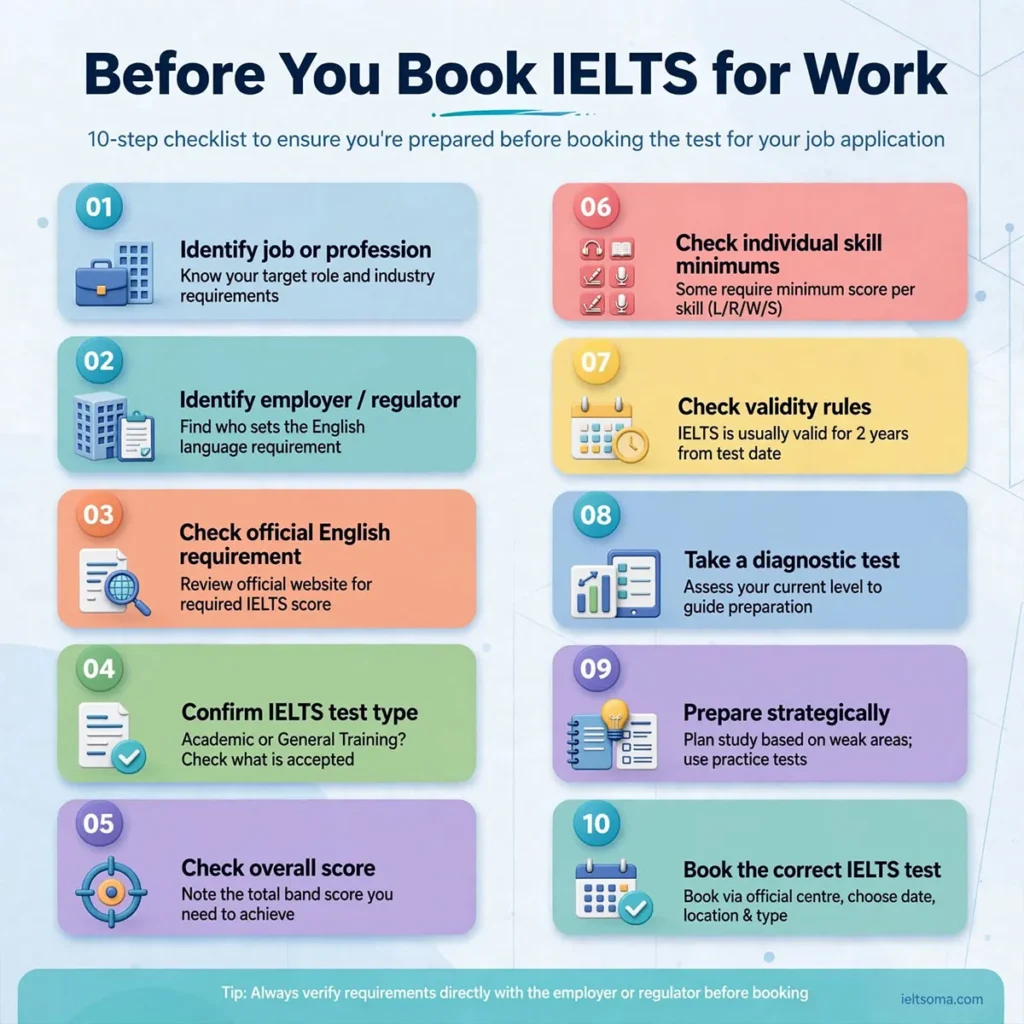
Follow this sequence:
Step 1: Identify the job, profession or registration pathway.
Step 2: Identify the employer or professional regulator.
Step 3: Find its official English-language requirement.
Step 4: Confirm which IELTS test is accepted.
Step 5: Record the overall and individual skill requirements.
Step 6: Check the result validity and submission rules.
Step 7: Take a diagnostic IELTS practice test.
Step 8: Identify your weakest skills.
Step 9: Create a preparation plan based on your target score.
Step 10: Book the appropriate IELTS test only after confirming the requirements.
This approach prevents one of the most costly IELTS mistakes: achieving a score that does not meet the requirement you actually need.
Frequently Asked Questions About IELTS for Work and Employment
Is IELTS required for employment?
Not for every job. Some employers require or accept IELTS as evidence of English ability, while others use different methods to assess candidates. The employer decides whether IELTS is required and what score is acceptable.
What IELTS score is needed for jobs?
There is no universal IELTS score for jobs. Employers can establish their own requirements, which may include an overall band and minimum scores in individual skills. Always check the specific employer’s requirements.
Is IELTS Academic or General Training better for work?
Neither is automatically better. The correct test depends on the organisation and purpose. IELTS Academic may be relevant to some professional bodies, while General Training is used in employment and other contexts. Check the requirements of your target organisation before booking.
Can IELTS be used for professional registration?
Yes. IELTS is accepted by professional associations and regulators in various professions and countries. However, requirements differ between organisations, professions and jurisdictions.
Do I need a particular IELTS score for professional registration?
Possibly. The required score depends on the professional registration body. Some organisations may specify both an overall score and minimum scores for individual skills. Check the regulator’s current requirements rather than relying on a general score recommendation.
Is Band 7.0 enough for a job?
It depends on the organisation. Band 7.0 may satisfy one employer’s requirement but not another’s. An employer may also require minimum scores in particular IELTS skills.
Can I use an IELTS result for more than one purpose?
Potentially, but acceptance depends on the organisations involved and their rules. For example, an IELTS result that satisfies one organisation’s requirement may not automatically satisfy a professional regulator or immigration authority.
Is IELTS Online accepted for professional registration?
IELTS states that IELTS Online is not accepted by governments and organisations for immigration or professional registration purposes. Always check the specific organisation before booking.
How long is an IELTS result valid for employment?
IELTS partners recommend a maximum period of two years as evidence of English ability, but an employer or professional organisation determines whether and how an older result is accepted.
Can IELTS help me work abroad?
Yes. IELTS is used by employers and professional organisations internationally, and IELTS results are also used in various migration pathways. However, IELTS is only one part of an employment or migration process and does not itself guarantee a job or work authorisation.
Final Thoughts
IELTS for work and employment is not about chasing a universally “good” band score.
It is about achieving the specific English result required for your professional goal.
If you need an IELTS score for jobs, check the employer’s requirements.
If you need IELTS for professional registration, check the regulator’s requirements.
Then confirm the test type, overall band, individual skill scores, validity rules and submission requirements before you book your test.
That small amount of research can make your IELTS preparation far more efficient.
Your target should not simply be:
“I need a high IELTS score.”
It should be:
“I know exactly what score I need, why I need it, and which organisation will accept it.”
That is a much more useful starting point for your IELTS journey.
Useful Links: