IELTS Reading Matching Headings questions can look deceptively simple. You read a paragraph, look at a list of headings, and choose the heading that seems to fit.
Then the mistakes begin.
Two headings may contain similar words. One heading may describe an interesting detail from the paragraph while another expresses its real purpose. Sometimes the paragraph starts by discussing one idea but finishes by making a completely different point.
The key is to stop looking for matching words and start looking for matching meaning.
This guide explains how to match headings in IELTS Reading, how to identify the main idea of a paragraph, how to eliminate misleading options, and which IELTS Reading Matching Headings strategy can save valuable time in the test.
Table of Contents
What Are IELTS Reading Matching Headings Questions?
In IELTS Reading Matching Headings questions, you are given a list of headings and several paragraphs or sections from a reading passage. Your task is to match each paragraph with the heading that best summarises its main idea.
The official IELTS test format explains that a heading summarises the main idea of a paragraph or section. There are normally more headings than paragraphs, so some headings are not used. A heading cannot normally be used more than once.
For example, you might see:
Headings
i. The unexpected benefits of urban gardens
ii. Problems caused by excessive rainfall
iii. How farming changed city life
iv. A solution to declining food production
v. The history of modern agriculture
vi. Why some traditional methods disappeared
Then you may need to match the headings with paragraphs A–D.
The important point is that the correct heading does not necessarily contain the same words as the paragraph.
What do Matching Headings questions test?
They test whether you can:
- identify the main idea of a paragraph
- distinguish a main idea from supporting details
- understand the overall purpose of a paragraph
- recognise paraphrased ideas
- ignore attractive but incomplete answers
- compare several possible meanings
- understand how ideas are developed within a paragraph
This is different from Matching Information, which focuses on locating specific information such as a reason, example, comparison, description or detail. IELTS specifically distinguishes Matching Headings from Matching Information because Matching Headings focuses on the main idea, not a specific piece of information.
Why Are IELTS Reading Heading Questions Difficult?
The biggest problem is that IELTS does not usually make the correct answer obvious through repeated vocabulary.
Instead, the test may paraphrase the idea.
For example, a heading might say:
The growing importance of renewable energy
But the paragraph might say:
Solar and wind power were once regarded as expensive alternatives. Falling production costs, however, have encouraged governments and businesses to invest heavily in these technologies.
There is no exact phrase saying “growing importance of renewable energy”.
You have to understand that the paragraph is mainly about the increasing significance of renewable energy, rather than simply about falling production costs.
Another difficulty is that a paragraph may contain several ideas.
You might find:
- a background statement
- an example
- a historical fact
- a problem
- a solution
- the author’s main point
Only one of these may represent the paragraph’s central message.
That is why IELTS Reading heading questions tips often focus on main idea recognition rather than vocabulary matching.
IELTS Reading Matching Headings Strategy: The 7-Step Method
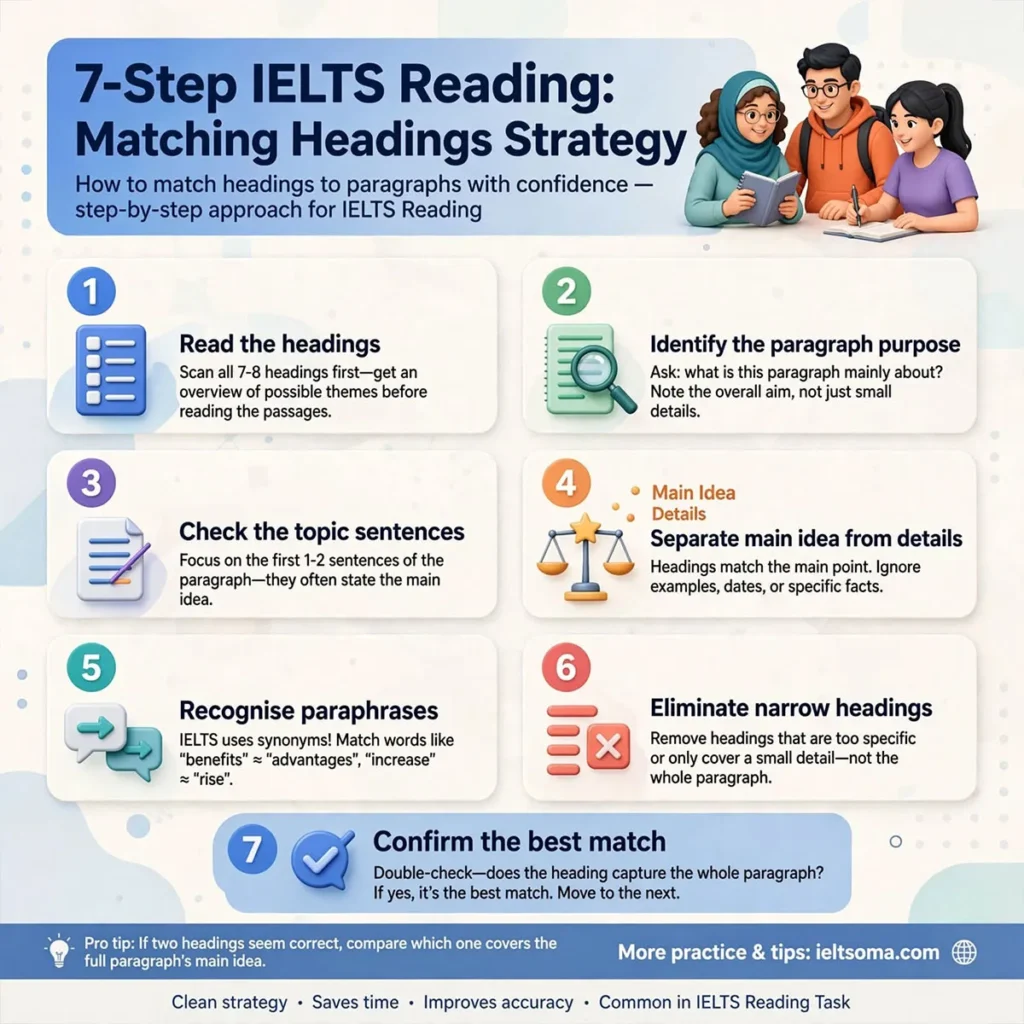
A reliable approach is to treat every paragraph as having a central message.
Use the following seven-step method.
1. Read the headings before matching
Start by reading the list of headings.
Do not try to memorise every word. Instead, identify the subject and meaning of each heading.
For example:
- The decline of traditional farming
- The economic value of farming
- New technology transforming agriculture
- The environmental cost of modern farming
You should immediately recognise that these headings concern similar general topics but different ideas.
Ask yourself:
What makes each heading different from the others?
Look for the important concept rather than individual vocabulary.
For example:
- decline
- economic value
- technology
- environmental cost
These differences will become useful when you analyse the paragraphs.
The British Council also recommends reading the headings first and then matching paragraphs that you are confident about before returning to uncertain answers.
2. Read the paragraph for its overall message
Now read the paragraph.
Do not immediately search for words from the headings.
Instead, ask:
“What is this paragraph mainly doing?”
Is it:
- explaining a problem?
- describing a change?
- presenting a solution?
- discussing a historical development?
- comparing two approaches?
- explaining a cause?
- describing an effect?
- challenging a common belief?
- giving evidence for an argument?
This question is extremely useful.
Consider this example:
For decades, researchers assumed that the decline in bee populations was mainly connected to agricultural pesticides. More recent studies, however, suggest that several factors are involved, including habitat loss, disease and changing weather patterns. Scientists now increasingly view the problem as the result of multiple interacting pressures.
A student might choose a heading about agricultural pesticides because that phrase appears prominently.
But the paragraph’s main idea is broader:
The decline of bees has several interconnected causes.
The pesticide reference is supporting information.
3. Check the first and last sentences carefully
The first sentence often introduces the subject of a paragraph.
The final sentence may reveal the writer’s conclusion or the paragraph’s real point.
This is not an absolute rule. Some paragraphs develop their main idea gradually, and the topic sentence can sometimes appear later.
The official IELTS teaching guidance notes that topic sentences can often occur near the beginning but may sometimes appear elsewhere, including towards the end.
A useful technique is:
Read the first sentence → skim the middle → read the final sentence carefully.
Then ask:
“What single idea connects these sentences?”
That idea is often the heading you need.
4. Separate the main idea from supporting details
This is perhaps the most important skill for IELTS Reading Matching Headings.
A paragraph may contain:
- an example
- a statistic
- a person’s opinion
- a historical event
- a scientific study
- a reason
- a result
But these may only support the paragraph’s central point.
Imagine this paragraph:
In 2010, only a small proportion of households in the region used solar panels. By 2020, installation rates had increased dramatically. Government incentives, falling equipment costs and greater public awareness all contributed to this change. The region has consequently become an important example of how renewable energy can expand rapidly when several favourable conditions occur together.
Possible headings:
A. Government policies for renewable energy
B. The rapid growth of renewable energy
C. The falling cost of solar panels
D. Public awareness of environmental problems
The paragraph mentions all four ideas.
But which one describes the whole paragraph?
B.
Government incentives, lower costs and public awareness are supporting explanations for the wider development.
5. Look for synonyms and paraphrases
Do not expect the heading to repeat the paragraph’s vocabulary.
IELTS deliberately tests your ability to recognise meaning expressed in different language.
For example:
| Heading | Possible wording in paragraph |
|---|---|
| A decline in traditional practices | traditional methods are disappearing |
| The expansion of online education | more students are studying remotely |
| The causes of urban congestion | factors contributing to traffic problems |
| A surprising scientific discovery | researchers found something unexpected |
| Changes in consumer behaviour | people are buying products differently |
The words are different, but the underlying ideas are similar.
When you read a heading, mentally convert it into a simple question.
For example:
“The decline of traditional farming”
becomes:
“Is this paragraph mainly about traditional farming becoming less common?”
That makes paraphrases easier to recognise.
6. Eliminate headings that are too narrow
A common trap is choosing a heading that is true but incomplete.
Suppose a paragraph discusses how a city introduced bicycle lanes, reduced car use, improved public transport and redesigned pedestrian areas.
One heading says:
The introduction of bicycle lanes
Another says:
A broader transformation of urban transport
The bicycle lanes may be discussed extensively, but if the paragraph is actually about a wider transport transformation, the first heading is too narrow.
This is one of the most important IELTS Reading heading questions tips:
A heading must summarise the paragraph, not merely describe one part of it.
7. Use elimination when necessary
You do not need to understand every word in the paragraph to answer a Matching Headings question.
If you confidently match four headings, remove them from consideration.
You now have fewer options for the remaining paragraphs.
This is particularly useful when two headings seem similar.
Suppose the options are:
- causes of the problem
- consequences of the problem
- attempts to solve the problem
- history of the problem
Once you understand whether the paragraph is discussing why something happened, what happened afterwards, or what people did about it, the correct heading becomes much easier to identify.
How to Match Headings in IELTS Reading Without Getting Tricked
The best question to ask is not:
“Which heading contains words from this paragraph?”
Ask:
“Which heading could I use as the title of this paragraph?”
Imagine removing the paragraph and leaving only its heading.
Would that heading accurately tell a reader what the paragraph is about?
If yes, you may have found the answer.
If the heading describes only one example, person, date or fact from the paragraph, keep looking.
A useful three-question test
For every possible heading, ask:
- What is the paragraph mainly about?
- Does this heading cover most of the paragraph?
- Is another heading more precise without being too narrow?
The third question is particularly useful when two options look possible.
A Practical Example
Read this short paragraph:
Early attempts to introduce electric buses were not always successful. Batteries were expensive, charging infrastructure was limited, and many operators were concerned about reliability. As battery technology improved and production costs fell, however, the situation changed. Several major cities began replacing diesel buses with electric models, particularly on routes where charging could be managed efficiently.
Consider these headings:
i. The environmental advantages of electric buses
ii. Why electric buses initially faced difficulties
iii. The rapid development of battery technology
iv. The increasing use of electric buses
v. Problems with public transport in major cities
The paragraph begins with difficulties and then explains how the situation changed.
Which heading is the best overall summary?
iv. The increasing use of electric buses might look attractive because the final sentence discusses cities replacing diesel buses.
But the paragraph gives considerable attention to the earlier difficulties and then explains the change.
Depending on the exact question design and the surrounding passage, you would need to assess the paragraph’s central purpose carefully rather than selecting an answer simply because it matches one sentence.
This illustrates an important principle:
Never decide from one sentence alone.
You need to understand the paragraph as a complete unit.
Should You Read the Whole Passage First?
Not necessarily.
For Matching Headings, reading the entire passage word-for-word before looking at the task can consume valuable time.
A more efficient approach is to:
- read the headings
- survey the passage
- identify the main idea of each relevant paragraph
- match the headings
- return to difficult questions
Official IELTS guidance identifies Matching Headings as a task that tests understanding of main ideas, and British Council teaching material specifically recommends a structured strategy rather than simply reading the entire passage in detail before beginning the task.
However, do not turn this into a rigid rule.
If a paragraph is difficult, read more of it.
The goal is not to read as little as possible. The goal is to spend your reading time where it produces the most useful information.
Do IELTS Matching Headings Answers Come in Order?
No.
This is an important difference between Matching Headings and some other IELTS Reading question types.
The headings do not necessarily follow the order of the paragraphs.
The British Council’s official Matching Headings material explicitly warns that the answers are not in the same order as the text.
For example:
- Paragraph A → heading v
- Paragraph B → heading ii
- Paragraph C → heading vi
- Paragraph D → heading i
Do not assume that the first paragraph must use the first available heading.
Instead, match according to meaning.
Common Mistakes in IELTS Reading Matching Headings
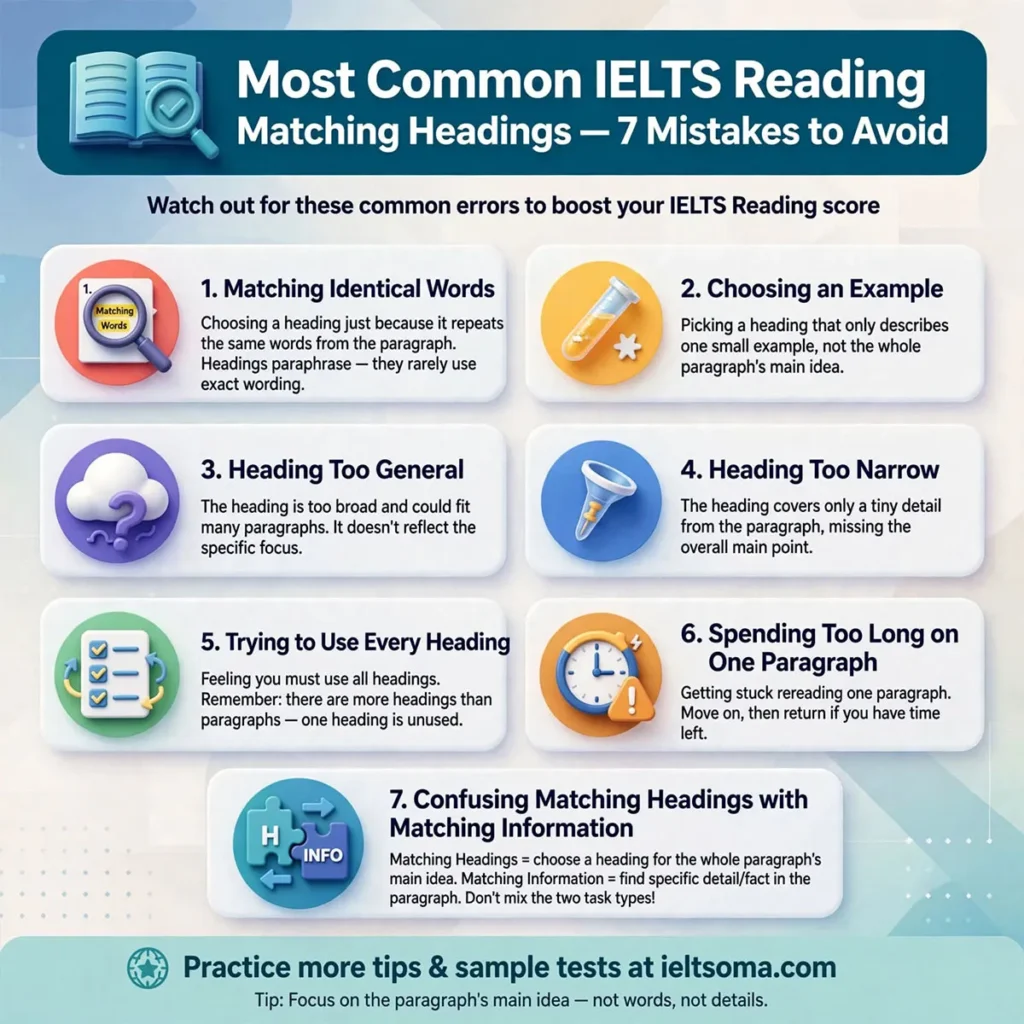
Mistake 1: Matching identical words
This is probably the most common error.
A heading contains the word “technology”, and the paragraph contains “technology”, so the student chooses it.
That is not enough.
IELTS tests meaning, and correct answers are often paraphrased.
Mistake 2: Choosing a heading about an example
A paragraph may mention one famous scientist, company or city.
That does not mean the paragraph is mainly about that person, company or city.
Ask what the example is being used to demonstrate.
Mistake 3: Choosing a heading that is too general
A heading such as “Changes in society” could theoretically describe almost anything.
The correct heading should normally capture the specific main idea of the paragraph.
Mistake 4: Choosing the first heading that seems possible
Sometimes two headings appear reasonable.
Do not stop immediately.
Compare them.
Ask which heading explains the largest part of the paragraph.
Mistake 5: Trying to use every heading
There are more headings than paragraphs, so some headings are deliberately unused.
An unused heading is not a problem.
It is part of the design of the task.
Mistake 6: Spending too long on one paragraph
If you cannot decide, mark your best option and move on.
Once other headings have been used, elimination may make the remaining answer much clearer.
Mistake 7: Confusing Matching Headings with Matching Information
Matching Headings asks:
“What is this paragraph mainly about?”
Matching Information asks:
“Where is this specific piece of information found?”
That distinction matters.
A Fast Strategy for Higher Band Scores
If you need a practical routine for the test, use this:
Before reading
Read all the headings.
Underline mentally or on paper the key concept in each heading.
For each paragraph
Read the opening sentence.
Skim the middle.
Read the final sentence carefully.
Ask:
“What is the writer’s main point?”
Before choosing
Compare the paragraph’s central idea with the remaining headings.
Reject options that:
- focus on only one detail
- mention an example rather than the main point
- are too broad
- contradict the paragraph
- rely only on matching vocabulary
After matching
Check every answer.
Ask:
“Could I explain why this heading summarises the whole paragraph in one sentence?”
If you cannot, reconsider it.
IELTS Reading Matching Headings Strategy for Academic and General Training
Matching Headings can appear in both IELTS Academic and IELTS General Training Reading.
The main difference between the two Reading tests is the type of material used. Academic Reading includes texts appropriate for academic or professional contexts, while General Training Reading uses texts drawn from everyday, workplace and general-interest contexts. The Matching Headings skill itself remains focused on identifying the main idea.
That means the strategy remains largely the same:
understand the paragraph → identify its central idea → compare meanings → eliminate distractors.
Do not rely on subject knowledge.
You are being tested on what the passage communicates, not what you already know about the topic.
5 IELTS Reading Heading Questions Tips to Remember
If you only remember five things, remember these:
- Read the headings first.
- Look for the main idea, not repeated vocabulary.
- Distinguish supporting details from the paragraph’s central message.
- Expect paraphrasing and synonyms.
- Use elimination when you are unsure.
The official IELTS guidance confirms that Matching Headings specifically tests the distinction between main ideas and supporting ideas.
A Simple Formula You Can Use
When you practise, train yourself to use this formula:
Paragraph → Main idea → Paraphrase → Heading
For example:
Paragraph: More people are working remotely because technology has made communication easier and companies have changed their working practices.
Main idea: Growth of remote working.
Paraphrase: Increasing numbers of employees are working away from traditional offices.
Heading: The expansion of remote employment.
This is much more reliable than:
Paragraph → find same word → choose heading
How to Practise Matching Headings Effectively
Simply doing dozens of questions is not enough if you repeatedly make the same type of mistake.
After each practice exercise, classify your mistakes.
Were you wrong because you:
- misunderstood the main idea?
- missed a paraphrase?
- chose a supporting detail?
- selected a heading that was too broad?
- selected one that was too narrow?
- failed to eliminate an option?
- read too quickly?
- misunderstood the paragraph structure?
Keep a small error log.
For example:
| Mistake | What happened | Correction |
|---|---|---|
| Keyword matching | I chose a heading because the vocabulary was similar | Compare meaning |
| Detail trap | I chose an example | Identify the overall point |
| Too broad | Heading described the general topic | Look for the specific message |
| Too narrow | Heading covered one sentence | Check the whole paragraph |
| Paraphrase | I did not recognise equivalent meaning | Build synonym awareness |
This turns practice into targeted improvement.
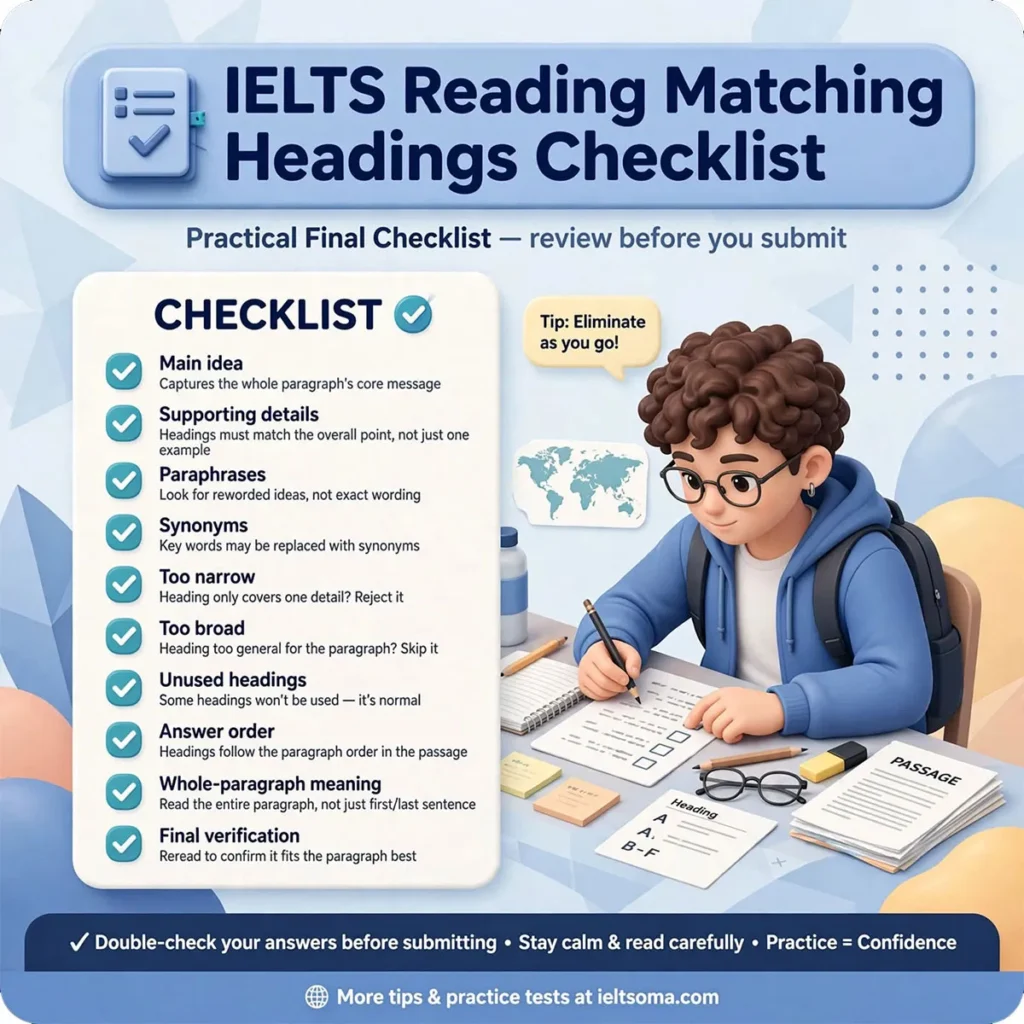
Final IELTS Reading Matching Headings Checklist
Before submitting your answers, ask:
- Have I understood the main idea of each paragraph?
- Did I avoid matching by vocabulary alone?
- Did I consider synonyms and paraphrases?
- Did I distinguish the main idea from examples?
- Did I reject headings that are too narrow?
- Did I reject headings that are too general?
- Did I remember that some headings are unused?
- Did I avoid assuming the answers follow paragraph order?
- Can I explain why each chosen heading summarises the paragraph?
If you can answer yes to these questions, you are approaching the task in the way it is designed to be solved.
FAQs About IELTS Reading Matching Headings
How do I match headings in IELTS Reading?
Read the headings first, identify the main idea of each paragraph, and then compare that idea with the meanings of the headings. Focus on the whole paragraph rather than matching individual words.
What is the main strategy for IELTS Reading Matching Headings?
The most useful IELTS Reading Matching Headings strategy is to identify the paragraph’s central message and distinguish it from supporting details, examples and specific facts.
Do IELTS Matching Headings answers come in order?
No. You should not assume that the answers follow the order of the paragraphs. Matching Headings requires you to match each paragraph with the heading that best represents its main idea.
Can I use the same heading more than once?
No. In the standard Matching Headings task, a heading is not used more than once, and there are more headings than paragraphs or sections, meaning some headings are not used.
Should I read the whole IELTS Reading passage first?
You can survey the passage first, but reading every sentence in detail before attempting the task may not be the most efficient use of your time. For Matching Headings, concentrate on understanding the main idea of each relevant paragraph.
Why do I keep getting IELTS Reading heading questions wrong?
A common reason is focusing on words rather than meaning. Other problems include choosing a heading based on one supporting detail, overlooking paraphrases, or selecting a heading that is too broad or too narrow.
Are Matching Headings questions in Academic and General Training IELTS?
Yes. Matching Headings is one of the Reading question types used in both Academic and General Training IELTS. The texts differ between the two tests, but the task requires you to identify the main idea of a paragraph or section.
What is the difference between Matching Headings and Matching Information?
Matching Headings asks you to identify the main idea of a paragraph or section. Matching Information asks you to locate specific information, such as a detail, example, reason, comparison or explanation.
Is Matching Headings difficult in IELTS Reading?
It can be challenging because several headings may appear related to the same paragraph. The key difficulty is distinguishing the paragraph’s central message from supporting information and recognising paraphrased ideas.
What should I do if two headings seem correct?
Compare the two headings against the entire paragraph. Choose the one that summarises the largest and most important part of the paragraph rather than one that describes only a particular sentence or example.
The Bottom Line
IELTS Reading Matching Headings is not fundamentally a vocabulary-matching exercise.
It is a main-idea recognition task.
The strongest approach is to understand what the paragraph is doing, separate its central message from its supporting details, recognise paraphrased meaning and eliminate headings that are too narrow, too broad or focused on the wrong idea.
With practice, you can make this process much faster.
Instead of asking:
“Where are the words from this heading?”
train yourself to ask:
“What is the writer really saying in this paragraph?”
That single change can make IELTS Reading heading questions much easier to handle under test conditions.
Useful Links: