
Achieving IELTS Band 9 is one of the most demanding goals an English-language test taker can set. It requires far more than memorising advanced vocabulary, learning essay templates or completing hundreds of practice tests. You need exceptional control of English, a precise understanding of the test, and the ability to perform consistently under exam conditions.
The good news is that Band 9 has clearly defined assessment standards. You can use these standards to identify weaknesses, build a focused preparation plan and measure your progress.
This guide explains what IELTS Band 9 means, how to get Band 9 in IELTS Listening, Reading, Writing and Speaking, and which preparation habits are most likely to help you reach the highest level. The advice applies to both IELTS Academic and General Training candidates, with separate guidance wherever their tests differ.
Table of Contents
What Does IELTS Band 9 Actually Mean?
IELTS Band 9 represents an expert level of English proficiency. According to the IELTS band scale, a Band 9 user demonstrates a fully operational command of the language, with appropriate, accurate and fluent use of English and complete understanding.
However, achieving Band 9 does not mean you must speak without pausing, use complicated words in every sentence or produce writing that sounds like an academic journal.
It means you can communicate with exceptional accuracy, flexibility and clarity, even when dealing with complex ideas or unfamiliar topics.
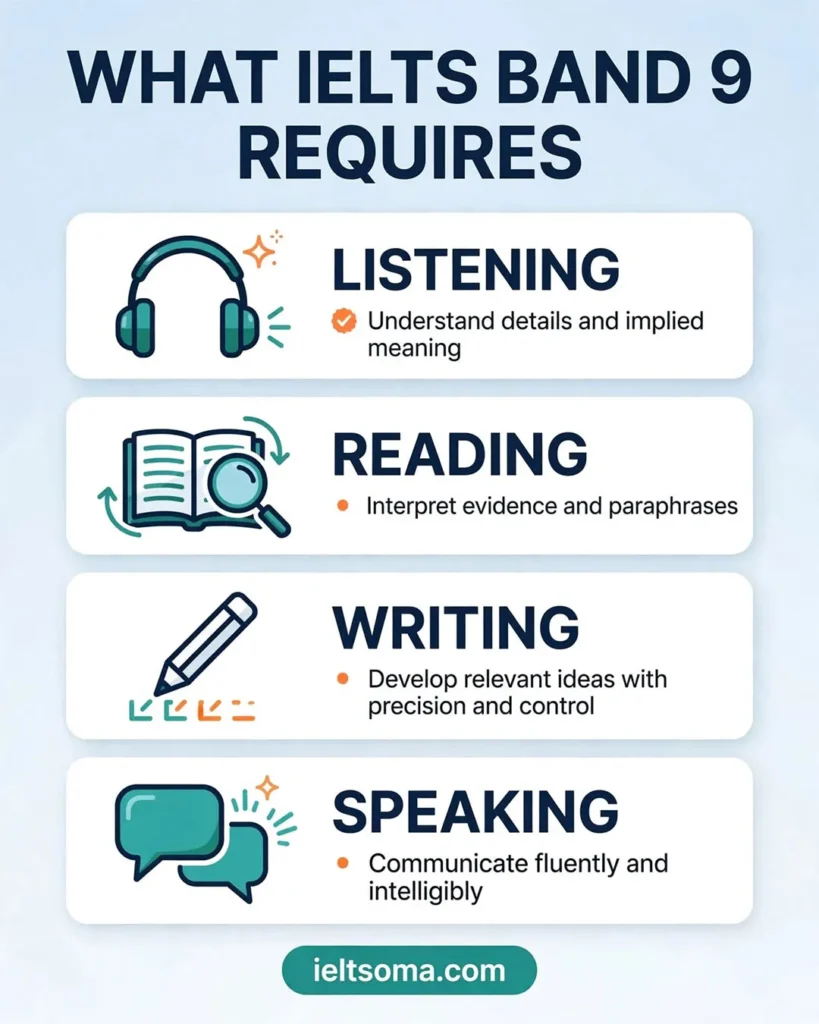
The four skills are assessed differently:
| IELTS skill | What you need to demonstrate |
|---|---|
| Listening | Understand the recording accurately, including details, opinions, relationships and implied meaning |
| Reading | Identify main ideas, locate specific information and understand arguments, details and paraphrases |
| Writing | Address every part of the task, develop ideas logically, use precise vocabulary and demonstrate excellent grammatical control |
| Speaking | Communicate fluently, develop ideas naturally, choose words accurately and use a wide range of grammatical structures |
Your Listening and Reading results depend on the number of correct answers, converted to the IELTS band scale. Writing and Speaking are assessed by examiners using published performance criteria.
You can review the official IELTS scoring system to understand how each skill is evaluated.
One crucial point: an overall Band 9 is not the same as receiving Band 9 in every skill. Your overall result is calculated from the four skill scores and rounded according to IELTS rules. If your goal is Band 9 in all four skills, you must prepare for each skill separately.
7 Proven IELTS Band 9 Preparation Strategies
Before focusing on individual skills, build a preparation system that develops your English and improves your exam performance simultaneously.
1. Establish Your Current Band Level
Do not begin with the assumption that you need the same amount of practice in every skill. Start with a realistic assessment of your current ability.
Complete a full IELTS practice test under timed conditions. Use reliable practice materials that reflect the current test format, and check your answers against the official answer key where available.
For Writing and Speaking, seek detailed feedback based on the relevant assessment criteria rather than relying exclusively on automated scores or general comments.
Record your results in a table:
| Skill | Current level | Main weakness | Next action |
|---|---|---|---|
| Listening | Your score | Missed details or distractors | Practise targeted question types |
| Reading | Your score | Timing or misinterpretation | Analyse incorrect answers |
| Writing | Feedback-based estimate | Task response or grammar | Rewrite and review |
| Speaking | Feedback-based estimate | Fluency or pronunciation | Record and analyse responses |
Repeat comparable assessments periodically. Your goal is to identify measurable improvement, not simply to complete more practice papers.
2. Understand the Band 9 Assessment Criteria
A strong candidate understands what examiners reward and what commonly limits performance.
For Writing, the four assessment criteria cover task achievement or task response, coherence and cohesion, lexical resource, and grammatical range and accuracy.
For Speaking, examiners assess fluency and coherence, lexical resource, grammatical range and accuracy, and pronunciation.
These criteria explain why sophisticated vocabulary alone cannot guarantee a high score. A well-written essay with impressive words may still underperform if it fails to answer the question fully. Similarly, a speaker with a broad vocabulary may lose effectiveness through unclear pronunciation or poorly connected ideas.
Study the official band descriptors and use them to evaluate your practice. Pay particular attention to the differences between your current performance and the standard you are targeting.
3. Practise With Purpose, Not Just Volume
Completing five practice tests without analysing your errors may be less useful than completing one test and thoroughly investigating every mistake.
After each practice session, ask yourself:
- Did I misunderstand the question or the recording?
- Did I overlook a paraphrase?
- Did I choose an answer based on a keyword rather than its meaning?
- Did I make a grammatical or spelling error?
- Did I run out of time?
- What specific action would prevent this mistake next time?
Keep an error log organised by skill and question type. Review it before your next practice session.
This is particularly valuable when you are already achieving high scores. At an advanced level, progress often comes from correcting recurring weaknesses rather than repeatedly practising areas you have already mastered.
4. Develop English Beyond IELTS Practice Papers
IELTS tests your ability to use English, not simply your familiarity with IELTS questions.
Read high-quality articles, listen to discussions and interviews, and practise explaining complex ideas. Use a variety of subjects, including education, technology, health, the environment, work and social change.
For every reading or listening activity, go beyond understanding the general message. Notice how speakers qualify opinions, how writers support claims, how arguments are organised and how vocabulary changes according to context.
For example, learn the difference between suggest, demonstrate, indicate and establish. These verbs have related meanings but are not interchangeable in every situation.
This broader exposure strengthens the language skills that support all four IELTS components.
5. Train Under Realistic Exam Conditions
High-level English ability does not automatically translate into a high test score. You must also manage the test’s timing, instructions and pressure.
Practise the relevant time limits, use the appropriate response format and avoid unnecessary interruptions during mock tests.
For computer-delivered practice, become comfortable reading on a screen, navigating questions and entering answers accurately. If you take a paper-based test, practise writing legibly and transferring answers where required.
For Speaking, practise responding to unfamiliar questions without preparing complete scripts. For Writing, practise planning and producing complete responses within the allotted time.
6. Use Feedback to Correct Specific Weaknesses
Feedback is most useful when it identifies a problem, explains why it matters and shows how to improve it.
For example, “improve vocabulary” is too vague. A more useful observation would be: “You repeatedly use important where a more precise expression is needed, and several word combinations are unnatural.”
Likewise, “improve grammar” should lead to identifiable targets, such as article use, subject–verb agreement, sentence boundaries or control of complex clauses.
For Writing and Speaking, compare your performance with the official descriptors. If possible, work with a qualified IELTS teacher who can explain recurring errors and assess your responses consistently.
7. Review Progress and Adapt Your Plan
Your IELTS Band 9 preparation plan should change as your performance improves.
If Listening and Reading are consistently strong but Writing remains weaker, devote more time to writing feedback and revision. If your Speaking responses contain repeated pauses because you cannot organise ideas quickly, practise structured responses and spontaneous discussion.
Use these principles:
- Spend more time on weaknesses that affect your score.
- Maintain stronger skills with shorter, regular practice sessions.
- Repeat tasks that reveal a clear problem, not merely because they are familiar.
- Track accuracy, timing and the quality of your language.
- Take full mock tests periodically to check whether improvements transfer to exam conditions.
There is no universal number of study hours that guarantees Band 9. The time required depends on your starting level, learning habits and the size of the gap between your current performance and the target.
IELTS Band 9 Listening: Strategies for Near-Perfect Accuracy
IELTS Listening contains four parts with 10 questions each. The recording is played once, and the test includes different question types and accents.
To achieve Band 9, you need highly developed listening comprehension and the ability to record answers accurately while following the recording.
Predict the Type of Answer
Before the recording begins, use the available time to read the questions and identify what each gap requires.
A blank may require a name, date, location, noun, adjective or number. Predicting the answer type helps you recognise relevant information when you hear it.
For example:
The workshop will take place in ______.
You should expect a location. However, do not commit to a particular answer before hearing the recording.
Recognise Distractors and Corrections
Speakers sometimes mention an option before rejecting or correcting it.
For example:
“The original meeting was planned for Thursday, but we’ve moved it to Friday afternoon.”
If the question asks for the final meeting day, the answer is Friday, not Thursday.
Practise listening for corrections, contrasting expressions and changes of plan. Pay attention to the complete meaning rather than the first familiar word you hear.
Improve Your Ability to Follow Paraphrases
The recording may express an idea differently from the question.
A question might refer to a place as inexpensive, while the speaker describes it as reasonably priced. You need to understand the meaning, not wait for identical wording.
Build this skill by comparing questions with the relevant recording transcripts after completing a practice test. Highlight paraphrases and note expressions that confused you.
Protect Easy Marks
Read instructions carefully, especially word limits. Check spelling, singular and plural forms, numbers and whether your response fits the grammatical structure of the question.
For example, if the instructions say NO MORE THAN TWO WORDS, an answer containing three words will not receive the mark.
Band 9 Listening practice routine:
- Complete a section without pausing the audio.
- Check your answers.
- Replay difficult sections and identify the exact point where understanding failed.
- Read the transcript to examine connected speech, paraphrases and unfamiliar expressions.
- Repeat the exercise with a different recording.
Aim for consistent accuracy across all four parts, including the more demanding academic discussions and monologues.
IELTS Band 9 Reading: Accuracy, Speed and Inference
Both Academic and General Training Reading contain 40 questions and have a 60-minute time limit. The texts differ between the two test types, so your preparation should reflect the version you intend to take.
Academic Reading includes texts of greater academic complexity, while General Training Reading includes everyday and workplace texts as well as a longer text on a general-interest topic.
Read for Meaning, Not Every Word
Reading every sentence slowly is rarely an effective strategy for a timed test.
Instead, use a combination of skimming, scanning and close reading.
- Skimming: identify the overall topic, purpose and structure of a passage.
- Scanning: locate specific names, dates, terms or other details.
- Close reading: examine the relevant passage carefully to determine the answer.
For example, a question may ask why a research project changed direction. You can locate the relevant paragraph using names or subject terms, but you must read carefully to distinguish the reason for the change from the result.
Master Paraphrasing and Meaning
Reading questions often express information differently from the passage. Recognising these relationships is essential for high-level performance.
Consider this pair:
Passage: “The number of commuters using bicycles rose substantially.”
Question: “Cycling to work became considerably more common.”
The wording differs, but the central meaning is similar.
Practise identifying synonyms, equivalent expressions, cause-and-effect relationships and statements that preserve the original meaning. Do not assume two statements are equivalent simply because they share a keyword.
Approach True, False and Not Given Carefully
These questions test whether you can distinguish between information that agrees with a passage, contradicts it or is not established by it.
- True: the passage supports the statement.
- False: the passage contradicts the statement.
- Not Given: the passage does not provide enough information to decide whether the statement is true or false.
Suppose the passage states that a company introduced flexible working hours. A question claims that employee satisfaction increased as a result.
Unless the passage establishes that outcome or provides contradictory information, you cannot infer the answer merely because flexible hours might improve satisfaction.
This distinction is especially important for candidates aiming for near-perfect Reading accuracy.
Manage the 60-Minute Limit
Practise allocating time according to your strengths and the difficulty of each passage. You might begin with approximately 18 minutes for the first passage, 20 minutes for the second and 22 minutes for the third, then adjust according to your performance.
This is a starting point, not a fixed rule. Some candidates benefit from a different allocation.
Avoid spending several minutes on a single difficult question while leaving easier questions unanswered. Make a provisional choice when necessary, move on and return if time permits.
Band 9 Reading practice routine:
- Complete a timed passage or full test.
- Categorise each incorrect answer by question type.
- Locate the exact evidence in the passage.
- Explain why your answer was wrong and why the correct answer is supported.
- Practise the weakest question type separately.
Your aim is not simply to read faster. It is to find evidence quickly and interpret it accurately.
IELTS Band 9 Writing: Precision, Development and Control
Writing is often challenging for candidates targeting the highest bands because good English is only one part of the assessment. You must also respond fully to the task and organise your ideas effectively.
The Academic and General Training Writing tests share the same 60-minute duration and two-task structure, but Task 1 differs between the test types.
Academic Writing Task 1
Academic candidates describe visual information, such as charts, tables, graphs, maps or processes.
A strong response identifies the most important features, provides an accurate overview and supports it with relevant comparisons or details.
Do not describe every figure mechanically. Select the information that best communicates the overall pattern.
For example, if a graph shows that public transport use increased while car use declined, highlight the contrasting trends before discussing the most relevant figures.
Use precise language to describe increases, decreases, stability and comparisons. Never invent explanations for trends that the visual does not establish.
General Training Writing Task 1
General Training candidates write a letter responding to a situation. You must address the required points and use a tone appropriate to the recipient and purpose.
A formal complaint to a company, for instance, requires a different register from a friendly letter to a relative.
Check that every bullet point is covered, the purpose is clear and the language remains consistent with the intended relationship.
Writing Task 2: Develop a Convincing Argument
Task 2 asks you to respond to an issue, opinion, problem or discussion. It carries greater weight than Task 1 in the Writing score, so preparation should reflect its importance.
A high-level essay needs a clear position, logical progression and sufficiently developed ideas.
Consider this question:
Some people believe that governments should invest more in public transport than in roads. To what extent do you agree or disagree?
A weak response might simply state that public transport is environmentally friendly and roads are necessary.
A stronger response explains the reasoning:
“Prioritising public transport can reduce the number of private vehicles on congested urban roads. If reliable bus and rail services become more accessible, commuters may have less incentive to drive, reducing pressure on existing road networks.”
The second response develops a cause-and-effect relationship instead of merely stating an opinion.
Use Vocabulary Naturally
Band 9 does not require obscure words or unnecessarily elaborate expressions. It requires precise and appropriate vocabulary.
Compare:
- Less precise: “The policy had a big effect on people.”
- More precise: “The policy significantly reduced commuting costs for low-income workers.”
The second sentence communicates more specific information.
Learn vocabulary through context, collocations and accurate usage. When reviewing an essay, identify vague expressions, repetition and unnatural word combinations. Replace them only when a better expression genuinely improves the meaning.
Demonstrate Grammatical Range and Accuracy
Use a mixture of simple and complex sentences, but prioritise control.
For example:
“Although online education offers flexibility, it cannot fully replace face-to-face interaction in courses that require practical supervision.”
This sentence combines a subordinate clause with a clear main argument. It is useful because the structure expresses a meaningful relationship, not because complexity is an end in itself.
Review recurring errors involving articles, prepositions, punctuation, agreement and sentence boundaries. A complex sentence that obscures your meaning is less effective than a clear, accurate one.
Practise Revision, Not Just Writing
Write Task 2 essays under timed conditions, then revise them using the four assessment criteria.
Ask yourself:
- Have I answered every part of the question?
- Is my position clear and consistent?
- Does each main paragraph develop one central idea?
- Are examples relevant and sufficiently explained?
- Are my vocabulary choices precise and natural?
- Are my sentences accurate and varied?
For Task 2, practise completing the essay within approximately 40 minutes, leaving around 20 minutes for Task 1. This reflects the commonly recommended time allocation.
Do not memorise complete essays for anticipated topics. Prepare flexible ideas, useful vocabulary and planning methods instead.
IELTS Band 9 Speaking: Natural Fluency and Precise Expression
Speaking is a live assessment lasting approximately 11–14 minutes. It includes an interview, an individual long turn and a discussion.
The objective is not to deliver a flawless speech. It is to communicate spontaneously, clearly and effectively across different types of questions.
Speaking Part 1: Answer Directly and Naturally
Part 1 covers familiar topics such as work, study, hobbies and everyday life.
Give a direct answer and add a relevant explanation or detail when appropriate.
Question: Do you enjoy reading?
Effective answer: “Yes, particularly non-fiction. I enjoy reading about psychology because it helps me understand why people behave differently in similar situations.”
This response answers the question and develops the idea without becoming unnecessarily long.
Avoid memorised introductions and overly elaborate answers to simple questions.
Speaking Part 2: Organise Your Long Turn
You receive a cue card and one minute to prepare before speaking for up to two minutes.
Use the preparation time to note key ideas rather than writing complete sentences.
For a cue card about a memorable journey, your notes might include:
- When and where
- Who accompanied you
- What happened
- Why it was memorable
Then organise the response into a coherent account with a beginning, relevant details and a clear ending.
Practise extending your answers through explanations, examples, comparisons and personal reflections. Do not add unrelated details merely to fill the time.
Speaking Part 3: Explain and Analyse
Part 3 explores broader issues related to the Part 2 topic. Questions may ask you to compare situations, explain causes, discuss consequences or predict future developments.
For example:
Question: Why do some people prefer living in large cities?
Effective answer: “One major reason is access to employment and services. Large cities tend to offer a wider range of professional opportunities, while residents may also benefit from better transport connections and specialist healthcare. However, these advantages can be offset by higher living costs and overcrowding.”
This response develops a position, explains supporting reasons and recognises a contrasting consideration.
Practise discussing both familiar and abstract topics so that you can organise ideas without depending on prepared scripts.
Improve Pronunciation, Not Your Accent
IELTS does not require you to imitate a British, American or Australian accent.
Focus on intelligibility, appropriate word stress, sentence stress, rhythm and effective use of intonation. Individual sounds matter, but pronunciation also involves how your speech flows as a whole.
Record yourself answering questions, then listen for unclear words, unnatural pauses, repeated fillers and sentences that become difficult to follow.
Expand Vocabulary Without Sounding Rehearsed
Use language that expresses your meaning accurately. Learn collocations, topic-related vocabulary and expressions for qualifying opinions.
For example, rather than repeating “I think” throughout a discussion, you might say “In my view”, “I would argue that” or “One possible explanation is”.
However, variety should be natural. There is no advantage in forcing a new expression into every answer.
Band 9 Speaking practice routine:
- Answer a Part 1 question without preparation.
- Record a two-minute Part 2 response.
- Discuss a related Part 3 question.
- Review fluency, vocabulary, grammar and pronunciation separately.
- Repeat the task, correcting one or two specific weaknesses.
How Long Does IELTS Band 9 Preparation Take?
There is no fixed preparation period that guarantees Band 9. A candidate already performing at Band 8 may need a different plan from someone whose current level is Band 6.
Your timeline depends on your existing English proficiency, the skills that need improvement, the quality of your practice and how consistently you apply feedback.
Use the following framework as a starting point:
| Preparation stage | Main objective |
|---|---|
| Initial assessment | Identify current scores and weaknesses |
| Foundation building | Strengthen vocabulary, grammar and comprehension |
| Skill-specific training | Address individual question types and assessment criteria |
| Timed practice | Improve accuracy, pacing and exam readiness |
| Final review | Confirm consistency and correct recurring mistakes |
Study regularly rather than relying on occasional marathon sessions. A focused daily session can include listening practice, reading analysis, writing revision and speaking exercises, with the proportions adjusted to your needs.
If your scores are already high, spend more time on detailed error analysis and feedback. At this level, careless assumptions, subtle misunderstandings and small but recurring language errors can make a meaningful difference.
Common Mistakes That Prevent Candidates From Reaching Band 9
Even advanced English users can underperform when their preparation is poorly targeted.
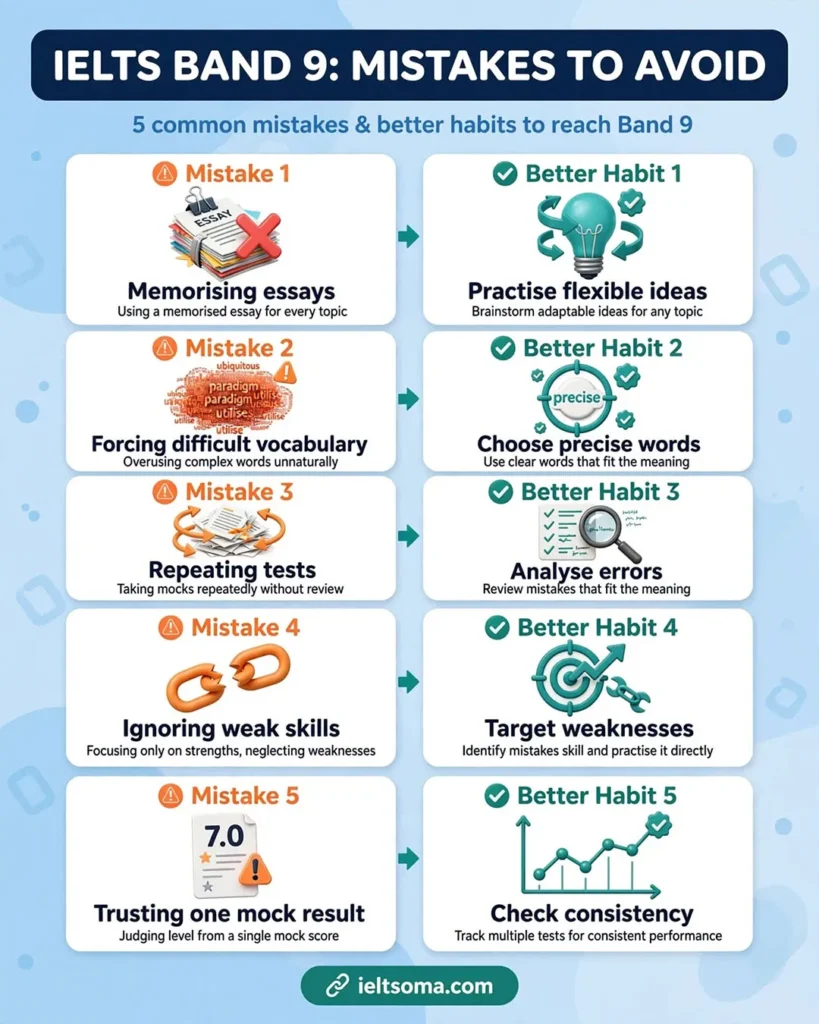
1. Memorising answers and essays. Prepared language may not answer the actual question and can sound unnatural.
2. Using complicated vocabulary unnecessarily. Incorrect collocations and imprecise word choices can weaken communication.
3. Ignoring the assessment criteria. Practising without understanding how performance is evaluated makes it harder to identify the right improvements.
4. Neglecting weaker skills. Strong Listening and Reading scores do not compensate for a specific skill requirement if an institution demands a minimum score in every component.
5. Repeating practice tests without reviewing errors. The number of completed tests matters less than what you learn from them.
6. Treating every pause or mistake as a disaster. Focus on maintaining clear communication and recovering naturally instead of becoming distracted by minor imperfections.
7. Assuming one mock-test score guarantees your result. Performance can vary between tests. Look for consistency across several reliable assessments.
A Practical Weekly IELTS Band 9 Study Plan
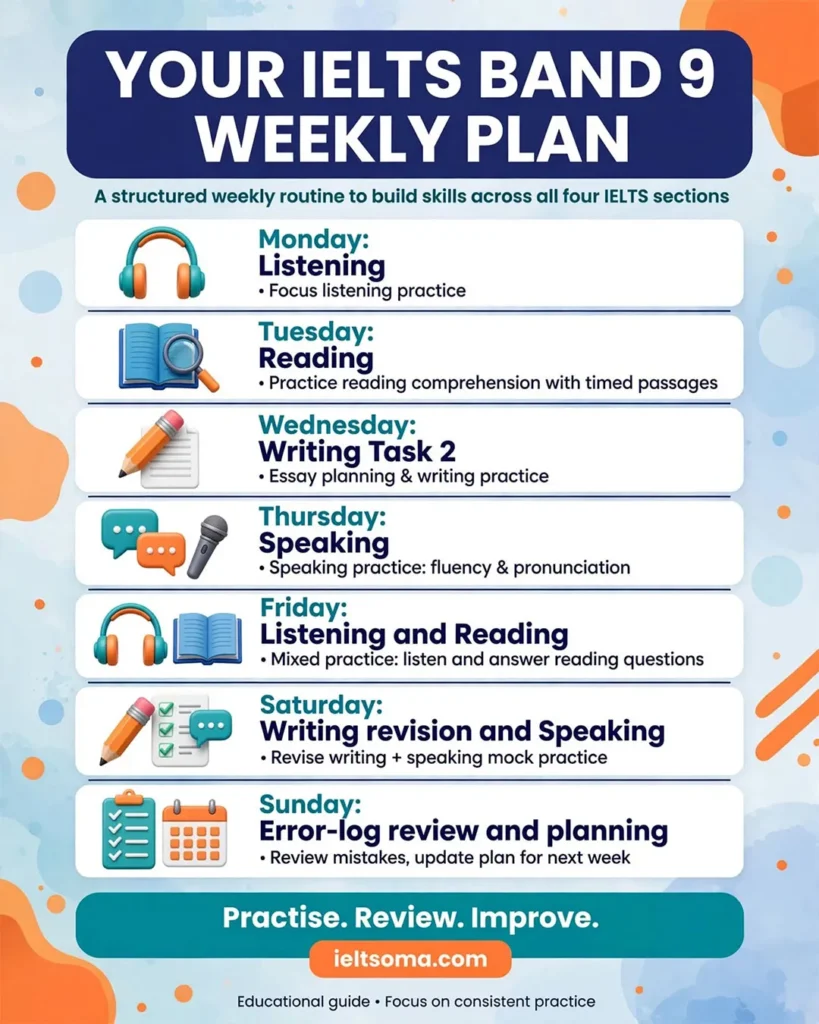
Use this sample schedule as a flexible template. Adjust the duration and emphasis to match your current level and available study time.
| Day | Main focus | Recommended activity |
|---|---|---|
| Monday | Listening | Complete a timed section and analyse errors |
| Tuesday | Reading | Practise difficult question types and locate evidence |
| Wednesday | Writing | Complete Task 2 and review the assessment criteria |
| Thursday | Speaking | Record Parts 1, 2 and 3 responses |
| Friday | Listening and Reading | Practise under timed conditions and review mistakes |
| Saturday | Writing and Speaking | Rewrite an essay and repeat a recorded speaking task |
| Sunday | Progress review | Review the error log and plan the next week |
Use official IELTS preparation materials for realistic practice. The official IELTS Academic sample questions and General Training sample questions are useful starting points.
If you are preparing for General Training, make sure you practise its specific Reading and Writing tasks rather than relying exclusively on Academic materials.
Frequently Asked Questions About IELTS Band 9
Is IELTS Band 9 difficult to achieve?
Yes. Band 9 represents expert-level performance and requires exceptional command of English. The challenge is not simply knowing advanced vocabulary; it is using English accurately, appropriately and consistently across different tasks.
How can I get Band 9 in IELTS?
Begin with a reliable assessment of your current level. Study the official band descriptors, identify your weakest skills, practice under realistic conditions and analyze every important error. For Writing and Speaking, obtain feedback that explains how to improve against the assessment criteria.
Can I achieve IELTS Band 9 without an English-speaking background?
Yes. IELTS assesses your English proficiency, not your nationality or where you learned the language. Candidates from any background can prepare towards Band 9, although the time required varies according to their current proficiency and learning needs.
Is Band 9 possible with a few weeks of preparation?
It may be realistic for someone already performing close to Band 9, but it is generally an ambitious target for a candidate with significant skill gaps. Use practice results and detailed feedback to set a realistic timeline rather than relying on a fixed number of weeks.
Do I need difficult vocabulary to achieve Band 9?
No. You need a broad vocabulary that you can use precisely and naturally. Accurate collocations, appropriate word choice and the ability to express subtle distinctions are more valuable than inserting obscure words into every response.
Can I get Band 9 in Speaking if I have an accent?
Yes. An accent does not automatically prevent a Band 9 Speaking score. Your pronunciation should make your speech easy to understand, with effective stress, rhythm and intonation. You do not need to imitate a particular native-speaker accent.
Is IELTS Band 9 the same as an overall Band 9?
No. An overall Band 9 is calculated from the average of your Listening, Reading, Writing and Speaking scores, rounded according to IELTS scoring rules. It does not necessarily mean you received Band 9 in each skill.
Should I take IELTS Academic or General Training for Band 9?
Choose the version that matches your purpose and the requirements of the organization requesting your result. Academic and General Training share the same Listening and Speaking tests, but their Reading and Writing tests differ.
Final Advice: Make Every Practice Session Count
IELTS Band 9 is a demanding target, but your preparation becomes more effective when you understand what the test measures and use that knowledge to guide your practice.
Develop accurate listening and reading habits, write with a clear purpose, speak naturally and review your weaknesses systematically. Use official materials, learn from detailed feedback and measure progress through consistent performance rather than isolated results.
Most importantly, do not confuse preparation with repetition. Completing another test is useful only when it helps you improve your understanding, language control or exam technique.
With a realistic plan and disciplined practice, you can work towards the highest level of IELTS performance while developing English skills that remain valuable well beyond the exam.
Further Reading:
- IELTS Band 7 to 8: What Needs to Change
- IELTS Band 6 to 7: A Practical Improvement Plan
- IELTS Score Not Improving? 9 Reasons You’re Stuck and How to Break Through