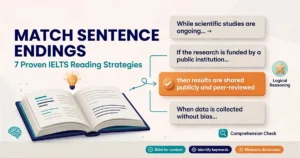
IELTS Reading Matching Sentence Endings questions can be deceptively difficult. You may understand the passage, recognise familiar vocabulary, and locate the relevant paragraph—yet still choose the wrong ending. The reason is simple: you must match meaning and grammatical structure, not just words that look similar.
In this question type, you receive a list of incomplete sentences and a separate list of possible endings. Your task is to match each sentence beginning with the ending that correctly completes its meaning according to the passage.
The strongest approach is to understand the sentence beginning, predict the information needed, locate the relevant passage section, and compare the available endings carefully.
This IELTS Reading Matching Sentence Endings strategy guide explains how the task works, how to eliminate distractors, and how to practise efficiently under exam conditions. You will also learn how to avoid common traps involving synonyms, partial matches, grammar, and misleading details.
Table of Contents
What Are IELTS Reading Matching Sentence Endings Questions?
IELTS Reading Matching Sentence Endings is a question type in which you match incomplete statements with the correct endings from a list. The answers are based on information in the reading passage, and you must choose the ending that completes each sentence accurately.
For example, you might receive these sentence beginnings:
- Researchers discovered that the new method…
- The experiment was repeated because…
- The findings suggest that…
You would then choose from a list of endings, such as:
A. …the original results were considered unreliable.
B. …produced more consistent measurements.
C. …the approach could be useful in other settings.
D. …required less equipment than expected.
E. …the participants preferred the older system.
Only the endings supported by the relevant passage information should be selected. An option may sound reasonable in general knowledge terms but still be incorrect if the passage does not support it.
How is this question type different from other IELTS Reading tasks?
Matching Sentence Endings differs from Matching Headings and Sentence Completion.
| Question type | What you need to do |
|---|---|
| Matching Sentence Endings | Connect sentence beginnings with the correct endings |
| Matching Headings | Identify the main idea of a paragraph or section |
| Sentence Completion | Complete a sentence using words from the passage, subject to the stated word limit |
| Matching Information | Locate paragraphs containing particular details or information |
The key distinction is that Matching Sentence Endings usually requires you to understand a specific relationship between two parts of a statement. You must identify what the passage says and ensure that the ending completes the beginning logically and grammatically.
7 Proven IELTS Reading Matching Sentence Endings Strategies
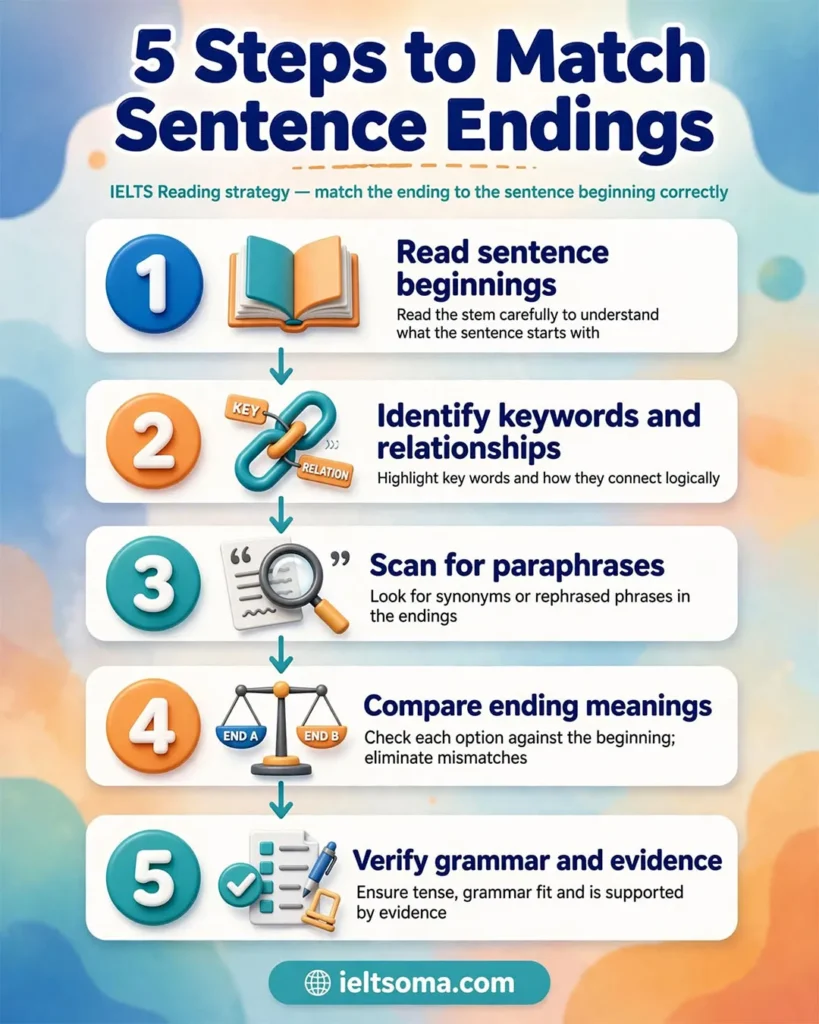
1. Read the Sentence Beginnings Before the Options
Start by reading all the sentence beginnings. Do not immediately study every ending in detail.
Your first task is to understand what each incomplete sentence is asking you to identify.
Pay attention to:
- The subject: Who or what is being discussed?
- The main verb: What happened, changed, caused, or was discovered?
- The relationship: Is the sentence likely to express a cause, result, contrast, purpose, or explanation?
- The grammatical structure: Does the beginning require a noun phrase, a verb phrase, or a complete clause?
For example:
The researchers changed the procedure because…
The word because signals a reason. You should look for an ending that explains why the researchers changed the procedure, not one that describes the final outcome.
Compare that with:
The revised procedure resulted in…
This beginning requires an outcome or consequence.
Expert tip: Underline the key subject and relationship in each sentence beginning. This gives you a clear search target when you return to the passage.
2. Predict the Meaning Before Reading the Endings
One of the most effective ways to improve accuracy is to predict what kind of information would logically complete each sentence.
Consider:
The museum introduced digital displays in order to…
Before looking at the options, you might predict a purpose such as improving access to information or helping visitors understand exhibits.
Your prediction does not need to match the exact wording in the passage. It simply establishes the meaning you are searching for.
This reduces the temptation to choose an ending merely because it contains familiar vocabulary.
However, keep your prediction flexible. The passage may explain an unexpected purpose, so your prediction should guide your search rather than determine the answer in advance.
3. Locate the Relevant Passage Using Keywords and Synonyms
Once you understand a sentence beginning, identify its most useful keywords. These may include names, technical terms, dates, distinctive nouns, or concepts that are likely to appear in the passage.
Do not rely exclusively on exact-word matching. IELTS Reading frequently paraphrases ideas.
For instance:
| Sentence wording | Possible passage wording |
|---|---|
| reduced expenses | lowered costs |
| improved accuracy | produced more reliable results |
| delayed the project | postponed the work |
| a lack of evidence | insufficient supporting data |
| changed their approach | adopted a different method |
These expressions are not interchangeable in every context, but they illustrate how the same idea can be expressed differently.
Scan the passage for distinctive terms first. Then read the surrounding sentences carefully to establish what the passage actually says.
Important: A keyword match is a clue, not proof. The correct ending must express the relevant meaning accurately.
4. Match the Meaning, Not Just Individual Words
This is the central skill in the IELTS Reading Matching Sentence Endings strategy.
An incorrect ending may repeat a word from the passage while changing the relationship between ideas. Another option may use completely different words but accurately paraphrase the information.
Consider this short practice passage:
The university introduced recorded lectures because several students could not attend the scheduled sessions. After the recordings became available, students reported that they found it easier to review complex explanations before examinations.
Sentence beginning:
The university introduced recorded lectures because…
Possible endings:
A. students wanted to stop attending classes altogether.
B. some students were unable to attend the scheduled sessions.
C. examinations had become more difficult than before.
D. the university intended to shorten every lecture.
The correct answer is B. It directly expresses the reason stated in the passage.
Option A might seem related to recorded lectures, but it introduces a claim the passage does not make. Option C refers to examinations, but that detail does not explain why the recordings were introduced.
When comparing endings, ask yourself:
- Does the passage support this idea?
- Does the ending preserve the original relationship between ideas?
- Does it introduce an unsupported claim?
- Does it change the meaning through words such as all, only, always, or never?
An option should not be selected simply because it sounds logical.
5. Check Grammar Before Confirming the Answer
A correct ending must fit the sentence grammatically as well as logically.
Suppose the sentence beginning is:
The main advantage of the new system was that it…
An ending beginning with because the operators… would not normally complete this sentence correctly without additional restructuring.
By contrast, an ending such as reduced the time needed to process applications may fit both the grammar and the meaning.
Check the following features:
- Subject–verb agreement: Does the completed sentence have the correct verb form?
- Verb patterns: Does the beginning require an infinitive, a gerund, or a particular clause structure?
- Articles and prepositions: Does the combination sound grammatically complete?
- Logical connection: Does the ending make sense after the complete beginning?
- Reference words: Do pronouns such as it, they, and these have a clear reference?
Grammar is particularly useful when two endings appear to express similar ideas. It can help eliminate an option that cannot fit the sentence correctly.
However, do not choose an answer based on grammar alone. More than one ending may be grammatically possible, so the passage must confirm the final choice.
6. Eliminate Distractors Systematically
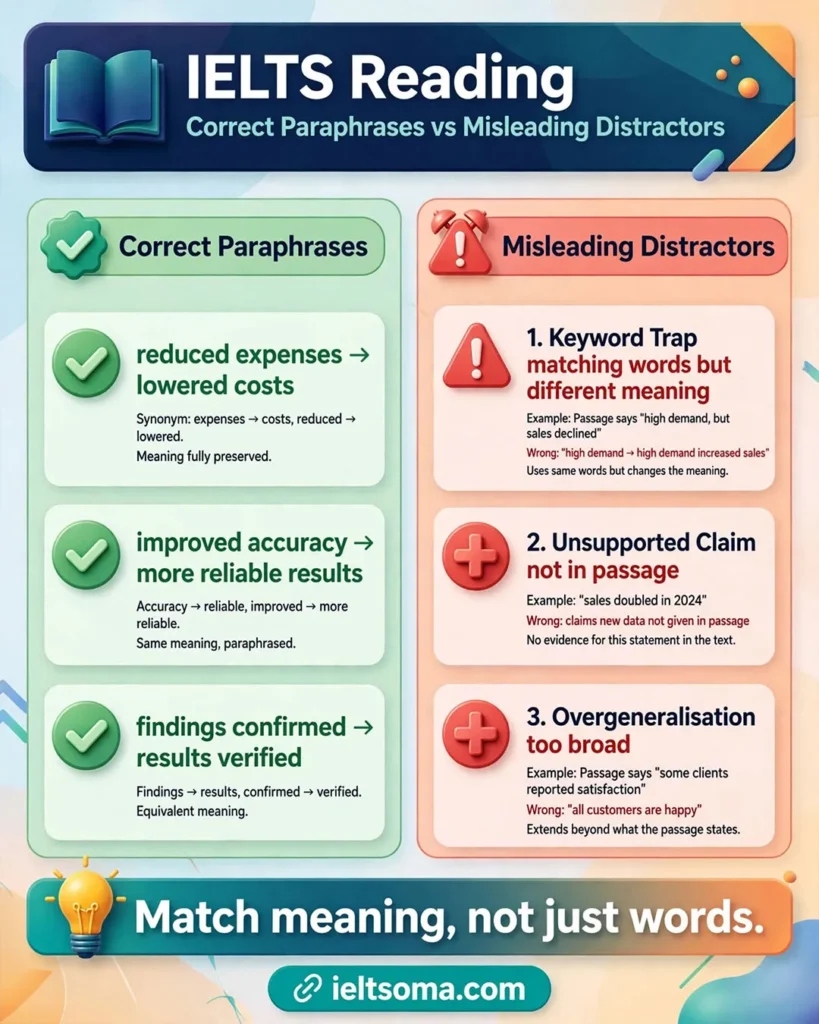
Distractors are incorrect options designed to look plausible. Some repeat passage vocabulary, while others describe related information without completing the sentence accurately.
Use a process of elimination rather than choosing the first attractive option.
| Type of distractor | Why it is wrong | How to identify it |
|---|---|---|
| Keyword trap | Repeats a word but changes the meaning | Compare the full idea, not one term |
| Partial match | Supports only part of the sentence | Check whether every key claim is supported |
| Wrong relationship | Gives a result instead of a reason, or vice versa | Identify the relationship required by the beginning |
| Unsupported detail | Adds information absent from the passage | Ask whether the text actually establishes the claim |
| Overgeneralisation | Turns a limited finding into a universal claim | Check words such as all, always, and never |
| Grammar mismatch | Does not fit the sentence structure | Read the completed sentence aloud mentally |
For example, if the passage says that a small trial improved performance in one laboratory, an ending claiming that the method improves performance in every workplace goes too far.
The option may contain the same central concept, but its claim is broader than the evidence.
Expert tip: Before selecting an ending, explain to yourself why the strongest alternative is wrong. This makes your decision more reliable and helps you recognise similar traps in future questions.
7. Use a Two-Pass Approach When Time Is Limited
Spending too long on one difficult match can cost you marks elsewhere.
A practical approach is to complete the easier matches first and return to uncertain ones later.
First pass
- Read the sentence beginnings.
- Identify the key idea in each.
- Locate the relevant passage sections.
- Match the endings you can confirm confidently.
- Mark uncertain questions for review.
Second pass
- Revisit the unanswered beginnings.
- Compare the remaining endings.
- Check grammar and logical relationships.
- Verify each choice against the passage.
- Transfer or review your answers according to the test format and instructions.
Do not assume that the longest or most complicated ending is incorrect. Likewise, do not choose a short ending simply because it appears easier to fit.
Your goal is accurate evidence-based matching, not guessing a pattern.
Step-by-Step Example: How to Match Sentence Endings in IELTS
The following example demonstrates the complete method.
Practice passage
For many years, scientists believed that the decline in the local bee population was mainly caused by habitat loss. However, a later study found that exposure to certain agricultural chemicals also affected the bees’ ability to navigate. The researchers concluded that protecting flowering habitats alone might not be sufficient to restore the population. They recommended further investigation into how different environmental pressures interact.
Sentence beginnings
- Earlier explanations for the decline in the bee population…
- The later study suggested that agricultural chemicals…
- Protecting flowering habitats alone…
- The researchers recommended further investigation because…
Possible endings
A. …could affect the bees’ navigation abilities.
B. …might not address every factor contributing to the decline.
C. …focused mainly on the loss of natural habitats.
D. …could help explain how environmental pressures work together.
E. …had already been proved to be the only cause of the decline.
Answers and explanations
1. C — focused mainly on the loss of natural habitats.
The passage says that scientists previously believed habitat loss was the main cause. Option C accurately paraphrases that earlier explanation.
Option E is incorrect because the passage does not say habitat loss was the only cause. In fact, the later study identified another factor.
2. A — could affect the bees’ navigation abilities.
The passage directly states that exposure to certain agricultural chemicals affected the bees’ ability to navigate.
The ending preserves the relationship and meaning without adding an unsupported claim.
3. B — might not address every factor contributing to the decline.
The researchers concluded that protecting flowering habitats alone might not be sufficient to restore the population. Option B captures that limitation.
Notice the importance of the word alone. The passage does not say that habitat protection is useless; it says that habitat protection by itself may be insufficient.
4. D — could help explain how environmental pressures work together.
The passage recommends further investigation into the interaction between different environmental pressures. Option D expresses this idea in different words.
The unused ending, E, is a distractor because it makes an absolute claim that the passage does not support.
What does this example teach you?
The correct answers depend on more than vocabulary recognition. You need to distinguish between earlier beliefs and later findings, identify the strength of a claim, and understand the relationships between ideas.
This is why reading the sentence around a keyword is often more useful than scanning for a matching word alone.
Common Mistakes in IELTS Reading Matching Sentence Endings
Even students with strong reading skills can lose marks through avoidable errors.
Choosing an ending because it repeats a keyword
A repeated word may indicate the right passage section, but it does not establish that the ending is correct. Check the entire statement against the text.
Reading the options before understanding the beginnings
If you study every ending without a clear search target, you may confuse similar options or waste time memorising unnecessary details.
Read the beginnings first, then use the endings to confirm the match.
Ignoring negative words and qualifiers
Words such as not, only, mainly, some, and all can change a statement significantly.
For example, some participants improved does not mean all participants improved.
Using your own knowledge instead of the passage
An answer may be scientifically reasonable or generally true but still be wrong for the question. Your answer must reflect the information presented in the text.
Assuming every ending will be used
Some versions of the task provide more endings than sentence beginnings. Follow the instructions on the test page rather than assuming that every option must be selected.
Spending too much time on one question
If you cannot establish a match after checking the relevant passage, move on temporarily and return later. A difficult question should not prevent you from answering several easier ones.
Confusing this task with Sentence Completion
Matching Sentence Endings generally asks you to select from provided options. Sentence Completion typically requires you to supply words from the passage within the stated word limit. Apply the instructions for the question type you actually receive.
How to Practise IELTS Reading Matching Sentence Endings Effectively
Improvement comes from reviewing the reasoning behind your answers, not simply completing more questions.
Practise in three stages
Stage 1: Accuracy without time pressure
Complete a small set of questions slowly. For every answer, identify the supporting passage sentence and explain why the selected ending fits.
Stage 2: Paraphrase recognition
Create a list of words and phrases that express similar ideas. For example:
- increase — rise, grow, expand
- cause — lead to, bring about, result in
- reduce — decrease, lower, cut
- evidence — findings, data, supporting information
- difficulty — obstacle, challenge, problem
Remember that synonyms depend on context. The aim is to recognise equivalent meanings, not to memorise lists mechanically.
Stage 3: Timed practice
Complete a full reading passage under realistic conditions. Record the time spent, the number of correct answers, and the type of mistake behind each incorrect response.
Keep an error log
Use a simple table to track recurring problems.
| Question | Error type | What went wrong? | Next action |
|---|---|---|---|
| 1 | Keyword trap | Matched a repeated word | Verify the complete meaning |
| 2 | Paraphrase | Missed an equivalent expression | Review synonyms in context |
| 3 | Grammar | Chose an incompatible ending | Check sentence structure |
| 4 | Overgeneralisation | Ignored some versus all | Check qualifiers carefully |
After several practice sessions, look for patterns. If most errors come from paraphrasing, focus on vocabulary in context. If you frequently choose endings that reverse cause and effect, practise identifying logical relationships.
Use official IELTS preparation materials
Practice with reliable sample questions and follow the instructions provided for each task. The official IELTS website is a useful starting point for understanding the test and accessing preparation resources:
Official IELTS preparation resources
Use practice questions to develop a repeatable method rather than memorising answer patterns.
How Much Time Should You Spend on Matching Sentence Endings?
There is no fixed time allocation that works for every IELTS Reading passage. The appropriate amount depends on the number of questions, their difficulty, and how quickly you can locate the relevant information.
As a practical training target, try to complete a short set of matching questions in approximately 5–8 minutes, then adjust based on your accuracy and the passage difficulty. This is a practice guideline, not an official IELTS timing rule.
Remember that IELTS Reading lasts 60 minutes for the entire test, including transferring answers where applicable. You must manage time across all question types rather than treating Matching Sentence Endings as an isolated task.
If a question takes too long, mark it mentally or on your working page as permitted by the test format, continue with the questions you can answer, and return when time allows.
Frequently Asked Questions
1. What is the best strategy for IELTS Reading Matching Sentence Endings?
Read the sentence beginnings, identify the key idea and grammatical structure, predict the type of information needed, and locate the relevant passage section. Compare the available endings and choose the one that matches both the meaning and grammar of the sentence.
2. How do you match sentence endings in IELTS Reading without guessing?
Use evidence from the passage. Identify the relevant sentence or group of sentences, compare the meaning with each option, and eliminate endings that introduce unsupported details or change the relationship between ideas. Grammar can help, but it should not replace textual evidence.
3. Do the words in the sentence endings match the passage exactly?
Not necessarily. IELTS Reading often uses paraphrasing, so an ending may express the same idea with different vocabulary. Look for equivalent meaning rather than expecting identical wording.
4. Are all the sentence endings used?
Not always. Some tasks provide more endings than sentence beginnings, leaving unused options. Read the instructions carefully and never assume that every ending must be selected.
5. Should I read the whole passage before answering Matching Sentence Endings questions?
You should understand the passage structure, but you do not always need to read every sentence in detail before starting. A practical method is to read the beginnings, scan for relevant keywords and paraphrases, and then read the surrounding passage carefully before confirming each match.
6. Can grammar help me choose the correct ending?
Yes. Grammatical structure can eliminate options that do not fit the sentence. However, several options may be grammatically possible, so you must also confirm that the passage supports the meaning.
7. What should I do if two endings seem correct?
Return to the passage and compare the exact claims. Look for differences in cause and effect, degree, timing, scope, and certainty. One ending may describe a related idea while the other accurately completes the sentence. Select the option supported by the text, not the one that merely sounds more natural.
8. Does Matching Sentence Endings appear in IELTS Academic and General Training?
IELTS Reading question types can vary between tests. Matching Sentence Endings may appear in IELTS Reading practice materials, but you should not assume that every test will contain this question type. Prepare for the full range of reading tasks relevant to your test.
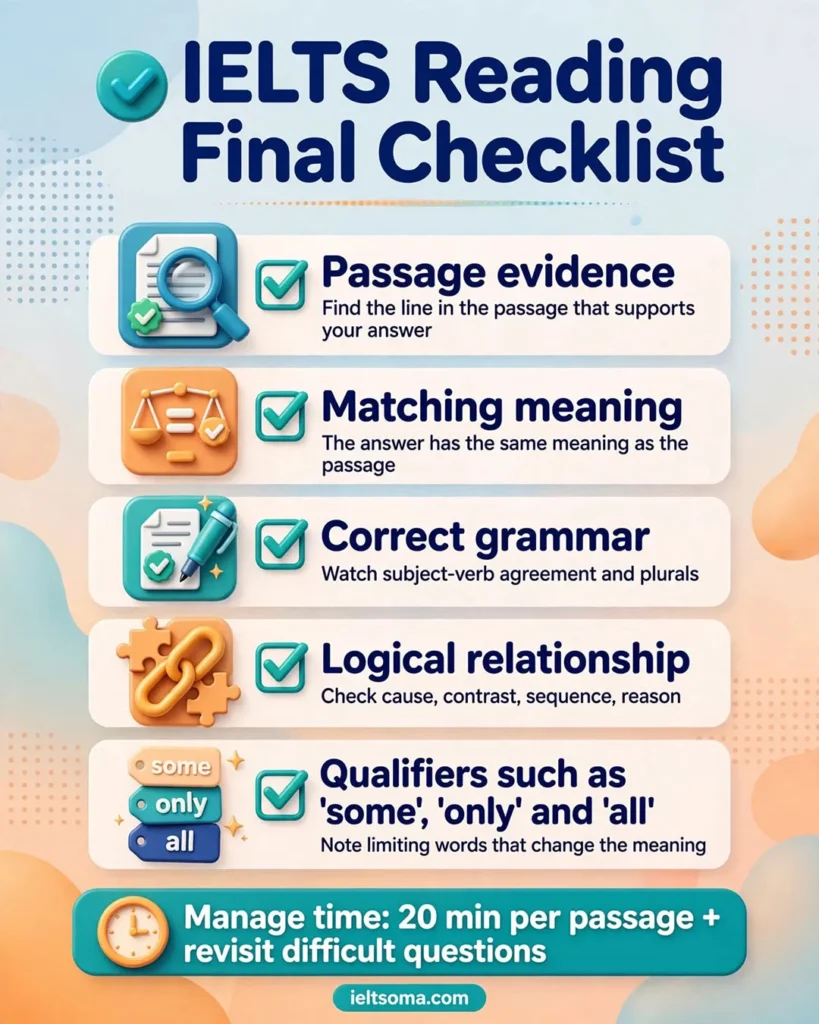
Final Checklist for IELTS Reading Matching Sentence Endings
Before submitting your answers, check that you have:
- Read each sentence beginning carefully.
- Identified the key subject and logical relationship.
- Recognised relevant keywords and paraphrases.
- Located supporting evidence in the passage.
- Checked grammar and sentence structure.
- Eliminated distractors containing unsupported claims.
- Paid attention to negatives and qualifying words.
- Followed the question instructions.
- Managed your time without getting stuck on one match.
The most reliable IELTS Reading Matching Sentence Endings strategy is to understand the beginning, locate the evidence, compare the meaning, and confirm the grammar. Do not let familiar vocabulary persuade you to choose an ending that the passage does not support.
Practise this process consistently, review your mistakes, and focus on accuracy before speed. With a clear method, matching sentence endings becomes a more manageable part of IELTS Reading preparation.
Further Reading: