Preparing for IELTS can feel overwhelming. There are four skills to improve, different question types to understand, vocabulary to learn, grammar to practise, and a target band score that may determine your next academic, professional or migration step.
The good news is that you do not need to study everything at once.
A Perfect IELTS Study Plan gives your preparation structure. Instead of spending hours randomly completing practice questions, you can identify your weaknesses, practise the right skills, measure your progress and gradually become more confident.
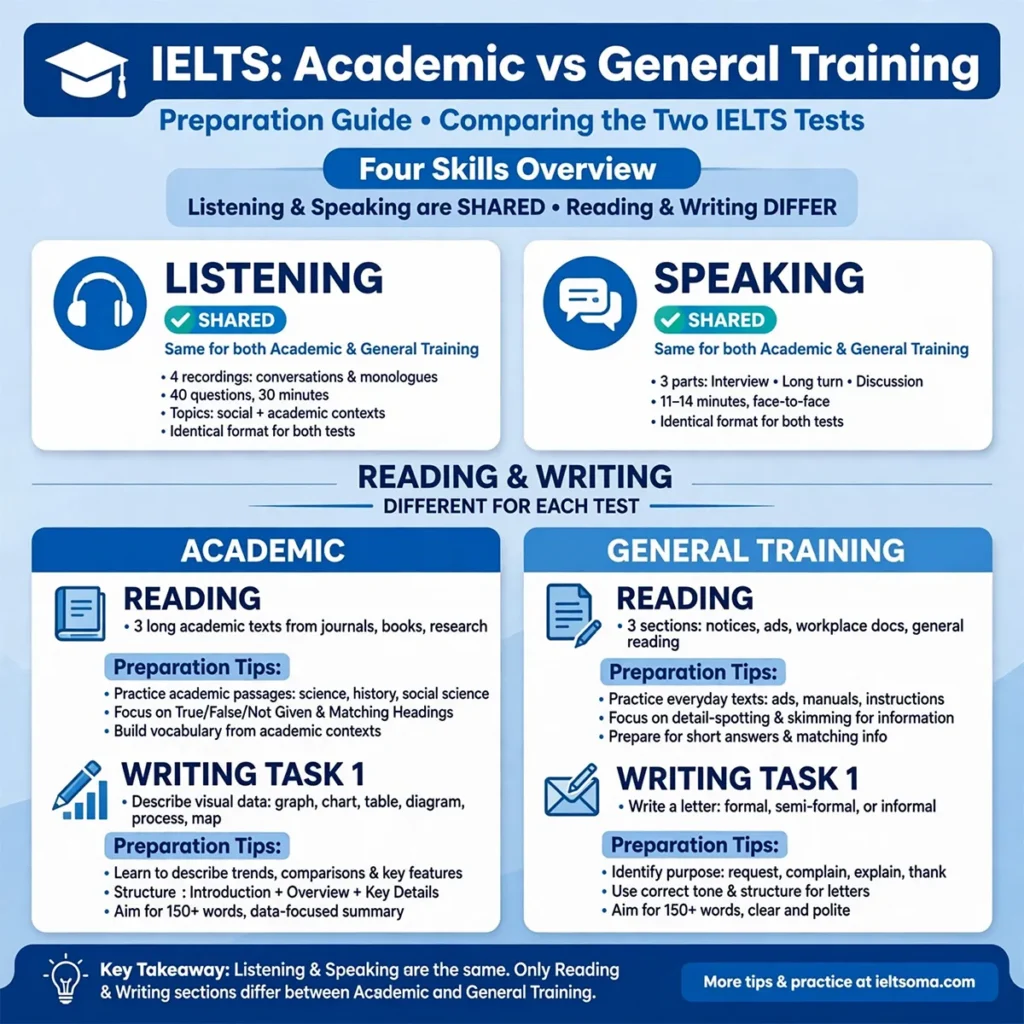
Whether you are preparing for IELTS Academic or IELTS General Training, the most effective approach is to combine English-language development with test-specific practice. Listening and Speaking are the same in both tests, while Reading and Writing differ.
This guide gives you a practical seven-step strategy, a 30-day timetable and specific advice for all four IELTS skills.
Table of Contents
What Makes a Perfect IELTS Study Plan?
A Perfect IELTS Study Plan is not simply a timetable showing two hours of study every day.
It should answer five important questions:
- What band score am I targeting?
- What is my current level?
- Which IELTS skills are weakest?
- What should I practise each day?
- How will I measure improvement?
Your plan should also balance skill development, IELTS strategies, timed practice and error analysis.
For example, completing five Reading tests without reviewing your mistakes may be less useful than completing two tests and carefully analysing every incorrect answer.
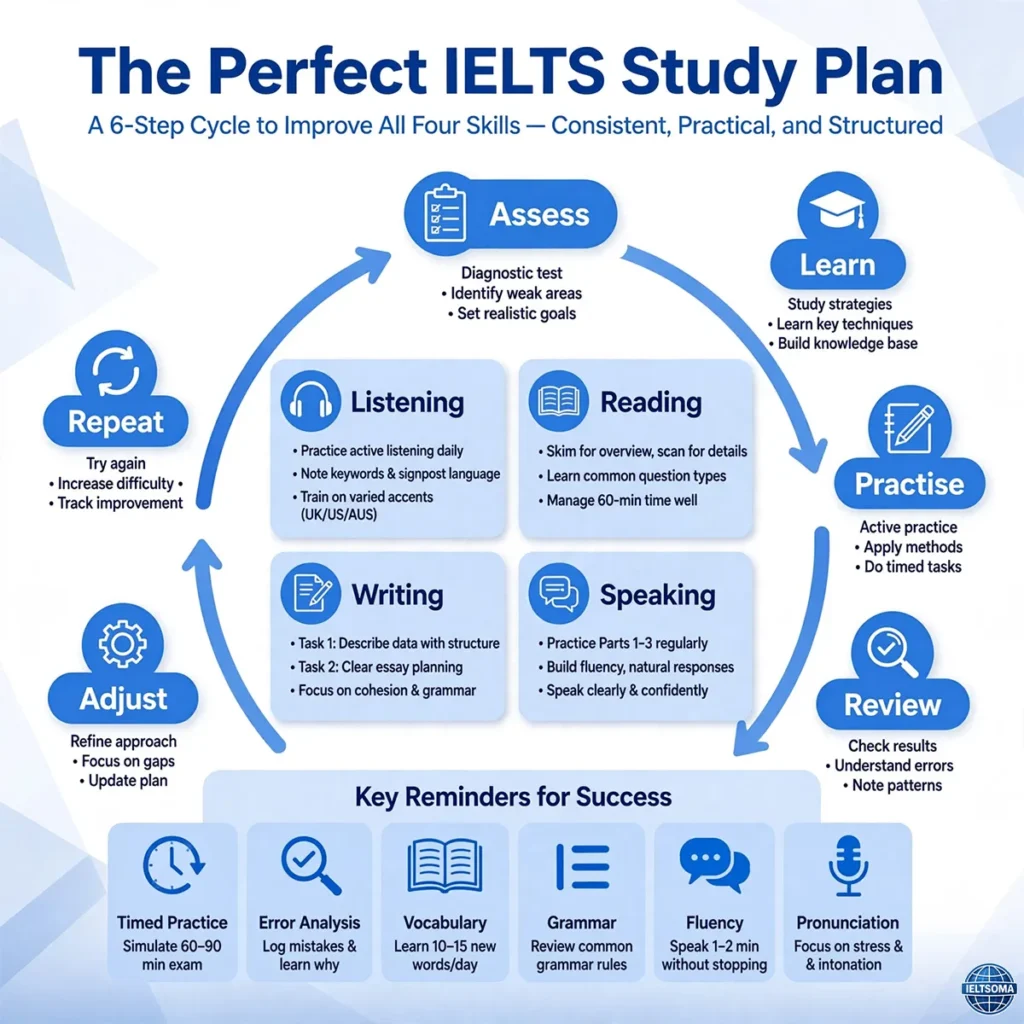
A strong plan therefore follows this cycle:
Assess → Learn → Practise → Review → Adjust → Repeat
That cycle is the foundation of a Perfect IELTS Study Plan.
Know Your IELTS Test Before You Study
Before creating your schedule, make sure you know which IELTS test you are taking.
IELTS has four sections:
- Listening
- Reading
- Writing
- Speaking
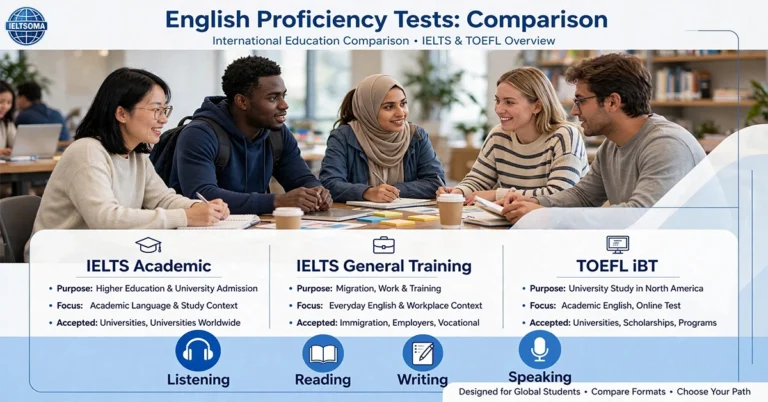
IELTS Academic is generally intended for people seeking undergraduate or postgraduate study or certain professional registration purposes. IELTS General Training is commonly used for migration, work and other purposes where the test type is appropriate. Always check the requirements of the organisation or immigration authority you are applying to before booking your test.
Listening and Speaking are the same in Academic and General Training.
Reading and Writing are different.
The IELTS Listening test has four parts and 40 questions. Reading has 40 questions and is completed in 60 minutes. Writing takes 60 minutes, while Speaking normally takes 11–14 minutes.
Understanding this structure prevents you from following the wrong preparation materials.
Step 1: Set a Clear IELTS Target Score
The first step in your Perfect IELTS Study Plan is deciding exactly what score you need.
Do not simply say, “I want a high band.”
Write down a specific target.
For example:
Overall target: Band 7.0
Listening target: 7.5
Reading target: 7.0
Writing target: 6.5
Speaking target: 7.0
Your required score may be different for each skill, depending on the requirements of your university, employer, professional body or immigration pathway.
Once you know the target, work backwards.
If your current level is around Band 6.0 and you need Band 7.0, your study plan should focus on the gaps preventing you from reaching Band 7.
This is much more effective than trying to improve every aspect of English equally.
Step 2: Find Your Current IELTS Level
The second part of your Perfect IELTS Study Plan is a realistic starting assessment.
Before spending weeks studying, complete a suitable practice test under timed conditions.
Do not look at the answers while working.
Record your performance in each skill.
For Writing and Speaking, use the official assessment criteria and, where possible, obtain qualified feedback. IELTS Writing and Speaking are assessed using specific criteria including task achievement or response, coherence and cohesion, lexical resource, grammatical range and accuracy; Speaking also assesses pronunciation.
Create a simple table:
| Skill | Current Level | Target | Main Weakness |
|---|---|---|---|
| Listening | 6.5 | 7.5 | Distractors |
| Reading | 6.0 | 7.0 | Timing |
| Writing | 6.0 | 7.0 | Idea development |
| Speaking | 6.5 | 7.0 | Fluency |
Your own results should determine where you spend the most time.
If Reading is already your strongest skill, you may not need to spend half of every study session on it.
Step 3: Build Your Weekly IELTS Study Schedule
A Perfect IELTS Study Plan should be realistic enough to follow consistently.
For many candidates, studying for around 1.5–3 hours per day can provide a manageable structure, but the right amount depends on your current English level, target score, available time and test date.
Consistency matters more than creating an impossible timetable.
A balanced weekly schedule could look like this:
| Day | Main Focus | Suggested Activities |
|---|---|---|
| Monday | Reading + Vocabulary | Timed passage, error analysis, vocabulary review |
| Tuesday | Writing | Task practice, grammar correction |
| Wednesday | Listening + Speaking | Listening test, shadowing, speaking practice |
| Thursday | Reading + Grammar | Question types, grammar exercises |
| Friday | Writing + Vocabulary | Essay practice, lexical improvement |
| Saturday | Full Practice | Timed test and detailed review |
| Sunday | Review | Correct mistakes and light English exposure |
Avoid spending every day completing full mock tests.
Practice tests are valuable, but improvement comes from understanding why you made mistakes.
Step 4: Master IELTS Listening and Reading
Listening and Reading can improve significantly when you understand your recurring errors.
IELTS Listening
In Listening, you hear each recording once, and the test uses a range of accents. The four parts contain 40 questions in total.
Your study routine should include:
- Predicting possible answers before listening
- Identifying keywords in questions
- Listening for paraphrases
- Recognising distractors
- Checking spelling
- Reviewing incorrect answers
- Practising different English accents
- Completing timed practice
Do not only check whether your answer was correct.
Ask:
Why did I get it wrong?
Perhaps you missed a word, misunderstood a paraphrase, followed a distractor, or made a spelling mistake.
Record the reason in an error log.
IELTS Reading
Reading requires both comprehension and time management.
Academic Reading contains three sections, while General Training Reading also contains three sections with different text types and purposes.
Practise:
- Skimming for general meaning
- Scanning for specific information
- Identifying paraphrases
- Understanding question instructions
- Locating evidence in the text
- Managing difficult questions
- Moving on when necessary
Do not try to understand every word.
IELTS Reading is a test of reading ability under time pressure, not a vocabulary translation exercise.
Step 5: Improve IELTS Writing
Writing deserves a major place in your Perfect IELTS Study Plan because it requires you to produce organised, relevant and accurate language under time pressure.
Both Academic and General Training Writing contain two tasks. Task 2 requires at least 250 words and carries greater weight than Task 1 in the Writing score calculation. Academic Task 1 involves visual information, while General Training Task 1 involves responding to a situation, usually through a letter.
A productive Writing routine includes four stages:
1. Plan
Spend a few minutes identifying the task, position, main ideas and supporting details.
2. Write
Follow a clear structure and answer the question directly.
3. Check
Look for grammar, spelling, punctuation and vocabulary problems.
4. Analyse
Identify repeated weaknesses and create exercises specifically for them.
Do not memorise complete essays.
Instead, learn how to develop ideas, organise paragraphs, use appropriate vocabulary and adapt your response to the question.
For higher bands, accuracy matters as much as variety. A complicated sentence is not useful if it repeatedly creates grammatical errors.
Step 6: Build IELTS Speaking Confidence
Speaking should appear throughout your Perfect IELTS Study Plan, not only during the final week.
You do not need a conversation partner every time.
Try recording yourself answering IELTS-style questions.
Listen again and check:
- Did I answer the question directly?
- Did I hesitate excessively?
- Did I repeat the same words?
- Did I explain my ideas?
- Did I use a suitable range of vocabulary?
- Were my sentences grammatically accurate?
- Was my pronunciation easy to understand?
The Speaking test contains three parts and assesses fluency and coherence, lexical resource, grammatical range and accuracy, and pronunciation.
For Part 2, practise speaking continuously for the required long-turn format.
For Part 3, practise giving opinions, explaining reasons, comparing ideas and discussing broader issues.
A useful technique is:
Answer → Explain → Example → Result
For instance, give your opinion, explain why you hold it, provide an example and then discuss the consequence or result.
Step 7: Practise, Review and Adjust
The final step is what turns an ordinary timetable into a Perfect IELTS Study Plan.
Your plan should change as you improve.
Keep an error notebook with categories such as:
- Vocabulary
- Grammar
- Spelling
- Reading question types
- Listening mistakes
- Writing organisation
- Speaking fluency
- Pronunciation
Review this notebook every week.
If the same error appears repeatedly, it deserves more attention.
Do not measure progress only by how many practice tests you complete.
Measure:
- Accuracy
- Timing
- Recurring errors
- Writing quality
- Speaking fluency
- Confidence under test conditions
Official IELTS preparation materials can help you become familiar with the format, question types and timed conditions.
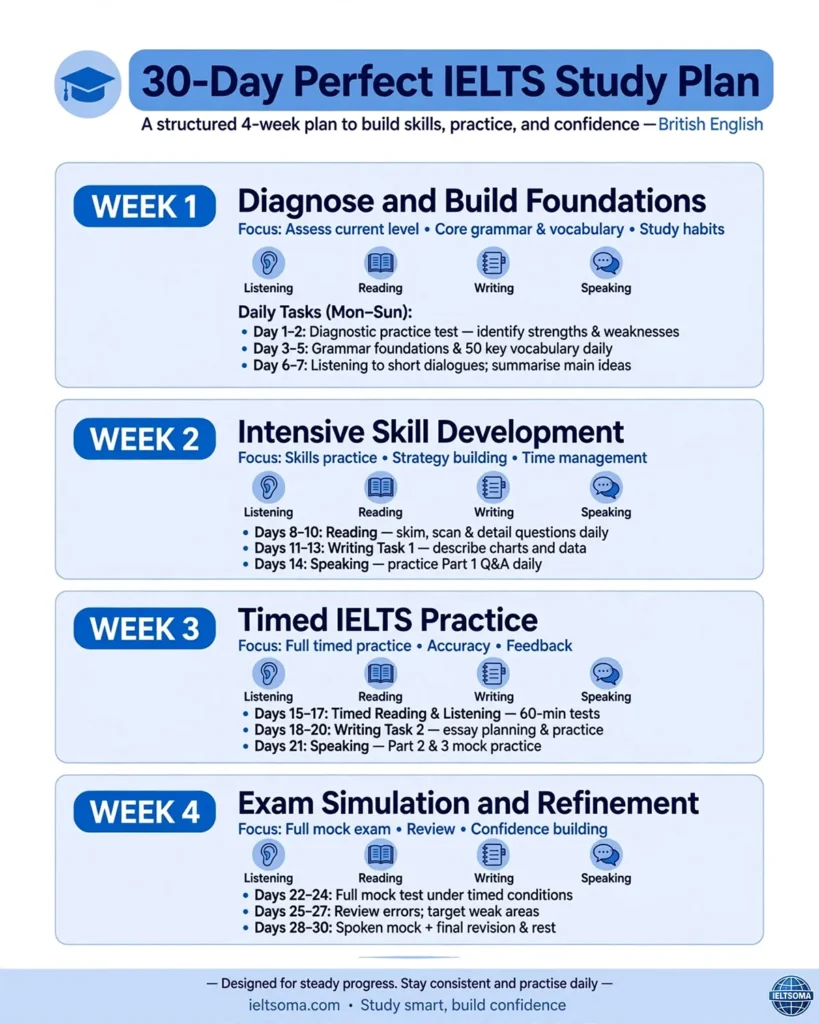
A 30-Day Perfect IELTS Study Plan
If your test is approximately one month away, use this four-week structure.
Week 1: Diagnose and Build Foundations
Focus on understanding the test and identifying weaknesses.
Complete one baseline practice test.
Then spend the rest of the week improving fundamental problems in grammar, vocabulary, Reading, Listening, Writing and Speaking.
Do not rush into daily full tests.
Your goal is to understand where you are starting.
Week 2: Intensive Skill Development
Increase focused practice.
Complete targeted Reading and Listening exercises.
Write several responses across the week.
Practise Speaking every day, even if only for 15–20 minutes.
Review your errors immediately after practice.
At this stage, quality matters more than quantity.
Week 3: Timed IELTS Practice
Begin introducing more realistic test conditions.
Complete timed sections and at least one full practice test.
Practise switching between skills without losing concentration.
For Writing, practise managing the 60-minute session effectively.
For Reading, focus heavily on timing.
For Listening, practise staying focused even when you miss an answer.
Week 4: Exam Simulation and Refinement
Your final week should focus on performance rather than trying to learn everything from scratch.
Complete realistic mock tests.
Review your error log.
Practise your weakest question types.
Continue Speaking practice.
Review useful vocabulary and grammar patterns, but avoid trying to memorise huge lists.
In the final days, prioritise sleep, routine, confidence and familiarity with the test process.
Academic vs General Training Study Plan
Your Perfect IELTS Study Plan should change depending on your test type.
If You Are Taking IELTS Academic
Give additional attention to:
- Academic Reading texts
- Academic Writing Task 1
- Formal academic vocabulary
- Describing graphs, charts and diagrams
- Complex arguments and ideas
- University-related contexts
Academic Reading uses texts from sources such as books, journals, magazines, newspapers and online resources, while Academic Writing Task 1 requires you to describe visual information.
If You Are Taking IELTS General Training
Focus more heavily on:
- Everyday Reading texts
- Workplace-related texts
- General Training Writing Task 1
- Letter-writing conventions
- Practical vocabulary
- Real-world communication
General Training Reading includes everyday and workplace-related material, while Writing Task 1 requires a response to a situation.
Remember that Listening and Speaking preparation can be shared between the two test types.
Common IELTS Study Plan Mistakes
Even a well-designed Perfect IELTS Study Plan can fail if you use it incorrectly.
Studying Without a Target
Without a target band, it is difficult to measure meaningful progress.
Taking Too Many Mock Tests
Tests identify problems. They do not automatically fix them.
Ignoring Writing Feedback
Writing mistakes can become habits if nobody identifies them.
Memorising Answers
Memorised responses may not suit the actual question and can prevent natural communication.
Learning Vocabulary Without Context
Knowing a word does not necessarily mean knowing how to use it correctly.
Learn vocabulary through phrases, examples and real contexts.
Changing Your Plan Every Day
Constantly switching resources can create the feeling of studying without producing measurable improvement.
Give your strategy enough time to work, then adjust it based on evidence.
How to Know When You Are Ready
You are approaching readiness when your practice performance is consistently close to your required score under realistic conditions.
Look for consistency rather than one unusually good result.
Ask yourself:
- Can I complete Reading within the time limit?
- Can I maintain concentration throughout Listening?
- Can I complete both Writing tasks within 60 minutes?
- Can I speak naturally without relying on memorised answers?
- Do I understand my most common mistakes?
- Are my recent practice results close to my target?
If the answer is yes, your preparation is moving in the right direction.
If your results remain below the required score, use your error analysis to decide what needs additional attention.
FAQs About a Perfect IELTS Study Plan
How many hours should I study IELTS each day?
There is no universal number of hours that guarantees a particular band score. Your ideal schedule depends on your current English level, target band, test date and available time. Consistent, focused practice is more useful than an unrealistic timetable.
What is the best IELTS study plan for Band 7?
A Band 7 preparation plan should combine all four skills with regular timed practice and detailed error analysis. Give extra attention to the skills where your current performance is furthest from the required level.
Can I prepare for IELTS in 30 days?
Yes, 30 days can provide a structured preparation period, particularly if you already have a reasonable level of English. Your starting level and target score will determine how much improvement is realistic.
Should I study IELTS every day?
Regular practice can help you maintain momentum. However, studying every day does not mean completing full tests every day. Mix intensive practice with review, speaking practice, vocabulary development and lighter English exposure.
Is Academic IELTS harder than General Training?
The two tests have different Reading and Writing content and purposes, so it is better to prepare specifically for the test you need. Listening and Speaking are the same in Academic and General Training.
How can I improve IELTS Writing quickly?
Start by identifying your recurring weaknesses. Practise planning, paragraph development, grammar, vocabulary and task response. Write under timed conditions and obtain useful feedback where possible.
How can I improve IELTS Speaking at home?
Record yourself answering IELTS-style questions. Listen to your responses and identify hesitation, repetition, grammar, vocabulary and pronunciation issues. Regular short sessions can be more manageable than occasional long sessions.
How often should I take an IELTS mock test?
Use mock tests strategically. A full test is most valuable when you can analyse your performance afterwards. Taking a test without reviewing your mistakes can limit the benefit.
What should I do if my IELTS score stops improving?
Return to your error log and identify the specific reason for the plateau. You may need to change your practice method rather than simply increasing the number of practice questions.
Conclusion
The best Perfect IELTS Study Plan is not the one with the most hours, the largest vocabulary list or the greatest number of mock tests.
It is the plan that matches your target score, current level, weaknesses and available time.
Start by assessing yourself. Set a measurable target. Build a realistic weekly schedule. Practise all four skills. Review every important mistake. Then adjust your preparation based on evidence.
Whether you are taking IELTS Academic or General Training, the goal is the same: arrive at the test knowing exactly how to approach each section and confident that your preparation has addressed your weaknesses.
Use your study time deliberately, practise under realistic conditions and keep improving one measurable skill at a time.
That is what makes a Perfect IELTS Study Plan genuinely useful.
Further Reading: