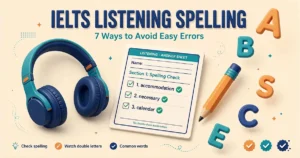
IELTS Listening spelling errors can cost you marks even when you understand the recording perfectly. You might identify the correct person, recognise the right place, or hear the exact answer to a question — yet lose the mark because one letter is missing or a word ending is incorrect.
The good news is that spelling is a trainable skill. You do not need to memorize an entire dictionary to improve your IELTS Listening score. You need to recognize common spelling patterns, anticipate the types of words likely to appear, and develop a reliable checking routine.
This guide explains how to avoid IELTS Listening spelling mistakes, apply practical spelling rules for IELTS Listening answers, and correct the common spelling errors IELTS candidates make under exam pressure.
Table of Contents
Why IELTS Listening Spelling Matters
In IELTS Listening, you answer 40 questions across four parts. Each correct answer earns one mark, and your total score is converted into a band score.
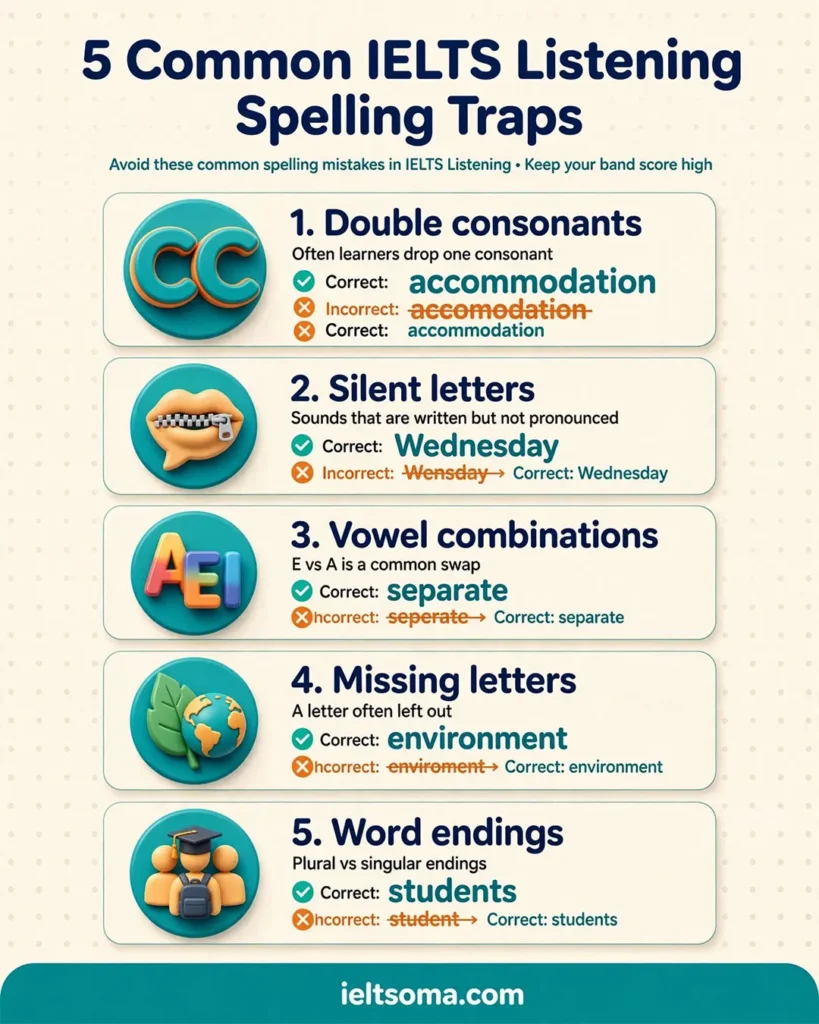
Spelling matters because an answer that communicates the correct meaning may still be marked incorrect if it is spelt wrongly. For example, writing accomodation instead of accommodation can cost you a mark.
Consider these examples:
| What you hear | Incorrect answer | Correct answer |
|---|---|---|
| Accommodation | Accomodation | Accommodation |
| Restaurant | Resturant | Restaurant |
| February | Febuary | February |
| Necessary | Neccessary | Necessary |
| Wednesday | Wensday | Wednesday |
These errors are particularly frustrating because they are often avoidable. You may already know the word but write it incorrectly when listening, reading the question, and managing your time simultaneously.
The key principle: IELTS Listening tests your ability to identify the correct answer, not merely to understand its meaning. Accurate spelling, appropriate grammar, and compliance with the word limit all matter.
1. Identify the Words Most Likely to Cause Spelling Problems
Not every English word presents the same difficulty. Some words are challenging because they contain silent letters, repeated consonants, unfamiliar vowel combinations, or unexpected endings.
Start by building a personal list of words you frequently misspell.
Common IELTS Listening spelling mistakes
| Word | Common mistake | What to remember |
|---|---|---|
| Accommodation | Accomodation | Double c and double m |
| Necessary | Neccessary | One c, two s letters |
| Separate | Seperate | The middle vowel is a |
| Definitely | Definately | The ending is -itely |
| Environment | Enviroment | Include the n after o |
| Government | Goverment | Include the n after r |
| Restaurant | Resturant | Remember the au sequence |
| Wednesday | Wensday | The written form includes d |
| February | Febuary | Remember the r after b |
| Business | Buisness | The vowel order is u-i |
| Beginning | Begining | Double n |
| Address | Adress | Double d |
| Successful | Succesful | Double s in the middle and at the end |
| Library | Libary | Include the first r after b |
| Privilege | Priviledge | The ending is -lege |
These are useful practice words, but do not assume that IELTS uses a fixed list of difficult spellings. The vocabulary varies according to the recording and question context.
Create a personal error log
Every time you make a spelling mistake during practice, record three things:
- The word you wrote incorrectly.
- Its correct spelling.
- The reason you made the error.
For example:
- Incorrect: enviroment
- Correct: environment
- Reason: I omitted the second n.
Review your error log regularly. Correcting repeated mistakes is usually more productive than memorising long lists of words you already spell correctly.
2. Learn Practical Spelling Rules for IELTS Listening Answers
English spelling has exceptions, so no single rule will solve every problem. However, several patterns can help you spell common words more accurately.
Rule 1: Pay attention to double consonants
Some words contain two identical consonants, and leaving one out is a frequent spelling error.
Examples:
- accommodation
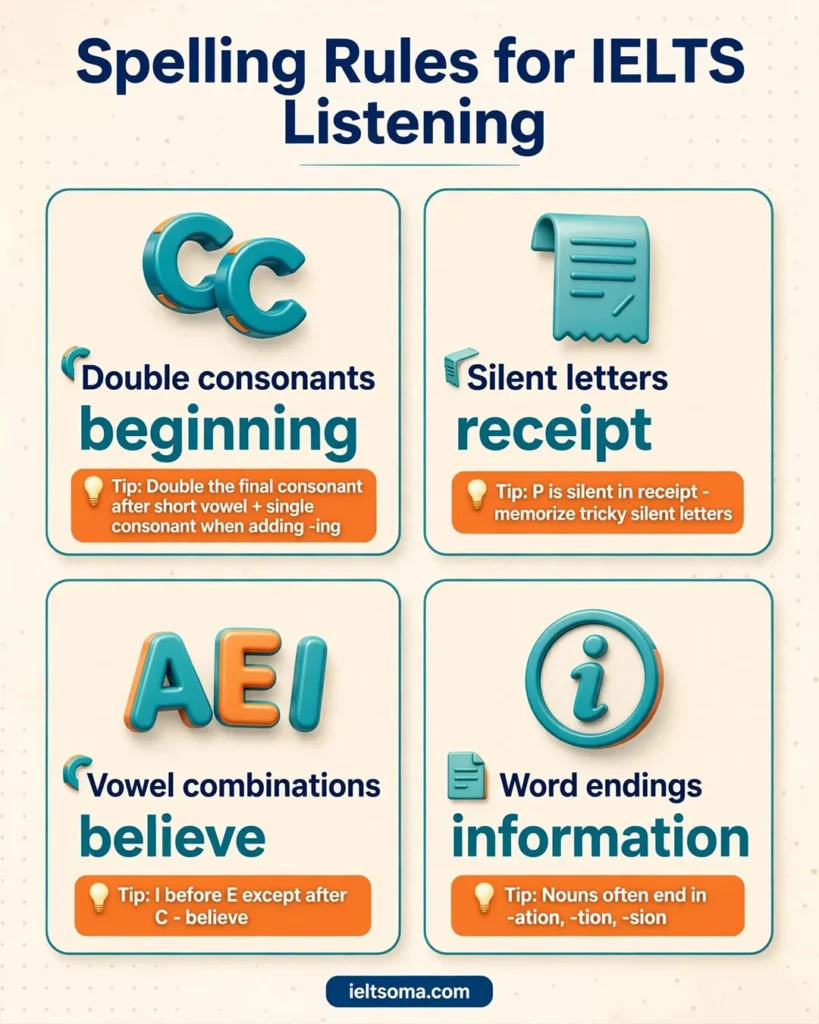
- beginning
- address
- necessary
- committee
- successful
When learning a word, notice the double letters deliberately. For example, remember accommodation as ac-com-mo-da-tion rather than treating it as one long sequence.
Do not automatically double a consonant whenever you hear a short vowel. Learn the spelling of each word and use the pattern as a memory aid.
Rule 2: Watch for silent letters
A letter may appear in the written word without being clearly pronounced.
Examples include:
- Wednesday
- island
- knowledge
- receipt
- answer
In receipt, for example, the p is silent. In island, the s is silent.
Practise these words by listening to their pronunciation and then writing them from memory. This helps you connect the sound of a word with its conventional spelling.
Rule 3: Distinguish between similar vowel combinations
Vowel combinations can be difficult because different spellings may produce similar sounds.
Examples:
- separate, not seperate
- friend, not freind
- believe, not beleive
- receive, not recieve
- their, not thier
The familiar mnemonic “i before e, except after c” has many exceptions. Do not rely on it as an absolute rule. Learn high-frequency words individually and practise them in context.
Rule 4: Remember common word endings
Word endings can be difficult to hear clearly, especially when the speaker talks quickly.
Pay attention to endings such as:
- -tion: information, application, reservation
- -sion: discussion, decision, television
- -ment: appointment, government, environment
- -able: available, comfortable, suitable
- -ance / -ence: attendance, difference, experience
For instance, a booking conversation might mention an appointment, while a university discussion might refer to an application. Knowing the topic helps you anticipate the word, but you must still listen for the actual answer.
Rule 5: Do not confuse British and American spelling
IELTS accepts standard British and American English spellings where both forms are legitimate. The important point is to use a correct, recognised spelling rather than an invented hybrid.
Examples include:
| British English | American English |
|---|---|
| Colour | Color |
| Centre | Center |
| Organise | Organize |
| Travelling | Traveling |
| Catalogue | Catalog |
Your spelling should be consistent where possible. For IELTS Listening, however, do not assume that every word has a different British and American form. Many words are spelt identically in both varieties.
Rule 6: Listen for singular and plural forms
Sometimes the spelling error is not in the main word but in its ending.
Compare:
- student / students
- room / rooms
- ticket / tickets
- class / classes
- opportunity / opportunities
The difference between room and rooms can determine whether your answer matches the recording and the question.
Listen carefully for plural markers and use the question’s grammar as a check. If the sentence reads “The building has three ___”, a plural noun is likely to be required. Nevertheless, the recording and the complete context must support your answer.
3. Use the Question to Predict the Type of Answer
One of the most effective ways to reduce spelling errors is to understand what kind of word the question requires before the recording begins.
Consider this question:
Complete the sentence using ONE WORD AND/OR A NUMBER.
The student must submit the application before ______.
Before listening, you can predict that the answer may be a day, date, or time expression. If the recording discusses a deadline, you can focus on that information instead of trying to remember every sentence.
Here are further examples:
| Question context | Likely answer type | What to check |
|---|---|---|
| Name of the street | Proper noun | Exact spelling |
| Cost of the course | Number or amount | Digits and currency context |
| Date of the appointment | Date | Day, month, and format required |
| Type of accommodation | Noun | Correct word and singular/plural form |
| Reason for the delay | Noun or noun phrase | Grammar and word limit |
| Name of the lecturer | Proper noun | Listen for the spelling if provided |
Prediction helps you focus, but it does not justify guessing. Wait for the relevant information and confirm the answer against the recording.
Example: A common accommodation error
Question: The student will stay in university ______.
Recording: “We can offer accommodation in the university residence halls.”
Possible answer: accommodation
Incorrect answer: acommodation
The context tells you what type of word is needed. Your spelling knowledge ensures that you write it correctly.
4. Handle Names, Addresses, and Place Names Carefully
Names and addresses are common sources of difficulty because you may not be familiar with them.
A speaker might mention a street called Ashfield Road, a person named Katherine, or a centre called Riverside. Familiar-sounding names can have several spellings, so do not automatically choose the version you know best.
What to do when you hear a name
- Listen for the full name before deciding how to write it.
- Pay attention to any spelling provided explicitly in the recording.
- Use the surrounding context to distinguish between similar-sounding words.
- Check the completed answer against the question.
- If the speaker spells the name letter by letter, follow those letters carefully.
For example, the names Sara and Sarah may sound identical in ordinary conversation. If the recording explicitly spells the name, follow that information. If it does not, use the evidence available rather than assuming one spelling is universally correct.
Expert tip: Do not spend so much time analysing one unfamiliar name that you miss the next answer. Make your best evidence-based choice, then continue listening.
5. Avoid Losing Marks During the Answer-Transfer Process
The way you enter your answers depends on whether you take IELTS on paper or on computer.
In paper-based IELTS Listening, you transfer your answers to the answer sheet during the allocated transfer time. In computer-delivered IELTS, you enter answers directly on the screen and have a short period at the end to review them.
In both formats, use your final review to check spelling, grammar, and word limits.
A practical checking routine
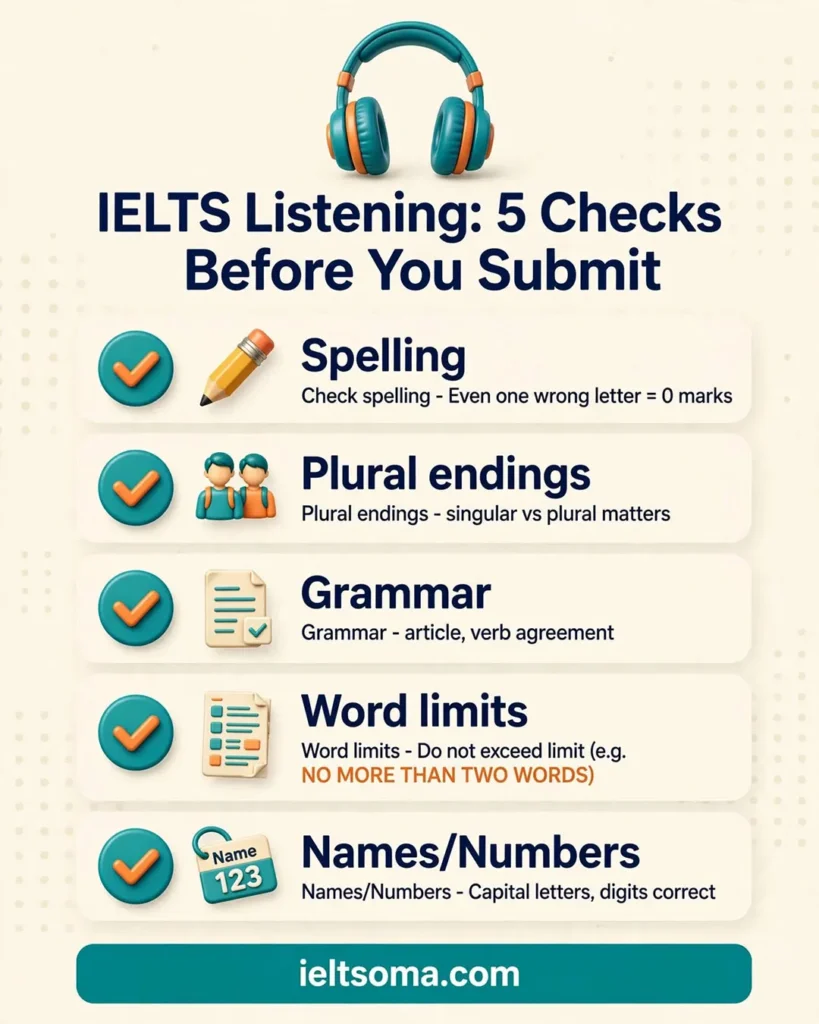
Check 1: Read the question again.
Does the answer fit the sentence or question logically?
Check 2: Check the spelling.
Look for omitted letters, repeated consonants, and incorrect vowel combinations.
Check 3: Check the ending.
Did you write student when the recording requires students? Did you omit an -s, -ed, or another ending?
Check 4: Check the word limit.
If the instruction says “NO MORE THAN TWO WORDS AND/OR A NUMBER”, an answer that exceeds the permitted limit can be marked incorrect.
Check 5: Check numbers and names.
Confirm that you have not reversed digits or confused a similar-sounding name with another word.
Avoid changing an answer merely because you suddenly feel uncertain. Make changes when you identify a concrete reason, such as a spelling error or a mismatch with the question.
6. Practise with Common Spelling Errors in IELTS
The following exercises help you identify and correct spelling errors before they become habits.
Exercise 1: Correct the spelling
Each word below contains one spelling error. Write the correct form.
- Accomodation
- Goverment
- Resturant
- Neccessary
- Enviroment
- Begining
- Seperate
- Febuary
- Buisness
- Succesful
Answers
- Accommodation
- Government
- Restaurant
- Necessary
- Environment
- Beginning
- Separate
- February
- Business
- Successful
Do not simply read the answers and move on. Write each correct word from memory, then compare it with the answer key.
Exercise 2: Complete the IELTS-style notes
Read the notes and choose the correctly spelt answer from the options.
Questions 1–5
Complete the notes below. Write ONE WORD ONLY for each answer.
Course registration
- Students must submit the application before the ______.
- The course includes a visit to the local ______.
- A confirmation email will be sent after successful ______.
- Students should bring their student ______.
- The college provides affordable ______ near the campus.
Options:
- deadline / dead line
- musuem / museum
- regestration / registration
- ID / identification card
- accomodation / accommodation
Answer key
- Deadline
- Museum
- Registration
- ID
- Accommodation
These are spelling and answer-format exercises, not a substitute for a listening recording. In the actual test, you must identify the information from the audio and obey the stated word limit.
Exercise 3: Build a five-minute spelling routine
Practise for five minutes each day:
- Minute 1: Review five words from your error log.
- Minute 2: Read the words aloud and notice difficult sounds.
- Minute 3: Cover the list and write each word from memory.
- Minute 4: Check the spelling and correct every mistake.
- Minute 5: Use the words in short sentences or IELTS-style notes.
Repeat the words you get wrong the following day. Once a word becomes consistently accurate, replace it with a more difficult one.
7. Common Mistakes That Cost IELTS Listening Marks
Even candidates with strong English vocabulary can lose marks through careless habits.
Mistake 1: Writing what you think you heard
A familiar word may come to mind before the speaker finishes. If you commit too early, you may miss a correction or clarification.
Better approach: Listen to the complete phrase and use the context to confirm the answer.
Mistake 2: Ignoring word endings
A missing plural -s or an incorrect verb ending can make an otherwise accurate answer wrong.
Better approach: Check the recording, the question, and the sentence grammar together.
Mistake 3: Overlooking the word limit
A long answer may contain the correct information but still break the instructions.
Better approach: Read the word-limit instruction before every question set and keep answers concise.
Mistake 4: Assuming proper names have only one spelling
Several names may share the same pronunciation.
Better approach: Use any spelling information supplied in the recording and avoid unsupported assumptions.
Mistake 5: Memorising words without testing yourself
Recognising a word on a list is easier than spelling it under exam pressure.
Better approach: Practise dictation, cover-and-write exercises, and timed IELTS Listening questions.
Mistake 6: Trying to correct every answer while the recording continues
Repeatedly revisiting earlier answers can distract you from new information.
Better approach: Write a provisional answer, move on, and review it when you have a suitable opportunity.
8. A Seven-Day Plan to Improve IELTS Listening Spelling
A short, structured plan can help you turn spelling practice into a habit.
| Day | Main focus | Practice task |
|---|---|---|
| Day 1 | Personal weaknesses | Create a list of 20 misspelt words |
| Day 2 | Double consonants | Practise words such as accommodation and beginning |
| Day 3 | Silent letters | Dictate words such as Wednesday and receipt |
| Day 4 | Vowels and word endings | Practise separate, believe, and application |
| Day 5 | Names and numbers | Complete timed note-completion exercises |
| Day 6 | Full listening practice | Complete a section and review every incorrect answer |
| Day 7 | Error correction | Retest your personal spelling list and compare results |
Keep track of your results. For example, if you make eight spelling errors in your first practice session and only three in a later session of comparable difficulty, you have evidence that your accuracy is improving.
Do not judge progress by one test alone. Record spelling errors separately from errors caused by misunderstanding the recording, missing information, or exceeding the word limit. This will help you identify the most useful next step.
Frequently Asked Questions
1. Does IELTS Listening penalize spelling mistakes?
Yes. A spelling error can cause an answer to be marked incorrect, even when the intended meaning is clear. Use the standard spelling of the word and check your answer before submitting it.
2. Which spelling mistakes are common in IELTS Listening?
Candidates often misspell words with double consonants, silent letters, unusual vowel combinations, and difficult endings. Examples include accommodation, necessary, separate, Wednesday, and environment. Your own error log will reveal which words require the most attention.
3. Are British and American spellings both accepted in IELTS Listening?
Recognized British and American spelling variants are generally accepted where both are valid. Use a standard spelling and avoid mixing forms incorrectly. If a proper name is explicitly spelt in the recording, reproduce the spelling provided.
4. Do capital letters matter in IELTS Listening answers?
Correct capitalization is good practice, especially for names, places, and the beginning of sentences. However, capitalization alone is not generally the main issue when answers are assessed. Focus first on the correct word, spelling, grammar, and answer instructions.
5. Should I write answers in capital letters?
In paper-based IELTS Listening, writing answers in capital letters can make them easier to read. On the computer-delivered test, enter answers clearly in the response fields. Follow the test interface and instructions, and do not confuse capitalization with spelling accuracy.
6. How can I improve spelling quickly for IELTS Listening?
Identify your most frequent errors, practice writing words from memory, complete listening dictations, and review mistakes after every practice test. Short, regular sessions are more useful than memorizing long lists without testing yourself.
7. What should I do if I cannot spell a word during the test?
Use the sounds, surrounding context, and any clues in the question to make the most informed choice you can. Do not dwell on one answer and miss the next. Review it later if time permits.
8. Is spelling more important than understanding the recording?
Both matter. You must identify the correct information and express it in an acceptable written answer. Excellent spelling cannot compensate for a wrong answer, and excellent comprehension may not earn a mark if the answer is spelt incorrectly.
Final Checklist for IELTS Listening Spelling
Before submitting your answers, ask yourself:
- Have I checked the spelling of unfamiliar words?
- Have I included necessary double letters and silent letters?
- Have I checked plural forms and other word endings?
- Have I followed the word limit?
- Have I written names and numbers accurately?
- Have I avoided changing correct answers without a reason?
The most effective way to improve IELTS Listening spelling is to turn every mistake into a specific learning task. Identify the error, learn the correct spelling, practise it from memory, and test it again in a listening exercise.
You do not need perfect spelling across every English word to improve your IELTS score. You need reliable habits, targeted practice, and a careful final check. Build these skills into your preparation, and you can reduce avoidable errors and protect marks you have worked hard to earn.
Keep practising with IELTSOMA: combine spelling drills with full Listening practice so that accuracy becomes automatic under exam conditions.
Useful Links Related to IELTS Listening: