IELTS Listening Sentence Completion questions test your ability to understand spoken English, identify specific information, and complete sentences accurately using words from a recording. To answer them successfully, you must predict the missing information, recognise paraphrasing, follow the recording in sequence, and obey the word limit.
Many candidates understand most of a recording but still lose marks because they miss a key word, write an incorrect grammatical form, or exceed the permitted number of words. The solution is not simply to listen harder. It is to use a systematic approach before, during, and after listening.
This guide explains an effective IELTS Listening sentence completion strategy, with practical examples, step-by-step techniques, common mistakes, and practice questions to help you improve your accuracy.
Table of Contents
What Is IELTS Listening Sentence Completion?
In IELTS Listening Sentence Completion, you are given sentences containing gaps. You listen to a recording and complete each gap with information you hear.
The missing information may include:
- A person’s name or a place
- A date, time, or number
- A noun or noun phrase
- An adjective or descriptive word
- A verb or another grammatically appropriate word
- A short phrase containing more than one word, if the instructions permit it
For example:
Recording information: “The workshop will take place on Thursday, and participants should arrive at nine fifteen.”
Question: The workshop will take place on ______.
Answer: Thursday
You do not need to reproduce the entire sentence from the recording. You need to identify the information that completes the printed sentence correctly.
Sentence completion may appear in different parts of the IELTS Listening test. The recording could involve everyday conversations, a discussion about an arrangement, a monologue, or an academic-style talk. The context changes, but the fundamental skill remains the same: identify the required information and record it accurately.
IELTS Listening Sentence Completion: Understand the Rules
Before practising a strategy, understand the instructions. They determine how many words you can write and what counts as an acceptable answer.
A question may say:
NO MORE THAN ONE WORD AND/OR A NUMBER
This means your answer may contain:
- One word
- One number
- One word and one number, if the wording permits it
Another question may say:
NO MORE THAN TWO WORDS
In that case, you can write one or two words, but not three.
The exact instruction on your question paper takes priority. Never assume that every sentence completion task has the same word limit.
Why the word limit matters
Suppose the recording says, “The meeting will be held in the main conference room.”
The question reads:
The meeting will be held in the ______.
If the instruction is NO MORE THAN TWO WORDS, main conference room would exceed the limit because it contains three words. However, conference room might fit grammatically if the question and recording support that answer.
Do not shorten an answer arbitrarily. Select the words that accurately complete the sentence while satisfying the instruction.
Remember that hyphenated expressions, numbers, and other answer formats should be handled according to the official test instructions and the answer requirements. When practising, follow the convention used by your test material.
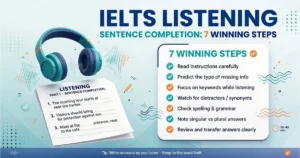
The 7-Step IELTS Listening Sentence Completion Strategy
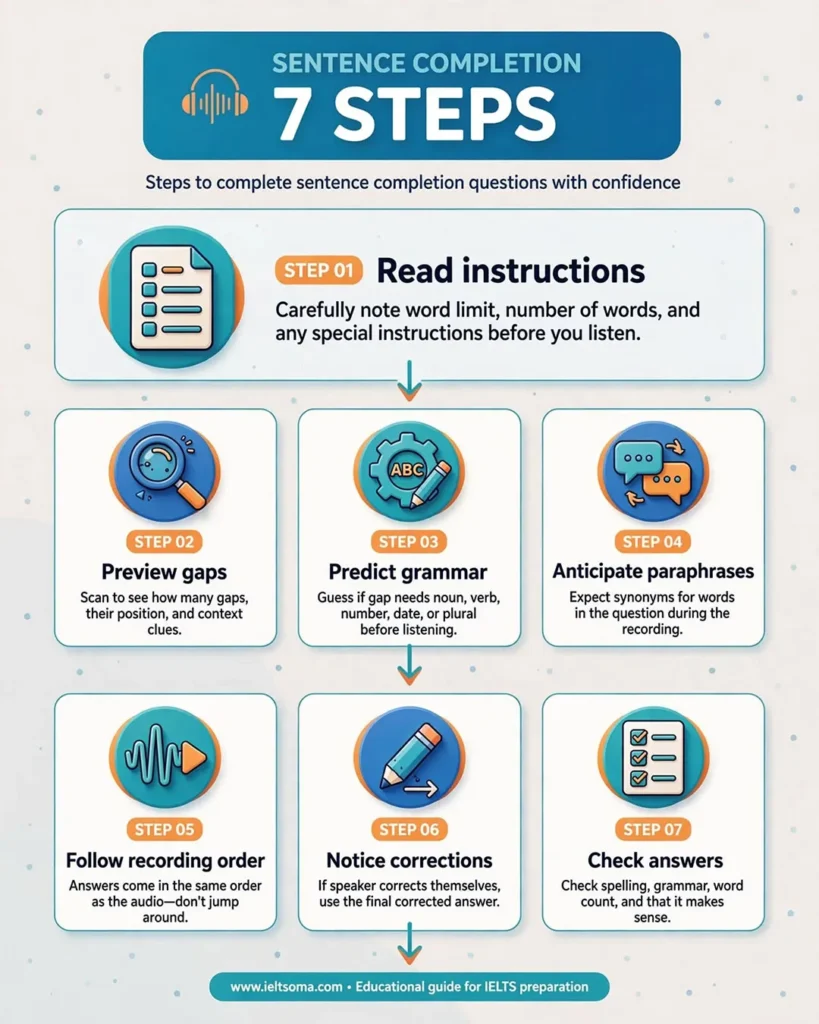
The most reliable approach combines prediction, focused listening, grammatical awareness, and careful checking. Use the following steps every time you practise.
Step 1: Read the instructions first
Before examining individual gaps, identify the maximum number of words permitted.
Underline or mentally note phrases such as “ONE WORD ONLY” or “NO MORE THAN TWO WORDS AND/OR A NUMBER”.
This prevents you from writing a correct piece of information in an invalid form.
For example, if the answer is “student accommodation” but the instructions allow only one word, you must determine whether the recording and sentence support a valid one-word answer. You cannot ignore the limit simply because the longer phrase sounds better.
Expert tip: Make word-limit checking part of your routine rather than something you remember only after listening.
Step 2: Preview the sentences and identify the gaps
Use the time before the recording starts to read the questions carefully. Do not attempt to memorise every sentence. Instead, identify what each gap requires.
Consider this question:
Applicants must submit their ______ before the deadline.
The word “their” suggests that a noun or noun phrase is likely to follow. Possible answers might include “applications”, “documents”, or “forms”.
These are predictions, not final answers. The recording determines which option is correct.
Now consider:
Applicants must submit their documents by ______.
The gap is likely to require a time, date, or another expression indicating a deadline.
The goal is to predict the type of information, not to guess the exact answer.
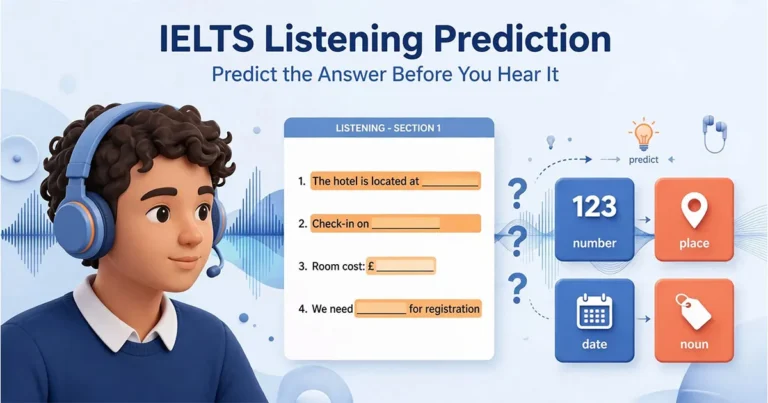
Step 3: Use grammar to predict the answer
Grammar helps narrow down the possibilities before you hear the recording.
Look at the words immediately before and after the gap.
| Sentence structure | Likely answer type | Example |
|---|---|---|
| The lecture begins at ______. | Time or number | 10:30 |
| Students must bring their ______. | Plural or singular noun, depending on context | notebooks |
| The building is located near the ______. | Noun or noun phrase | station |
| The new system is more ______. | Adjective | efficient |
| Visitors are advised to ______ early. | Base-form verb | arrive |
These patterns are useful clues, but they are not absolute rules. A sentence may allow more than one grammatical possibility, so keep listening for the actual information.
Also check singular and plural forms. If the sentence requires a plural noun, writing a singular form may make the answer incorrect even when the meaning is close.
Step 4: Predict meaning, not just vocabulary
One of the biggest mistakes in IELTS Listening is waiting for the exact words printed in the question.
IELTS often tests your ability to recognise paraphrasing. The speaker may express the same idea using different vocabulary or a different sentence structure.
For example:
Question: The course is suitable for people with ______ experience.
Recording: “You don’t need to have worked in this field before joining the course.”
The speaker does not repeat the phrase “without experience”. You must understand the meaning and select an answer that fits the printed sentence and the information given.
Depending on the exact wording of the question, a suitable answer might be “no previous” if the word limit and grammar allow it. The key is to understand the relationship between the spoken statement and the sentence on the page.
Before the recording begins, ask yourself:
- What information is missing?
- What related words might the speaker use?
- Could the speaker express this idea indirectly?
- Which details would distinguish the correct answer from similar information?
This prepares you to recognise the answer even when the vocabulary changes.
Step 5: Follow the recording in order
In most IELTS Listening tasks, answers follow the order of the recording. Use the sequence of the questions to maintain your place.
As you listen:
- Keep your eyes on the current question.
- Listen for the relevant idea rather than one specific word.
- Record the answer as soon as you are reasonably confident.
- Move your attention to the next gap.
- If you miss an answer, continue listening instead of dwelling on it.
The fifth point is especially important. Spending too long trying to recover a missed answer can cause you to miss the next two.
If you are uncertain, make a provisional note when practising and continue. Return to it during the available checking time if the test format permits.
Step 6: Listen for corrections and changes
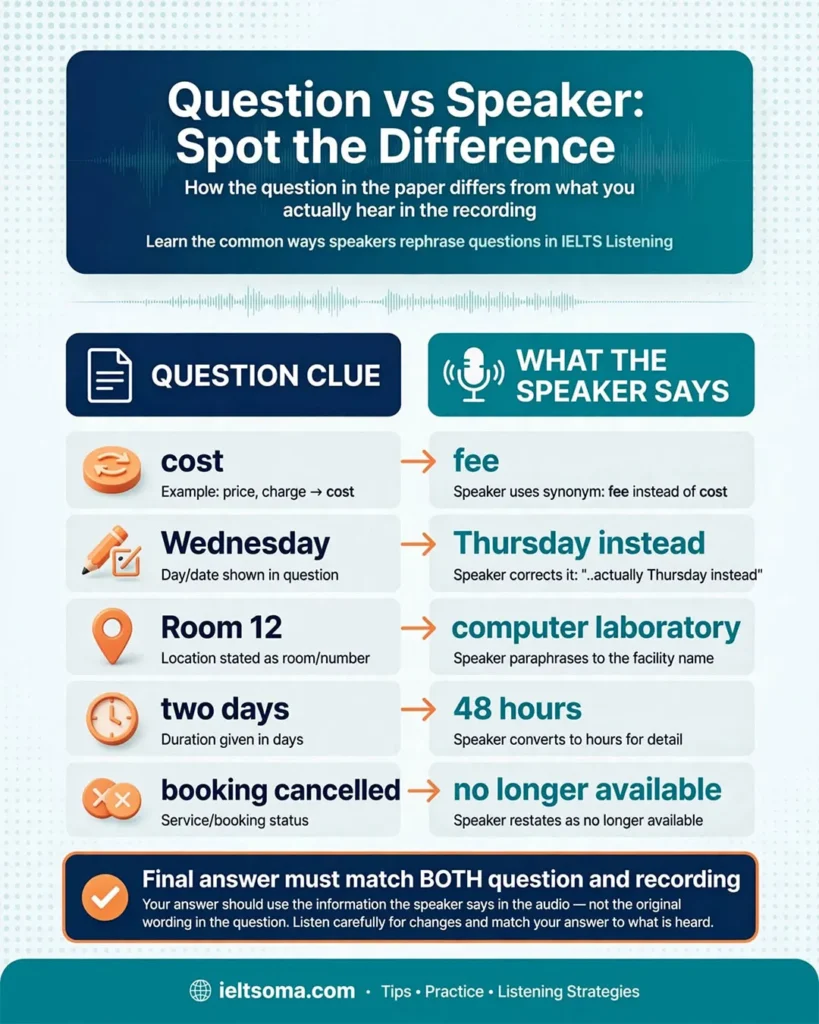
Speakers sometimes mention one detail and then correct or replace it.
For example:
“The original appointment was on Tuesday, but we’ve moved it to Thursday.”
If the question asks for the new appointment day, the answer is Thursday, not Tuesday.
Other changes may involve prices, dates, room numbers, meeting places, or arrangements.
Listen for expressions such as:
- “Actually…”
- “Sorry, I meant…”
- “We’ve changed it to…”
- “Instead…”
- “Rather than…”
- “The original plan was…, but…”
These expressions can signal that the first detail is no longer correct.
Do not automatically select the first relevant word or number you hear. Determine which information answers the question.
Step 7: Check grammar, spelling, and word limits
After the recording, use the checking time to review your answers.
For each gap, ask:
- Does the answer make sense in the completed sentence?
- Is the singular or plural form correct?
- Is the spelling accurate?
- Have I followed the word limit?
- Have I copied the intended number, date, or name correctly?
- Does the answer reflect the final information in the recording?
For example:
Question: The library closes at ______.
Your answer: nine o’clock
If the instruction allows NO MORE THAN TWO WORDS, your answer may exceed the permitted limit depending on the test’s counting convention. A valid answer such as “nine” may be more appropriate if it accurately conveys the recorded information and fits the question.
Do not add words simply to make an answer sound more natural. The answer must be accurate, concise, and compliant with the instructions.
How to Answer Sentence Completion IELTS Listening Questions Under Pressure
Knowing the strategy is one thing; applying it while the recording continues is another. Use these techniques to improve your timing and concentration.
Scan all the questions before listening
If time allows, read the entire set of sentences rather than focusing exclusively on the first gap. This gives you a general idea of the topic and helps you anticipate the progression of information.
You might notice that the first three gaps concern a course location, schedule, and fee. That context prepares you to listen for practical details.
Do not spend so long analysing one gap that you fail to preview the others.
Mark keywords that identify meaning
Choose one or two meaningful words around each gap. These are your reference points when the recording begins.
For example:
The museum offers reduced admission to ______.
Useful clues include “museum”, “reduced admission”, and the group of people who qualify.
The speaker might say “children”, “school groups”, or “people under sixteen”. The correct answer depends on the exact question and the information in the recording.
Avoid translating every sentence
If you mentally translate every spoken word into your first language, you may fall behind. Focus on the meaning of the sentence and the information needed for the gap.
Practise recognising common expressions, dates, prices, directions, and paraphrases directly in English. This makes it easier to process information at normal speaking speed.
Use the context without inventing answers
Context is useful for predicting the answer type, but it cannot replace evidence from the recording.
Suppose a sentence asks for the name of a transport service. You may expect “bus”, “train”, or “taxi”, but you must listen for the actual service mentioned.
A plausible guess is not necessarily a correct answer.
Common IELTS Listening Sentence Completion Mistakes
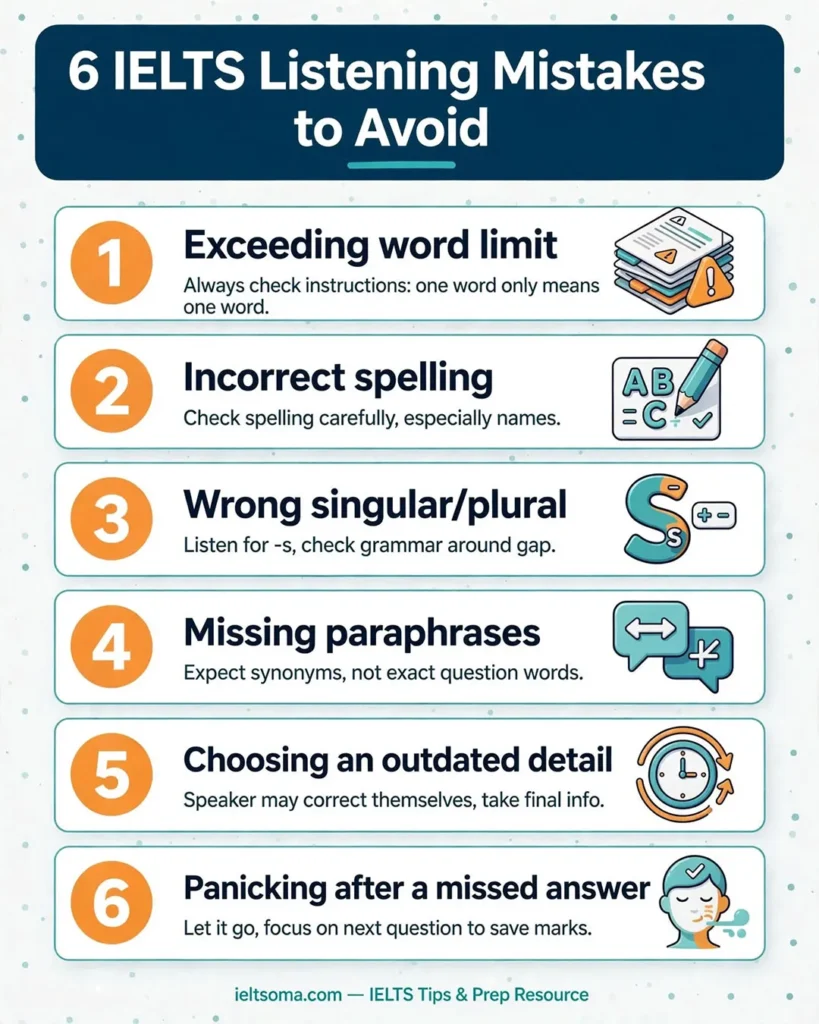
Even candidates with strong listening skills can lose marks through avoidable errors.
1. Writing too many words
This is a straightforward mistake. A response can contain the correct information but fail to follow the instructions.
Solution: Check the word limit before listening and count the words in each answer when reviewing.
2. Choosing a word that does not fit grammatically
Suppose the question reads:
The new facilities are particularly ______ for international students.
The recording describes the facilities as “useful”. Writing “use” would not complete the sentence correctly.
Solution: Predict the grammatical form before listening, then check the completed sentence.
3. Missing paraphrased information
The question may use “cost”, while the speaker says “fee” or “charge”. The answer may still be clear even though the wording differs.
Solution: Build your awareness of synonyms, related expressions, and changes in sentence structure.
4. Selecting the first number or date mentioned
A speaker may compare an old price with a new one or correct a date.
Solution: Listen for the relationship between the details. Determine whether the question asks for the original amount, current amount, or revised arrangement.
5. Panicking after missing one answer
A missed answer does not mean the whole section is lost. The next question may be easier.
Solution: Move on immediately. Maintain your place in the recording and return to the missed gap only if time allows.
6. Ignoring spelling
Names, places, and ordinary vocabulary may be difficult to spell, especially when the recording contains unfamiliar terms.
Solution: Practise spelling common topic vocabulary and review every answer. Do not rely on a word that merely sounds similar if its spelling is uncertain.
7. Adding unnecessary information
Candidates sometimes write a longer phrase when one word is enough.
Solution: Provide only the information needed to complete the sentence. Concise answers reduce the risk of grammatical and word-limit errors.
IELTS Listening Sentence Completion Practice
Use the following mini-exercises to apply the strategy. Read each question, predict the answer type, and then check the answer key.
These are original practice examples created for this guide, not official IELTS questions.
Practice Set 1: Predicting the missing information
Complete each sentence using the information in the recording.
Question 1
The orientation session begins at ______.
Recording script: “New students should arrive by 8:45 a.m. for the orientation session.”
Question 2
Participants should bring their ______.
Recording script: “Please remember to bring your identification cards, as staff will check them at reception.”
Question 3
The workshop will take place in the ______.
Recording script: “We had originally booked Room 12, but the workshop has been moved to the computer laboratory.”
Question 4
The discounted ticket costs ______.
Recording script: “The standard ticket costs fifteen pounds. Students with a valid card pay only twelve pounds.”
Question 5
Applicants must submit their forms by ______.
Recording script: “The application deadline has been extended from 3 May to 10 May.”
Practice Set 2: Recognising paraphrasing and corrections
Question 6
The course is intended for people with ______ experience.
Recording script: “You can join even if you have never worked in this area before.”
Question 7
The meeting will now be held on ______.
Recording script: “We initially planned to meet on Wednesday, but Thursday is more convenient for everyone.”
Question 8
Visitors can obtain a map from the ______.
Recording script: “When you enter the building, go to the reception desk. The staff there will give you a map.”
Question 9
Students can access the materials ______.
Recording script: “The reading materials are available on the university website, so you can download them whenever you need them.”
Question 10
The speaker recommends travelling by ______.
Recording script: “Driving can be difficult because parking is limited. Taking the underground is usually the easiest option.”
Answer key and explanations
| Question | Answer | Why it is correct |
|---|---|---|
| 1 | 8:45 a.m. | The recording gives the arrival time for the session. |
| 2 | identification cards | The speaker explicitly identifies what students must bring. |
| 3 | computer laboratory | The original room is replaced by the new location. |
| 4 | twelve pounds | This is the discounted student price, not the standard price. |
| 5 | 10 May | The deadline has been extended to this date. |
| 6 | no previous | This captures the meaning of never having worked in the area; check that it fits the exact word limit. |
| 7 | Thursday | The speaker changes the original Wednesday plan. |
| 8 | reception desk | “The staff there” refers to reception. |
| 9 | online | This summarises the availability described through the university website. |
| 10 | underground | The speaker recommends it as the easiest transport option. |
For Questions 6 and 9, the answers demonstrate meaning-based completion. In a real test, the exact printed sentence, word limit, and grammar determine which form is acceptable. Always evaluate the answer in its full context.
How to Practice IELTS Listening Sentence Completion Effectively
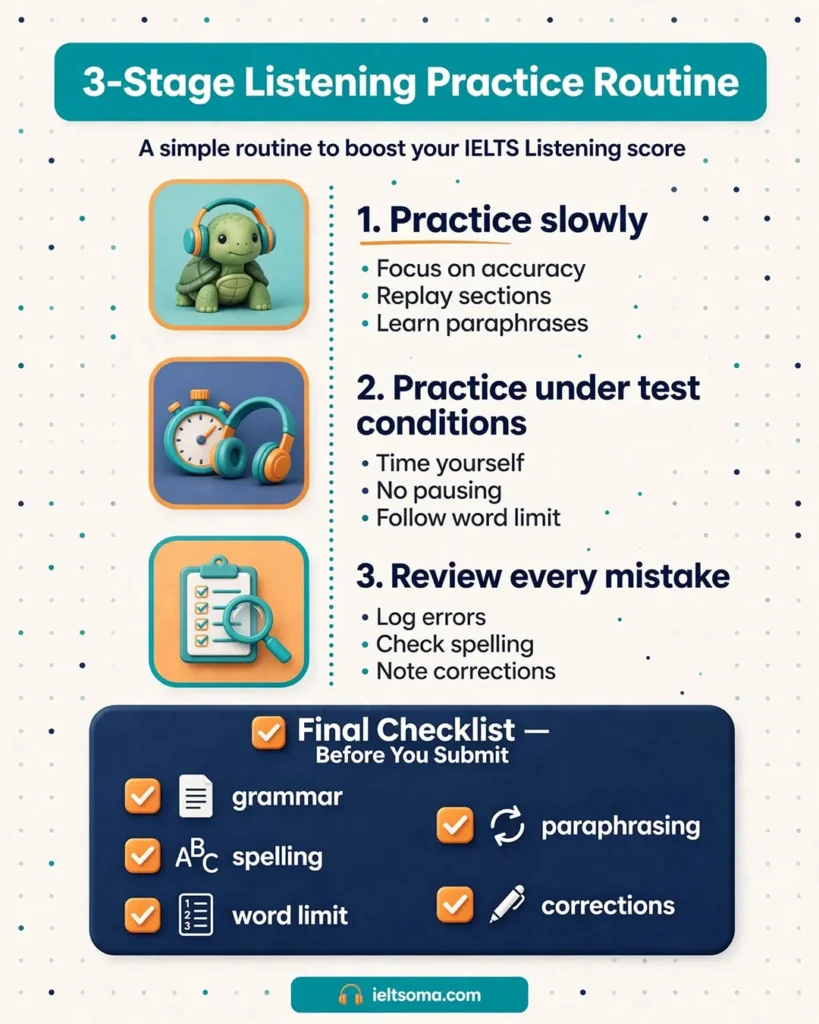
Improvement comes from identifying why you miss answers, not simply completing more practice tests.
Use a three-stage practice routine
Stage 1: Practise without time pressure.
Choose a short listening exercise. Read the questions, predict the answer types, and listen carefully. Focus on understanding the recording and recognising paraphrases.
Stage 2: Practise under test conditions.
Use a timed exercise and follow the instructions without pausing the recording. This develops concentration and the ability to move between questions.
Stage 3: Analyse your errors.
Review the transcript after completing the exercise, if one is available. Classify each mistake:
- You did not know the vocabulary.
- You missed the relevant information.
- You failed to recognise a paraphrase.
- You selected an earlier detail instead of a correction.
- You made a spelling or grammar error.
- You exceeded the word limit.
- You lost your place while listening.
Your error pattern determines what you should practise next.
Keep an error log
Record the question, your answer, the correct answer, the reason for the mistake, and the action you will take to prevent it.
For example:
| Error | Reason | Next action |
|---|---|---|
| Missed a changed date | Selected the first date mentioned | Practise listening for corrections |
| Incorrect plural | Did not check sentence grammar | Review noun forms before answering |
| Too many words | Ignored the instruction | Count words during final checking |
| Missed a paraphrase | Expected the exact question wording | Practise synonyms in context |
Repeat this process across several practice sessions. Over time, you will identify recurring weaknesses and spend less time repeating skills you have already mastered.
Choose reliable practice materials
Use official IELTS preparation materials where possible, including the sample questions and test information available through the official IELTS website. Supplement these with recordings that match your current level and gradually increase in difficulty.
Practise with different accents and topics. The goal is not to memorise answers but to become comfortable identifying information in natural spoken English.
Official resource: IELTS preparation and sample test questions.
IELTS Listening Sentence Completion: Final Checklist
Before submitting your answers, check the following:
- I followed the exact word-limit instruction.
- I answered each gap using information supported by the recording.
- I considered paraphrasing rather than waiting for identical wording.
- I listened for corrections and changes.
- My answers fit the grammar of the printed sentences.
- I checked spelling, numbers, and dates.
- I moved on when I missed an answer instead of losing concentration.
- I removed unnecessary words.
The most effective IELTS Listening sentence completion strategy is a repeatable process: predict the answer type, listen for meaning, recognise paraphrasing, follow the recording, and check your response. With regular practice and careful error analysis, you can improve both accuracy and confidence.
Frequently Asked Questions
1. How do I answer IELTS Listening sentence completion questions?
Read the instructions, preview the sentences, predict the type of information missing, and listen for the relevant meaning. Write the answer in the required form, then check grammar, spelling, and the word limit.
2. What is the best IELTS Listening sentence completion strategy?
The best strategy combines grammatical prediction, keyword awareness, paraphrase recognition, and careful listening for corrections. Practice following the order of the questions so that one missed answer does not affect the rest of the task.
3. Can I use my own words in IELTS Listening sentence completion?
You should use information supported by the recording and complete the printed sentence accurately. Do not invent an answer or replace recorded information with an unsupported guess. Follow the question’s word limit and the conventions of the test.
4. Do IELTS Listening sentence completion answers follow the recording order?
In IELTS Listening, questions generally follow the order of the recording. Following that sequence helps you anticipate the next answer, although you should always concentrate on the actual information rather than assume that every recording will be predictable.
5. What happens if I write more words than the limit?
If your answer exceeds the stated word limit, it may be marked incorrect even when it contains the correct information. Always read the instruction and keep your answer within the permitted number of words.
6. How can I improve my spelling in IELTS Listening?
Practice common vocabulary, names, places, dates, and topic-specific words. When a transcript is available, compare your spelling with the recorded information and keep a list of recurring errors.
7. How can I recognize paraphrasing in IELTS Listening?
Build vocabulary around synonyms and common expressions. For example, “cost” may be expressed as “fee”, and “not necessary” may be expressed as “optional”. During practice, compare the question wording with the way the speaker communicates the same idea.
8. Is sentence completion difficult in IELTS Listening?
It can be challenging because you must understand the recording, predict the missing information, and write an accurate answer within a limited time. However, a structured method and regular review of mistakes can make the task more manageable.
9. How often should I practice sentence completion?
Practice regularly as part of your wider IELTS Listening preparation. Begin with shorter exercises that target a specific weakness, then use full listening sections to develop timing, concentration, and consistency.
10. Is sentence completion the same as form completion?
No. Sentence completion requires you to fill gaps in sentences using information from the recording. Form completion usually involves completing fields in a form, such as a name, address, date, or contact number. Both tasks require accurate listening, but their layouts and contexts differ.
Further Reading: