IELTS Reading Short Answer Questions can look easy because you do not need to choose from options or write a long response. Yet many candidates lose marks by finding the right paragraph but copying too many words, overlooking a detail, or giving an answer that does not match the question.
The solution is to read with a purpose. You need to identify what the question is asking, locate the relevant information, and copy the smallest complete answer that satisfies the question and the word limit.
This guide explains an effective IELTS Reading short answer questions strategy for both Academic and General Training candidates. You will learn how to recognize keywords, scan passages efficiently, handle paraphrasing, avoid common traps, and practice with examples and answer explanations.
Table of Contents
What Are IELTS Reading Short Answer Questions?
IELTS Reading Short Answer Questions require you to answer factual questions using information from the reading passage. Your answers are usually short words, phrases, or numbers taken directly from the text.
For example:
Reading passage: The research centre opened in 2018 and employs 45 full-time researchers.
Question: In which year did the research centre open?
Answer: 2018
You do not need to explain the background or write a complete sentence. You need to identify the requested fact and provide it accurately.
According to the official IELTS test format, short-answer questions assess your ability to locate and understand specific information. The answers appear in the same order as the relevant information in the passage.
This question type can appear in both IELTS Academic Reading and IELTS General Training Reading. The passages differ between the two tests, but the core answering principles remain the same.
What Skills Do These Questions Test?
Short-answer questions assess several connected reading skills:
- Scanning: Finding names, dates, places, quantities, and other specific details quickly.
- Understanding paraphrases: Recognising that a question may express an idea differently from the passage.
- Reading for detail: Checking the exact information surrounding a possible answer.
- Following instructions: Respecting the maximum number of words or numbers allowed.
- Selecting relevant information: Giving the requested detail rather than copying an entire sentence.
The challenge is not simply finding words that look familiar. You must understand which detail answers the question.
7 Proven Strategies for IELTS Reading Short Answer Questions
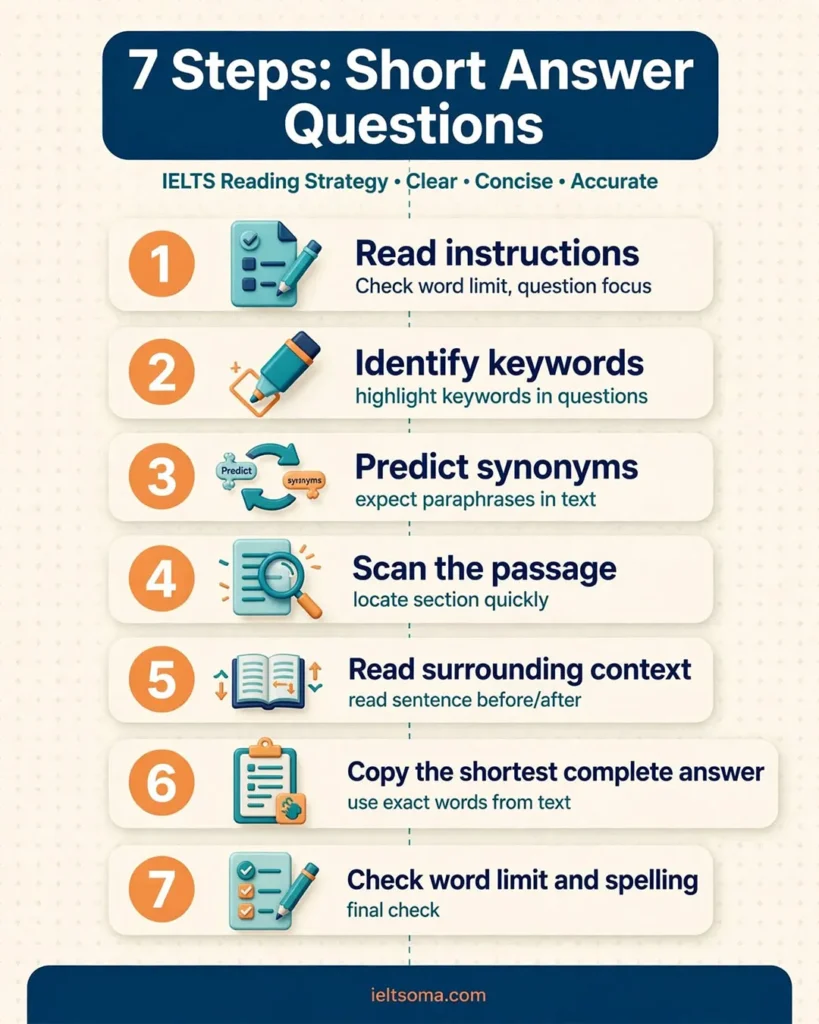
1. Read the Instructions Before Answering
Always check the word limit before you begin. Different tasks may use instructions such as:
- NO MORE THAN ONE WORD
- NO MORE THAN TWO WORDS
- NO MORE THAN THREE WORDS AND/OR A NUMBER
- ONE WORD AND/OR A NUMBER
These instructions determine how much you can write. An otherwise correct answer can lose its mark if it exceeds the permitted limit.
Consider this example.
Passage: The museum introduced a new ticketing system in March 2022.
Question: When did the museum introduce the new ticketing system?
Instruction: NO MORE THAN TWO WORDS AND/OR A NUMBER
Correct answer: March 2022
Incorrect answer: In March 2022
The incorrect version contains three words if counted as “In” + “March” + “2022”, exceeding the two-word limit.
Remember that hyphenated words count as one word under the official IELTS guidance. Numbers may generally be written as figures or words, subject to the instructions.
Expert tip: Underline or mentally note the word limit before you read the passage. Do not wait until you have written an answer to check it.
2. Identify the Key Information in Each Question
Before scanning the passage, identify the most important words in each question. These words help you predict what information to look for.
Pay particular attention to:
- Names of people, organisations, or places
- Dates, years, prices, and measurements
- Nouns describing objects, processes, or events
- Verbs that indicate an action
- Question words such as who, where, when, why, and how many
For example:
Question: What material did researchers use to build the experimental shelter?
The key information includes “material”, “researchers”, “build”, and “experimental shelter”. The answer will probably be a material such as wood, steel, or recycled plastic.
Do not assume that the passage will repeat the entire question word for word. It may describe the same idea using different vocabulary.
Question: Why did the residents oppose the proposal?
Passage: Local people objected because the planned road would remove several public gardens.
Answer: It would remove several public gardens.
The question uses “oppose”, while the passage uses “objected”. Recognising this relationship helps you find the answer.
3. Use Scanning Instead of Reading Every Sentence Slowly
Scanning means moving quickly through a text to locate specific information. It is particularly useful when answering questions about dates, names, locations, quantities, and clearly identifiable facts.
A practical scanning method is:
- Read the question and identify its keywords.
- Think of possible synonyms or alternative expressions.
- Move your eyes quickly through the passage to find a matching detail.
- Slow down when you reach a relevant sentence.
- Read that sentence and its surrounding context carefully.
- Confirm that the information answers the question.
For example, if the question asks when a programme began, look for dates, years, or expressions such as “was launched”, “started”, “was introduced”, and “came into operation”.
Scanning does not mean guessing based on the first familiar word. The purpose is to locate a likely section quickly and then read it accurately.
A useful habit is to skim the passage briefly before answering a set of questions. This gives you a general idea of the topic and the location of major sections. You can then scan for individual details without repeatedly reading the entire text.
4. Recognise Paraphrasing and Synonyms
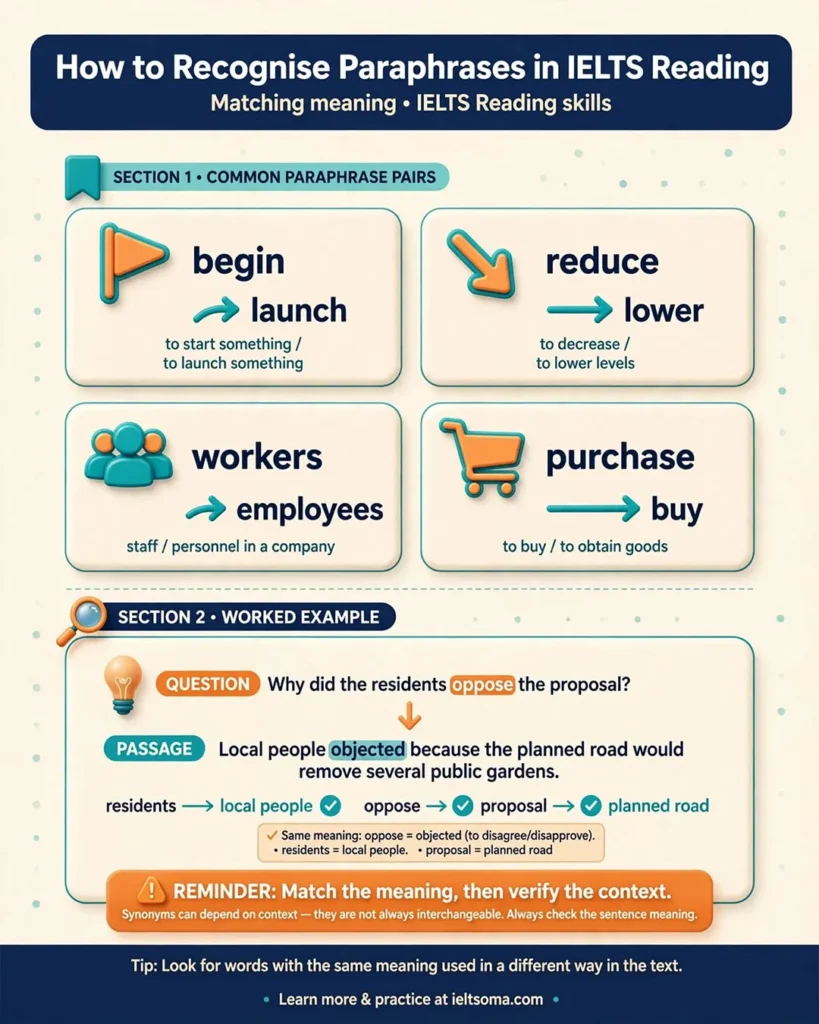
One of the most important parts of the IELTS Reading short answer questions strategy is recognising that the passage may express an idea differently from the question.
Study these common relationships:
| Wording in the question | Possible wording in the passage |
|---|---|
| begin | start, commence, launch |
| purchase | buy, acquire |
| cost | price, fee, charge |
| reduce | decrease, lower, cut |
| reason | cause, explanation |
| workers | employees, staff |
| help | assist, support |
| improve | enhance, strengthen |
| move to | relocate, transfer |
| end | finish, conclude |
These are possible paraphrases, not interchangeable words in every context. Always confirm the meaning in the actual sentence.
Example
Question: What did the company do to reduce its energy costs?
Passage: The firm installed solar panels to lower its electricity bills.
Answer: Installed solar panels
The question says “company”, while the passage says “firm”. Similarly, “reduce” corresponds to “lower”, and “energy costs” relates to “electricity bills”.
The answer is taken from the passage rather than rewritten in your own words.
To improve this skill, keep a vocabulary notebook containing common paraphrases from authentic IELTS practice passages. Record the complete sentence, not just a list of isolated synonyms. Context will help you understand how words are used.
5. Follow the Order of the Questions
In IELTS Reading Short Answer Questions, the answers generally follow the order of the relevant information in the passage.
This gives you an important advantage: after locating the answer to one question, the information for the next question is usually further down the text.
Suppose your questions ask:
- When was the laboratory established?
- How many scientists initially worked there?
- Which university funded its first major project?
If the first answer appears in paragraph two, look for the next answers in the same paragraph or in the following sections rather than repeatedly returning to the beginning.
However, do not treat the order as an absolute guarantee that every answer will appear in a separate paragraph. Several answers may be close together, and you should always verify each one.
Expert tip: Mark the location of each answer mentally or on your permitted question materials. Move forward through the passage as you progress through the questions.
This approach reduces unnecessary rereading and helps you manage your time.
6. Give the Shortest Complete Answer
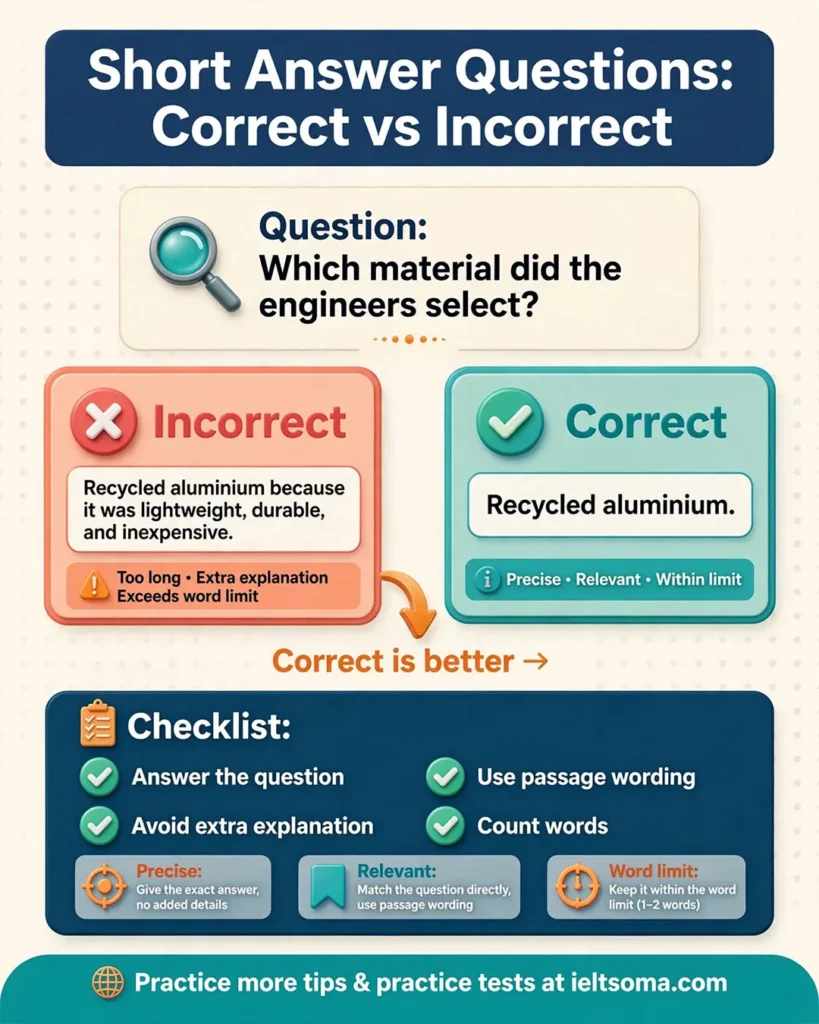
A strong answer includes all the information needed to answer the question, but nothing unnecessary.
Consider the following passage:
“After testing several materials, the engineers selected recycled aluminium because it was lightweight, durable, and relatively inexpensive.”
Question: Which material did the engineers select?
Correct answer: Recycled aluminium
Incorrect answer: Recycled aluminium because it was lightweight, durable, and relatively inexpensive.
The longer response includes the correct information, but it adds an explanation that the question does not request and may exceed the word limit.
Now consider a different question:
Question: Why did the engineers select recycled aluminium?
Correct answer: It was lightweight, durable, and relatively inexpensive.
The required answer changes because the question asks for a reason rather than a material.
This illustrates a fundamental principle: identify the type of information requested before copying anything from the passage.
Use the question word as your guide:
- Who? A person, group, or organisation
- Where? A place or location
- When? A date, time, or period
- What? An object, action, name, or fact
- Why? A reason or cause
- How many? A number or quantity
- How? A method or process
The shortest answer is not always the shortest possible string of words. It must still be complete and unambiguous.
7. Check Word Count, Spelling, and Meaning
Before moving on, perform a quick final check.
Ask yourself:
- Does my answer directly address the question?
- Have I copied the relevant wording accurately?
- Is the answer within the stated word limit?
- Have I included the essential noun or other required detail?
- Is the spelling correct?
- Have I accidentally included an explanation that is not needed?
For example:
Passage: The workshop takes place in the science building on the third floor.
Question: On which floor is the workshop held?
Correct answer: Third floor
Incorrect answer: The third floor of the science building
The second answer may be understandable, but it is unnecessarily long. Under a two-word limit, it would also exceed the permitted number of words.
Spelling matters because an incorrectly written answer may not receive credit. If you are working on a computer-delivered test, take care when entering answers into the correct fields.
How to Answer Short Answer Questions in IELTS: A Worked Example
The following original practice passage demonstrates the complete process.
Practice Passage: An Urban Gardening Project
In 2021, the town of Greenford launched an urban gardening initiative to make better use of unused land. The local council converted an abandoned car park into a community garden. Volunteers grew tomatoes, beans, and leafy vegetables in raised beds made from reclaimed timber.
The project was initially funded by a £12,000 environmental grant. Later, a nearby supermarket donated gardening equipment and supplied compost. According to the project coordinator, the garden produced 450 kilograms of vegetables during its first growing season. Most of the produce was distributed to local families, while the remainder was used in cooking workshops at a community centre.
The council plans to expand the initiative by establishing two additional gardens near local schools. Before work begins, volunteers will attend a training session on water conservation. The coordinator believes that teaching residents to collect rainwater will help the project remain sustainable during dry periods.
Questions 1–5
Answer the questions below using NO MORE THAN THREE WORDS AND/OR A NUMBER for each answer.
- In which year did the initiative begin?
- What type of location was converted into a community garden?
- How much was the initial environmental grant worth?
- How many kilograms of vegetables did the garden produce in its first growing season?
- What will volunteers learn about before the expansion begins?
Answers and Explanations
1. 2021
The first sentence states that the initiative was launched in 2021. The question asks for a year, so the number alone is sufficient.
2. An abandoned car park
The passage identifies the former location of the garden. “An abandoned car park” answers the question precisely and remains within the word limit.
3. £12,000
The grant amount appears directly in the second paragraph. The currency symbol does not create an additional word.
4. 450 kilograms
The coordinator reports that the garden produced 450 kilograms of vegetables. Both the quantity and the unit are relevant to the question.
5. Water conservation
The final paragraph states that volunteers will attend a training session on water conservation. This phrase answers what they will learn about.
What Does This Exercise Teach You?
Notice how the questions follow the order of information in the passage. The first answer appears early, and subsequent answers are found as you move through the text.
Also notice that the questions do not always repeat the exact wording. “In which year did the initiative begin?” refers to the passage’s statement that the initiative was launched in 2021.
The best approach combines scanning, paraphrase recognition, careful reading, and concise answers. None of these skills is sufficient on its own.
Common Mistakes to Avoid
Even candidates who understand the passage can lose marks through preventable errors.
Copying Too Many Words
Candidates sometimes copy a complete sentence when only a name, date, or short phrase is needed.
Fix: Identify the information requested and remove any unnecessary explanation.
Using Synonyms Instead of the Passage’s Words
If the instructions require answers from the passage, replacing its wording with a synonym may make your answer less accurate or unsuitable for the task.
Fix: Use the passage’s exact wording where possible, preserving the correct form and meaning.
Choosing a Related but Incorrect Detail
A passage may mention several dates, people, or quantities. Finding a familiar number does not automatically make it the answer.
Fix: Read the full sentence and confirm that the detail answers the specific question.
Ignoring the Word Limit
An answer may contain the correct information but still fail because it exceeds the permitted length.
Fix: Count the words after writing each answer, especially when the instruction says “NO MORE THAN TWO WORDS” or “NO MORE THAN THREE WORDS AND/OR A NUMBER”.
Answering the Wrong Question
Candidates may find the correct sentence but respond to a different part of it.
For example, a question asking where something happened requires a location, not the reason it happened.
Fix: Circle or mentally emphasise the question word before scanning.
Spending Too Long on One Answer
Repeatedly searching for the same detail can waste valuable time.
Fix: Scan for likely synonyms, check the surrounding context, and move on if the answer remains uncertain. Return to difficult questions after completing easier ones.
Time Management for Short Answer Questions
The IELTS Reading test lasts 60 minutes and contains 40 questions. You must manage that time across the complete paper, rather than treating short-answer questions as an isolated test.
There is no universal time limit for this particular question type because the number and difficulty of questions vary.
A practical approach is to:
- Read the instructions and word limit first.
- Spend a short time identifying keywords in the questions.
- Scan the passage rather than reading every line at the same speed.
- Check the context around each possible answer.
- Move forward when the answer is clear.
- Reserve time to review unanswered questions and check your entries.
If you repeatedly spend several minutes searching for one fact, practise scanning with a timer. The goal is to become faster without sacrificing accuracy.
You should also practise short-answer questions in both Academic and General Training materials if you are preparing for a particular test version. General Training passages may include practical texts such as notices, advertisements, and workplace information, while Academic passages often feature more extended informational or analytical texts.
Short Answer Questions vs Sentence Completion
These two question types can look similar because both may require you to copy words from the passage. However, the way you approach them is slightly different.
| Feature | Short-answer questions | Sentence completion |
|---|---|---|
| Task | Answer a direct question | Complete a sentence with missing information |
| Main clue | Question word and key details | Meaning and grammar around the gap |
| Typical answer | A short phrase, name, date, or number | Word or phrase that completes the sentence |
| Main challenge | Finding the precise requested fact | Finding information that fits both meaning and sentence structure |
| Word limit | Follow the stated instructions | Follow the stated instructions |
For short-answer questions, begin by asking what information the question requires. For sentence completion, consider both the meaning and the grammatical structure of the missing part.
Both question types require careful attention to word limits, paraphrasing, and accurate copying.
How to Practise IELTS Reading Short Answer Questions Effectively
Consistent practice is more valuable than completing large numbers of questions without reviewing your mistakes.
Use this four-step routine:
Step 1: Practise scanning. Take a short passage and locate five names, dates, quantities, or places without answering any questions. This trains your eyes to recognise specific information.
Step 2: Answer under a word limit. Complete a short-answer exercise and follow the instructions exactly. Do not add explanations unless they are necessary.
Step 3: Analyse every error. For each wrong answer, identify the cause: missed keyword, misunderstood paraphrase, incorrect detail, spelling mistake, or word-count error.
Step 4: Repeat with a new passage. Apply the same method until you can find details efficiently and explain why each answer is correct.
Use official preparation materials wherever possible. Start with the official IELTS Academic Reading format and question types, which explains the task and the skills it assesses. You can also consult the corresponding IELTS General Training Reading format if that is the test you plan to take.
Keep an error log containing the original question, the correct answer, your answer, and the reason for the mistake. Reviewing this log will help you identify patterns and target the skills that need the most improvement.
Frequently Asked Questions
1. How do I answer IELTS Reading Short Answer Questions?
Read the instructions, identify the question keywords, scan the passage for relevant information, and read the surrounding sentence carefully. Copy a concise answer from the text, follow the word limit, and check that it answers the exact question.
2. Do I need to use the exact words from the passage?
When the instructions require answers from the passage, use the relevant words or numbers from the text. Recognize paraphrasing in the question to locate the answer but avoid unnecessarily replacing the passage’s wording with your own synonyms.
3. Do short-answer questions follow the order of the passage?
Yes. Official IELTS guidance states that answers to short-answer questions appear in the same order as the relevant information in the text. Use this to guide your search, while still checking the context of every answer.
4. Can I write a complete sentence as my answer?
Usually, a complete sentence is unnecessary. A short phrase or number is often sufficient, provided it answers the question accurately and follows the word limit. Do not add words simply to make the response sound more natural.
5. What happens if I exceed the word limit?
You can lose the mark even if your answer contains the correct information. Always follow the exact instruction, whether it allows one word, two words, or a specified number of words and numbers.
6. Are short-answer questions different in Academic and General Training Reading?
The passages and their typical contexts differ, but the core principles are similar. In both versions, you need to locate specific information, understand the question, and follow the stated answer instructions.
7. How can I get faster at short-answer questions?
Practice scanning for names, dates, numbers, and paraphrased expressions. Review incorrect answers to identify why you missed the information and use timed exercises to improve your speed while maintaining accuracy.
Final Checklist
Before submitting your IELTS Reading answers, make sure you have:
- Read the word-limit instructions.
- Identified what each question is asking.
- Used keywords and paraphrases to locate the relevant information.
- Checked the surrounding sentence for meaning.
- Copied the necessary information accurately.
- Removed unnecessary words.
- Checked spelling and word count.
The key to success is precision, not lengthy answers. Once you learn to scan systematically, recognise paraphrases, and select only the information required, IELTS Reading Short Answer Questions become much more manageable. Practise consistently, review your mistakes, and apply the same process in timed reading tests.
Further Reading: