When preparing for the IELTS exam, the first and most crucial step is choosing the right version: IELTS Academic vs General. While they may seem similar at first glance, they serve completely different purposes, and choosing the wrong one can set you back in your academic or immigration journey.
In this blog, we’ll break down the key differences, guide you on how to choose the right version, and share expert tips to help you succeed.
Table of Contents
Understanding the IELTS Exam Structure
The International English Language Testing System (IELTS) is one of the world’s most trusted English exams. It’s recognized in over 140 countries and used for a variety of purposes including university admissions, work visas, and permanent residency.
There are two main types of IELTS exams:
- IELTS Academic
- IELTS General Training
Both versions test the four language skills: Listening, Reading, Writing, and Speaking. However, the Reading and Writing sections differ significantly between the two.
What is IELTS Academic?
IELTS Academic is designed for those:
- Applying to universities or colleges
- Seeking professional registration (e.g., doctors, nurses)
- Planning to study at undergraduate or postgraduate levels
The test reflects features of academic language and assesses whether you’re ready to begin studying or training in an English-speaking environment.
What is IELTS General Training?
IELTS General Training is typically chosen by:
- People migrating to Australia, Canada, New Zealand, or the UK
- Individuals applying for secondary education, work experience, or training programs
It focuses more on everyday English and workplace contexts.
IELTS Academic vs General – Quick Comparison Table
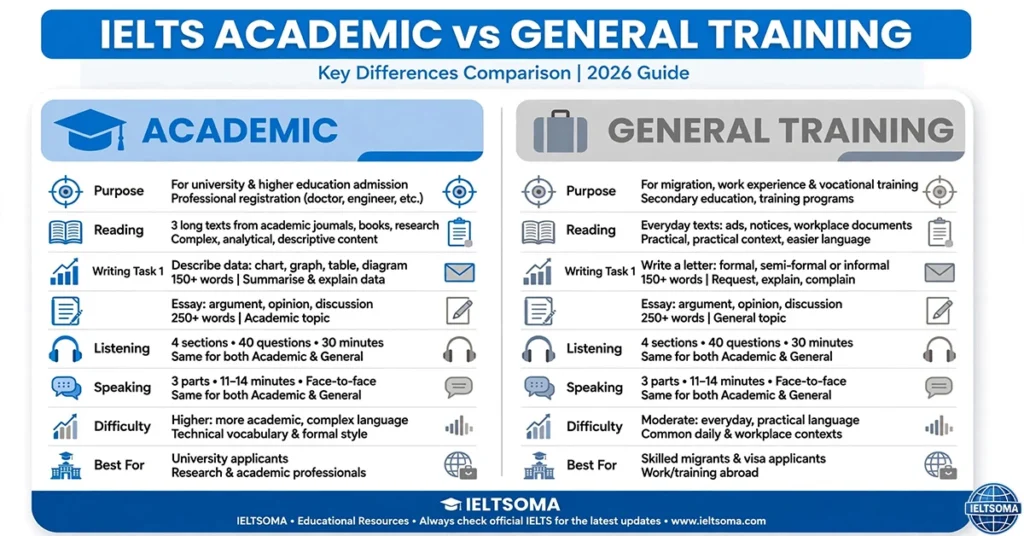
| Section | IELTS Academic | IELTS General Training |
|---|---|---|
| Reading | 3 long academic texts | 3 sections with workplace, social, and everyday topics |
| Writing | Task 1: Describe a graph, chart or diagram Task 2: Essay | Task 1: Letter writing Task 2: Essay |
| Listening | Same for both | Same for both |
| Speaking | Same for both | Same for both |
| Purpose | Academic and professional registration | Migration, employment, general training |
Reading Section – What Sets Them Apart
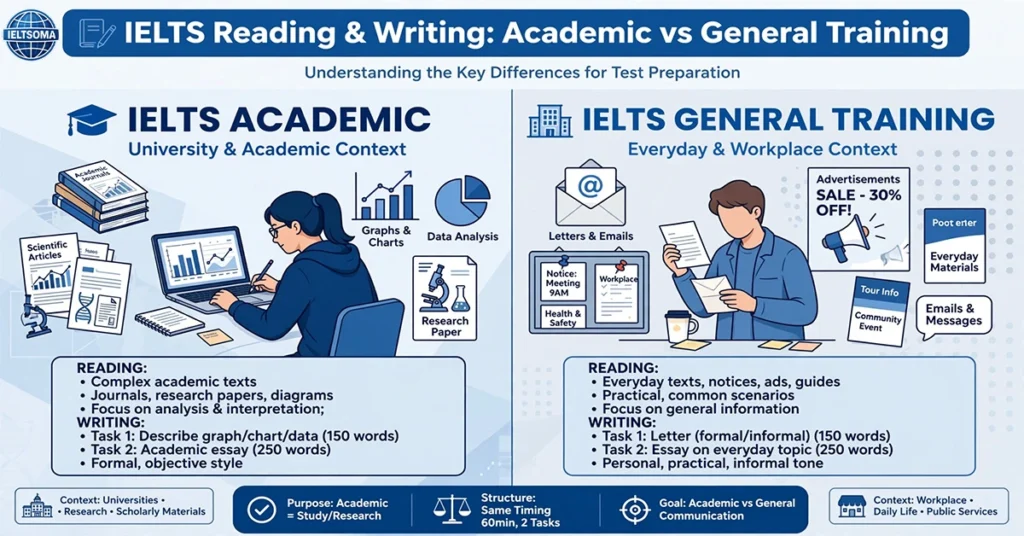
The IELTS Academic Reading includes texts from books, journals, and newspapers. It often has technical vocabulary and complex arguments.
In contrast, the General Reading section has texts you might encounter in daily life: advertisements, timetables, or manuals. The language is simpler and more practical.
Writing Section – Big Differences You Must Know
The writing section shows the clearest difference between the two formats.
- Academic Writing Task 1: Summarize or describe visual data like charts or tables.
- General Writing Task 1: Write a formal, semi-formal, or informal letter.
Both formats have a Task 2, which is an essay, but the Academic essays are usually more analytical, while General essays focus on general-interest topics.
Listening and Speaking – What’s Similar and What’s Not
The Listening and Speaking sections are the same for both Academic and General IELTS.
- Listening: You’ll hear four recordings including conversations and lectures in different accents.
- Speaking: A face-to-face interview with an examiner. Includes a short speech, questions, and discussion.
Scoring & Band Descriptors Comparison
Both versions use the same scoring system, from Band 1 (non-user) to Band 9 (expert user).
However, the difficulty of questions in the Academic test may lead to different scoring expectations. For example, to get Band 7 in Reading, you may need:
- 30 out of 40 (Academic)
- 34 out of 40 (General)
Academic vs General – Which Test Is Easier?
Many believe that the General IELTS is easier. That’s partly true—especially in Reading and Writing.
But it depends on your strengths:
- If you’re good at academic writing and reading complex texts, Academic may suit you.
- If you prefer practical communication, General may feel easier.
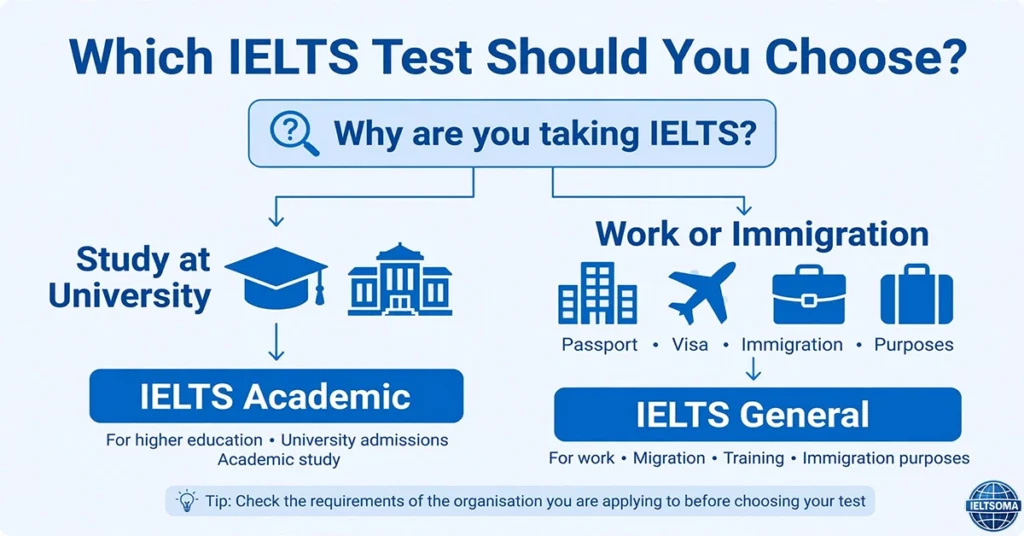
IELTS Academic vs General – Which One Should You Choose?
Choose IELTS Academic if:
- You’re applying to universities or professional organizations.
Choose IELTS General if:
- You’re applying for immigration or looking for a job abroad.
Important: Always check the requirements of your institution or visa authority before choosing.
Impact on Immigration and Study Opportunities
- Australia accepts both versions for migration.
- Canada immigration requires IELTS General for Express Entry.
- UKVI Academic IELTS is accepted for study visa in the UK.
- New Zealand accepts both for various purposes but recommends General for residency.
Preparation Tips for Each Version
For IELTS Academic:
- Practice interpreting graphs and statistics.
- Improve your academic vocabulary.
For IELTS General:
- Practice letter writing with different tones.
- Focus on common everyday topics for reading.
General Tips:
- Use official practice tests from IELTS.org
- Join study groups or consider hiring a certified IELTS tutor.
Test Day Experience – What to Expect
- Arrive early with valid ID.
- No phones or bags allowed inside the exam room.
- Use either of British or American spelling, both are accepted, but be consistent and do not mix.
- You can choose paper-based or computer-delivered versions.
Common Mistakes Students Make When Choosing
- Taking Academic for migration (wrong!)
- Assuming General is too simple for professional use
- Not checking university or visa requirements
- Overlooking differences in Writing tasks
Expert Advice on Making the Right Choice
“The number one mistake I see is students preparing for the wrong version. Always confirm with your university or immigration body before booking your test.”
— Jane Dawson, IELTS Trainer & Coach
FAQs – IELTS Academic vs General
Q1: Can I switch from Academic to General after booking?
A: Yes, but only before the test day. Contact your test center.
Q2: Is IELTS General accepted for university applications?
A: Usually no. Universities typically require IELTS Academic.
Q3: Which IELTS is accepted for Canadian PR?
A: IELTS General Training is required for Express Entry and most PR programs.
Q4: Is there a difference in test fees?
A: No, both versions usually cost the same.
Q5: Can I take both Academic and General?
A: Yes, but not at the same time. Choose based on your goals.
Q6: Is the speaking test face-to-face or recorded?
A: It’s face-to-face with an examiner, regardless of test format.
Conclusion – Your IELTS Journey Starts Here
Choosing between IELTS Academic vs General doesn’t have to be confusing. Start by understanding your goal—study, work, or migrate. Match that goal to the right test, prepare with intent, and you’ll be on the path to success.
Remember, the right preparation and correct choice can make all the difference.
Further Reading: