If you want to improve your IELTS Writing score, learning to write complex sentences accurately is one of the most useful grammar skills you can develop. However, simply making sentences longer will not automatically earn you a higher band score. What matters is your ability to combine ideas clearly, choose appropriate grammatical structures, and control them accurately.
IELTS Writing Complex Sentences help you explain reasons, compare situations, express conditions, describe trends, and develop arguments without relying on short, repetitive sentences. They are useful in both IELTS Academic and General Training Writing.
The key is balance: use a mixture of simple, compound, and complex sentences, choosing the structure that best expresses each idea.
In this guide, you will learn seven practical strategies, study complex sentence examples for IELTS, understand common grammar mistakes, and practice building sentences that demonstrate grammatical range and accuracy.
Table of Contents
What Are Complex Sentences in IELTS Writing?
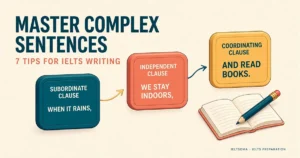
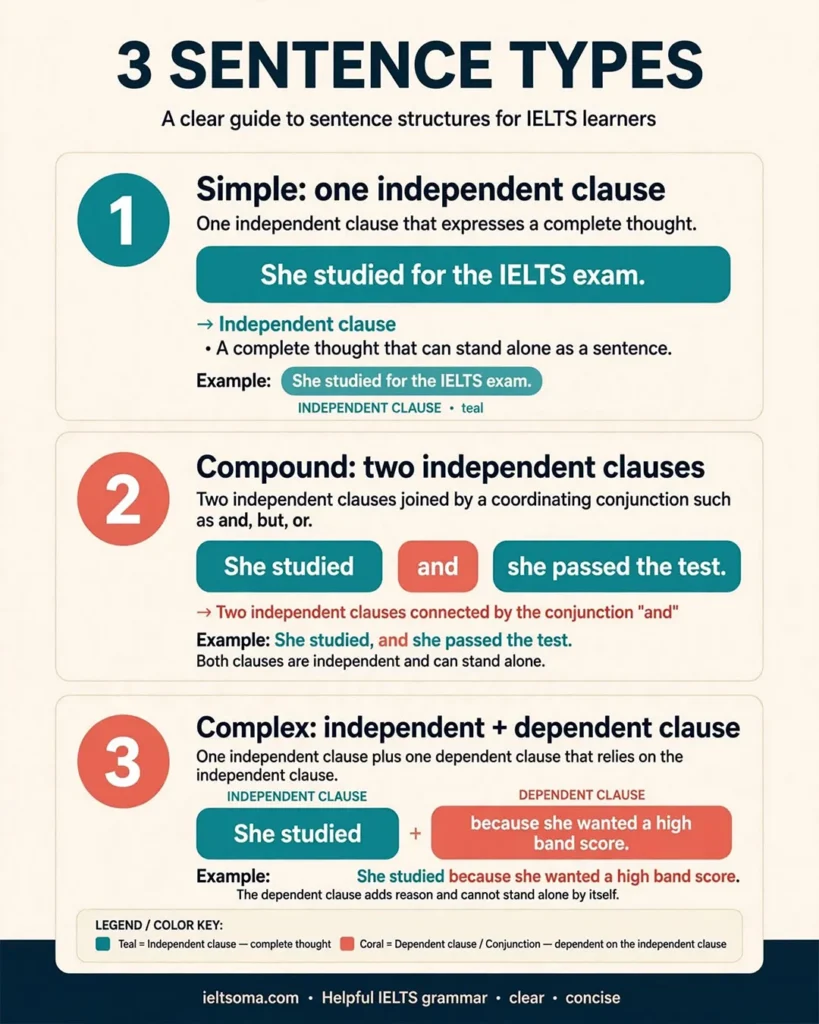
A complex sentence contains one independent clause and at least one dependent (subordinate) clause.
An independent clause expresses a complete thought and can stand alone. A dependent clause adds information but cannot normally function as a complete sentence on its own.
For example:
- Simple sentence: Many students study online.
- Complex sentence: Many students study online because it gives them greater flexibility.
The independent clause is “Many students study online”. The dependent clause explains why they do so.
Notice that the second sentence does more than add words. It communicates a relationship between two ideas.
This ability to express relationships accurately is central to grammatical range in IELTS Writing.
Simple, compound, and complex sentences compared
| Sentence type | Structure | Example |
|---|---|---|
| Simple | One independent clause | Public transport reduces congestion. |
| Compound | Two or more independent clauses | Public transport reduces congestion, and it can lower emissions. |
| Complex | An independent clause and at least one dependent clause | Public transport can reduce congestion because fewer people need to drive. |
All three sentence types are useful. Strong writing does not require every sentence to be complex. Instead, it requires variety, precision, and appropriate grammatical control.
Why Complex Sentences Matter for IELTS Band Scores
Grammatical Range and Accuracy is one of the four assessment criteria for IELTS Writing, alongside Task Achievement or Task Response, Coherence and Cohesion, and Lexical Resource.
The official IELTS Writing band descriptors distinguish between a limited mixture of sentence forms and the flexible, accurate use of a variety of complex structures. At Band 7, for example, candidates are expected to use a variety of complex structures with some flexibility and accuracy.
This does not mean that inserting a particular number of complex sentences guarantees Band 7. Examiners assess your writing as a whole, including how well you communicate ideas and how accurately you use grammar.
Read the official IELTS Writing preparation resources to understand the assessment criterion.
What does grammatical range mean?
Grammatical range means using different structures to communicate different meanings. These may include:
- Subordinate clauses to explain reasons or conditions.
- Relative clauses to identify or describe people, places, and things.
- Conditional sentences to discuss possible outcomes.
- Concession clauses to acknowledge contrasting ideas.
- Passive structures to emphasise actions or processes.
- Comparative structures to describe differences and changes.
- Participle clauses where appropriate and accurately constructed.
Accuracy matters as much as variety. A clear sentence using a familiar structure is more effective than an ambitious sentence containing several grammatical errors.
7 Proven Strategies for Writing Complex Sentences
1. Use subordinating conjunctions to explain relationships
Subordinating conjunctions connect a dependent clause to a main clause. They help you explain why something happens, when it happens, what condition applies, or how two ideas contrast.
| Relationship | Useful words | IELTS example |
|---|---|---|
| Reason | because, since, as | Some employees prefer remote work because it reduces commuting time. |
| Contrast | although, even though, whereas | Although online learning is convenient, it requires considerable self-discipline. |
| Condition | if, unless, provided that | If governments improve public transport, fewer people may rely on private cars. |
| Time | when, while, before, after | When children read regularly, they can develop stronger vocabulary. |
| Purpose | so that, in order that | Universities can provide additional support so that international students can adapt more easily. |
Choose the conjunction according to the relationship you intend to express. Do not select a word simply because it sounds formal.
Compare these examples:
Weak: People use cars. Traffic becomes worse.
Improved: Traffic becomes worse because many people rely on private cars.
More developed: Although private cars offer convenience, heavy dependence on them can worsen traffic congestion, particularly in densely populated cities.
The final version combines contrast and a clear explanation. Use this degree of complexity only when it helps communicate your point.
2. Build relative clauses to add precise information
Relative clauses describe or identify a noun. They commonly begin with who, which, that, whose, or where.
For example:
- People who work long hours may have less time for exercise.
- Public transport, which is often cheaper than driving, can help reduce household expenses.
- Schools that provide regular feedback may help students recognise their weaknesses.
Relative clauses are particularly useful in IELTS Academic Writing Task 1 when describing processes, equipment, or stages, and in Task 2 when developing an argument.
Defining relative clause:
Employees who work remotely may save time on commuting.
The clause identifies the employees being discussed.
Non-defining relative clause:
Public transport, which is widely used in many large cities, can reduce the number of private vehicles on the road.
The clause adds extra information and is separated by commas.
A common error is omitting the necessary comma around a non-defining relative clause. Another is using that in a non-defining clause.
Incorrect: My university, that is located in the city centre, has a large library.
Correct: My university, which is located in the city centre, has a large library.
3. Use concession clauses to present balanced arguments
High-quality IELTS Task 2 essays often acknowledge an opposing view before explaining the writer’s position. Concession clauses make this possible.
Useful structures include:
- Although + subject + verb, main clause.
- Even though + subject + verb, main clause.
- While + subject + verb, main clause.
- Despite + noun or -ing form, main clause.
- In spite of + noun or -ing form, main clause.
Complex sentence examples for IELTS:
Although online education offers flexibility, some students struggle to remain motivated without face-to-face interaction.
Even though public transport requires substantial investment, it can provide long-term benefits to urban communities.
Despite the convenience of online shopping, many consumers still prefer to examine products in person.
Notice the grammatical difference: although is followed by a clause, whereas despite is followed by a noun phrase or an -ing form.
Incorrect: Despite public transport is affordable, many people drive.
Correct: Although public transport is affordable, many people drive.
Also correct: Despite being affordable, public transport is not always convenient.
Expert tip: Use concession structures when you genuinely need to recognise another perspective. A balanced argument is more persuasive than adding although to a sentence that contains no meaningful contrast.
4. Use conditional sentences to discuss consequences
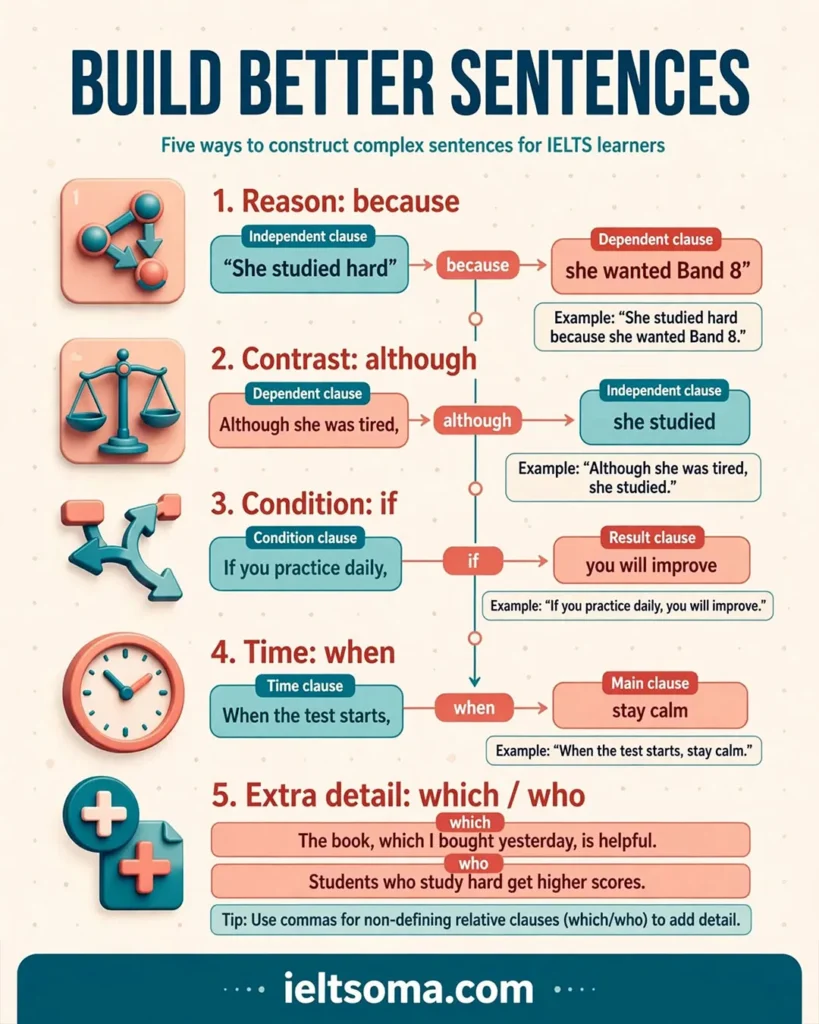
Conditional sentences are valuable when explaining what might happen if a situation changes.
First conditional: real or plausible future situations
If governments invest in renewable energy, they may reduce their dependence on fossil fuels.
Second conditional: hypothetical or less likely situations
If every city offered reliable public transport, fewer residents would need to own cars.
Third conditional: hypothetical past situations
If the company had invested in staff training earlier, it might have avoided some costly mistakes.
In IELTS Task 2, first and second conditionals are especially useful for discussing policies, recommendations, and potential consequences. Third conditionals can also be appropriate when the question involves past decisions or missed opportunities.
Be careful with verb forms.
Incorrect: If governments will invest in public transport, congestion will decrease.
Correct: If governments invest in public transport, congestion may decrease.
In a standard first conditional, use the present simple in the if-clause and an appropriate future or modal construction in the main clause.
Do not use conditional sentences merely to make your writing look advanced. Use them when you need to discuss a genuine condition and its result.
5. Use complex sentences to compare data in Academic Task 1
IELTS Academic Writing Task 1 requires you to describe and compare visual information, including charts, tables, graphs, and diagrams. Complex sentences can help you compare trends without repeating the same sentence pattern.
Consider this hypothetical chart information:
- Car use increased from 40% to 55%.
- Bus use decreased from 35% to 25%.
You could write:
While the proportion of people travelling by car increased from 40% to 55%, the figure for bus travel fell from 35% to 25%.
Another example:
The number of international students rose steadily, whereas domestic enrolments remained relatively stable throughout the period.
For process diagrams, relative clauses and time clauses can also help:
After the raw materials have been collected, they are transported to a facility where they are processed.
These examples combine information efficiently while maintaining a clear relationship between the details.
Important: Only report figures, trends, and comparisons that the visual actually supports. Complex grammar cannot compensate for inaccurate data interpretation.
6. Use passive structures when the action matters more than the actor
Passive structures are particularly useful in Academic Task 1 process descriptions and in formal discussions where the action or result is more important than the person performing it.
Active: The authorities introduced a new recycling programme.
Passive: A new recycling programme was introduced by the authorities.
In a process description:
First, the collected plastic is sorted according to its type before it is cleaned and processed.
You can combine a passive construction with a subordinate clause:
Once the materials have been separated, they are transferred to a processing facility.
Passive voice is not automatically more academic. Use it when it makes the sentence more appropriate for its purpose.
For example, in Task 2, an active sentence may be clearer when you need to identify responsibility:
Governments should enforce environmental regulations more consistently.
The goal is to select the most suitable structure, not to make every sentence passive.
7. Practise participle clauses and other advanced structures carefully
Participle clauses can make writing more concise by expressing information related to the main clause.
For example:
- Having completed the survey, the researchers analysed the results.
- Faced with rising housing costs, many young adults continue living with their parents.
- Compared with the previous year, the figure was considerably higher.
These structures can be effective, but they require careful control.
The subject of the participle clause should normally match the subject of the main clause.
Incorrect: Having completed the survey, the results were analysed by the researchers.
This sentence incorrectly suggests that the results completed the survey.
Better: Having completed the survey, the researchers analysed the results.
Or: After the survey had been completed, the results were analysed by the researchers.
Learn a few reliable patterns and practise them before attempting more complicated constructions under exam conditions.
How to Improve Grammatical Range in IELTS Writing
Knowing grammar rules is only the first step. You must also apply them naturally when responding to an actual IELTS question.
Use the following process during practice.
Step 1: Identify the relationship between your ideas.
Ask yourself whether you are explaining a reason, showing contrast, describing a condition, adding detail, or comparing information.
Step 2: Choose a suitable structure.
For a reason, use because. For contrast, consider although or whereas. For additional information about a noun, use a relative clause.
Step 3: Write the sentence clearly.
Start with the meaning you want to communicate. Avoid adding extra clauses that do not strengthen your point.
Step 4: Check grammar and punctuation.
Check subject–verb agreement, verb tense, articles, prepositions, clause structure, and commas.
Step 5: Read the sentence again for meaning.
Ask whether a reader can understand the relationship between the ideas without having to reread the sentence.
A practical weekly routine is to select one or two structures, write five original examples, use them in a short paragraph, and then review the errors. This is more useful than memorising dozens of sentence templates without understanding their grammar.
A practical sentence-upgrading exercise
Start with a basic statement:
Many people work from home.
Add a reason:
Many people work from home because it allows them to avoid long commutes.
Add a contrast:
Although working from home can improve flexibility, some employees find it difficult to separate their professional and personal lives.
Add a condition:
If employers provide clear expectations and regular communication, remote workers may find it easier to maintain productivity.
Each sentence communicates a different relationship. This is the purpose of grammatical range: expressing your ideas precisely and flexibly.
Common Mistakes to Avoid When Writing Complex Sentences
Even candidates with strong vocabulary can lose clarity through avoidable grammar errors.
| Common mistake | Incorrect example | Correct version |
|---|---|---|
| Sentence fragment | Because public transport is affordable. | Public transport is popular because it is affordable. |
| Comma splice | Online learning is convenient, students need discipline. | Online learning is convenient, but students need discipline. |
| Double conjunction | Although the policy is expensive, but it may work. | Although the policy is expensive, it may work. |
| Incorrect despite structure | Despite it is costly, the scheme is popular. | Although it is costly, the scheme is popular. |
| Faulty conditional | If people will exercise, they feel healthier. | If people exercise regularly, they may feel healthier. |
| Incorrect punctuation | Students, who practise regularly improve faster. | Students who practise regularly improve faster. |
| Overly long sentence | A sentence containing several loosely connected arguments and multiple unclear clauses. | Divide the ideas into two or more clear sentences. |
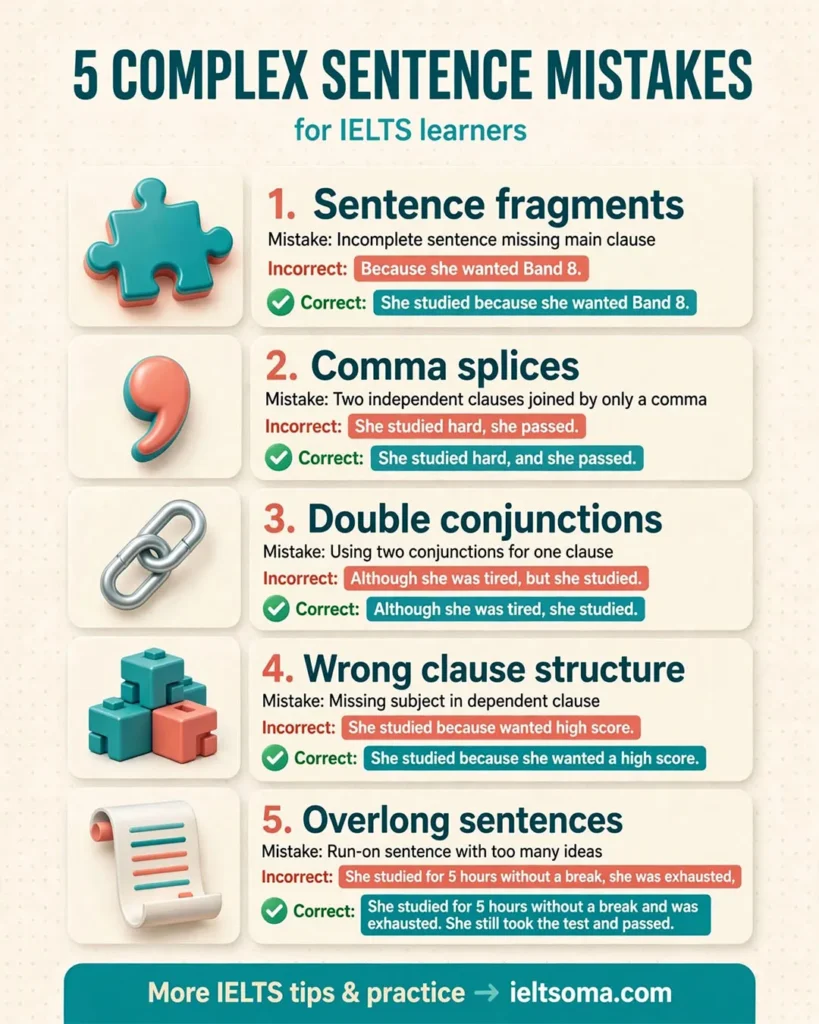
Avoid the temptation to write very long sentences
Long sentences are not necessarily complex in a useful way. A sentence can contain many words but still have poor structure.
For example:
Although public transport is useful and because it is affordable, which helps people who live in cities, governments should improve it and the roads are congested.
The relationships are unclear, and several ideas have been forced together.
A clearer version is:
Although public transport is often affordable, its reliability varies between cities. Governments should therefore improve transport services, particularly in areas where congestion is severe.
The revised version is easier to follow and gives each idea an appropriate grammatical structure.
Do not memorise complicated sentences for every essay
Memorised phrases may be unsuitable for the question, and inserting them can make your writing unnatural. Learn grammatical patterns instead, then adapt them to the specific topic.
For example, rather than memorising a complete sentence about technology, practise this structure:
Although [opposing point], [your main argument].
You could then write:
Although digital technology makes information more accessible, schools must still teach students how to evaluate sources critically.
The structure remains useful across many topics, but the content responds to the question.
Complex Sentence Practice: Test Your Accuracy
Try the following exercises before reading the answers.
Exercise 1: Join the ideas using because.
Many people cycle to work. They want to reduce their transport costs.
Exercise 2: Rewrite the sentence using although.
Online courses are convenient. Some learners find them difficult to complete.
Exercise 3: Complete the conditional sentence.
If cities improve their public transport systems, residents __________ (rely) less on private cars.
Exercise 4: Correct the grammar mistake.
Despite the weather was poor, the event attracted many visitors.
Exercise 5: Add a relative clause.
Students benefit from regular feedback. The feedback helps them identify their weaknesses.
Answers and explanations
- Many people cycle to work because they want to reduce their transport costs.
- Although online courses are convenient, some learners find them difficult to complete.
- If cities improve their public transport systems, residents may rely less on private cars.
- Although the weather was poor, the event attracted many visitors. Alternatively: Despite the poor weather, the event attracted many visitors.
- Students benefit from regular feedback, which helps them identify their weaknesses.
Other answers may be correct if they preserve the intended meaning and use accurate grammar.
Frequently Asked Questions
1. How many complex sentences should I use in IELTS Writing?
There is no official required number or percentage. The IELTS Writing criteria assess the range and accuracy of your grammar, not whether you have reached a fixed quota. Use complex sentences when they express relationships clearly and retain simple sentences when they communicate an idea more effectively.
2. Do complex sentences improve my IELTS Writing band score?
They can contribute to a stronger Grammatical Range and Accuracy performance when used appropriately and accurately. However, complex sentences alone do not guarantee a higher score. You must also address the task, organize ideas logically, and use vocabulary appropriately.
3. Can I use complex sentences in IELTS Academic and General Training?
Yes. Both versions assess Grammatical Range and Accuracy in Writing. Academic candidates may use complex structures to compare data and describe processes, while General Training candidates can use them to explain circumstances, make requests, and communicate their views in letters. Task 2 essays in both versions also benefit from accurate grammatical variety.
4. Which conjunctions are most useful for IELTS Writing?
Useful conjunctions include because, although, even though, whereas, while, if, unless, when, and since. Choose the word that expresses the correct relationship. Do not use them interchangeably: for example, because expresses a reason, whereas although introduces a contrast.
5. Are long sentences better than short sentences in IELTS?
No. Length does not determine grammatical quality. A mixture of simple and complex sentences is usually more effective because it gives your writing flexibility and helps maintain clarity. Split a sentence when it contains too many loosely connected ideas.
6. How can I improve grammatical range in IELTS Writing?
Practice a range of structures, including subordinate clauses, relative clauses, conditionals, comparisons, and passive constructions. Use them in timed essays and Task 1 responses, then review your errors. Focus on using each structure accurately before trying to make your sentences more elaborate.
7. What is the difference between a complex sentence and a compound sentence?
A complex sentence contains an independent clause and at least one dependent clause. A compound sentence joins two or more independent clauses, often with a coordinating conjunction such as and, but, or so. For example, “Although it was raining, we continued walking” is complex, while “It was raining, but we continued walking” is compound.
Final Advice: Prioritize Accuracy, Variety, and Meaning
Improving your use of IELTS Writing Complex Sentences is not about making every sentence longer or filling your essay with advanced grammar. It is about expressing relationships between ideas accurately, selecting appropriate structures, and giving your writing the flexibility needed for a strong response.
Start with subordinate clauses and relative clauses, then practice conditionals, concession structures, comparisons, and passive constructions. Review your mistakes regularly and use the structures that suit each question.
Remember three principles:
- Accuracy first: make sure your sentence is grammatically correct.
- Variety second: practise different structures rather than repeating the same pattern.
- Clarity always: make every clause contribute to your meaning.
With consistent practice, you can develop more natural, precise, and flexible writing for both IELTS Academic and General Training.
Further Reading: