Your IELTS result can depend on more than your English ability. You might understand a recording perfectly but lose marks because you misspell an answer. You might know how to write a strong essay but run out of time before completing it. Or you might speak confidently yet misunderstand what a question is asking.
The solution is not to rush, memorise complicated tricks or attempt every question in the same way. Effective IELTS Test-Taking Strategies help you manage time, follow instructions, recognise common traps and demonstrate your English ability as clearly as possible.
Whether you are taking IELTS Academic for university admission or IELTS General Training for migration, work or other purposes, a well-planned approach can help you avoid preventable mistakes.
This guide explains what to do before the exam, how to approach each test section and which habits can cost you marks unnecessarily.
Table of Contents
What Are the Most Effective IELTS Test-Taking Strategies?
The most effective IELTS test-taking strategies combine preparation, time management, careful reading of instructions and regular answer checking. Before the test, understand the format and practise under timed conditions. During the exam, prioritise accuracy, keep moving when a question becomes difficult and follow the exact requirements of each task.
Use these 12 strategies as your starting point:
- Confirm your test details and identification requirements.
- Practise with the correct IELTS test format.
- Arrive prepared and mentally settled.
- Read instructions before answering.
- Manage time according to the task.
- Predict information before listening.
- Use targeted reading rather than reading every passage word for word.
- Follow the question requirements in Writing.
- Answer Speaking questions naturally and directly.
- Avoid spending too long on one difficult question.
- Check spelling, grammar and answer requirements.
- Review your mistakes during preparation and refine your approach.
The sections below explain how to apply each strategy in practice.
1. Prepare for Test Day Before You Enter the Exam Room
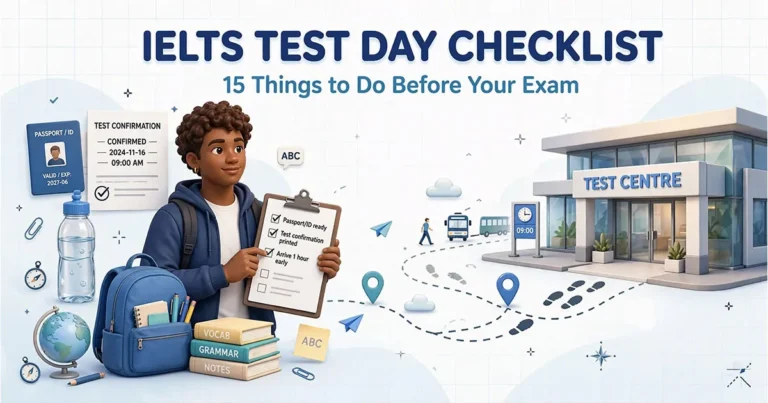
Good exam performance begins before the first question appears. Avoidable problems such as arriving late, bringing the wrong identification document or feeling unfamiliar with the test interface can distract you from the actual assessment.
Confirm your test details
Before exam day:
- Check the test date, reporting time and location.
- Confirm which identification document you must bring.
- Review the instructions provided by your test centre.
- Check the permitted belongings and security procedures.
- If taking a computer-delivered test, familiarise yourself with the relevant test interface and practise typing under timed conditions.
- Plan your journey and allow extra time for unexpected delays.
Requirements can vary by location and test delivery option, so follow the instructions from your test centre rather than relying on advice from another candidate.
Read the official IELTS test-day advice for further guidance.
Prepare your mind as well as your materials
Avoid staying awake late to learn new vocabulary or memorise essay templates. A tired mind is more likely to overlook instructions, lose concentration and make simple errors.
The evening before your test, prepare everything you need, eat normally and aim to get sufficient sleep. On test day, arrive with enough time to settle in and listen carefully to the supervisor.
Expert tip: Your final preparation should focus on confidence and familiarity, not learning an entirely new strategy at the last minute.
2. Practise the Correct IELTS Test Format
IELTS Academic and IELTS General Training share the Listening and Speaking tests, but their Reading and Writing tests differ. Make sure your practice materials match the test you have booked.
The Listening test contains four parts and 40 questions. Reading lasts 60 minutes, Writing lasts 60 minutes, and Speaking usually takes 11–14 minutes. The Listening, Reading and Writing sections are normally completed in one session without breaks between them.
Check the official IELTS test format and sections for the current details applicable to your test.
Practising the right format helps you understand the task types, instructions and time limits before they matter.
Use timed practice tests
Complete practice tests under realistic conditions. Avoid pausing recordings, checking dictionaries or extending the time limit when practising exam performance.
After each test, review your answers and classify your mistakes:
| Mistake type | Example | What to practise |
|---|---|---|
| Misunderstanding | Choosing an answer based on a related but incorrect idea | Paraphrases and meaning |
| Carelessness | Missing a negative word in a question | Reading instructions carefully |
| Time management | Leaving several Reading questions unanswered | Timed question sets |
| Language accuracy | Writing an incorrect plural form | Spelling and grammar |
| Task response | Giving an opinion without addressing both parts of a prompt | Analysing Writing questions |
This review is more useful than simply counting your correct answers. It reveals why you lost marks and what you should do differently next time.
3. Read Every Instruction Carefully
One of the simplest ways to avoid losing marks in the IELTS test is to follow the instructions exactly.
Candidates sometimes understand the passage or recording but still lose marks because they provide too many words, select the wrong number of options or misunderstand what a question requires.
For example, suppose a Listening question says:
Write NO MORE THAN TWO WORDS AND/OR A NUMBER.
If the correct information is “the central library”, writing “the large central library” exceeds the word limit. Even if the meaning is understandable, the answer does not follow the instruction.
Before answering, check:
- How many answers are required?
- Is there a maximum word limit?
- Must you select a letter, write a word or complete a sentence?
- Does the question ask for a reason, an example, a date or an opinion?
- Are there any special instructions for the task?
In Reading, distinguish between instructions asking you to select one answer and those asking you to select multiple answers. In Writing, identify every part of the prompt. In Speaking, listen to the complete question before responding.
Remember: Understanding the general topic is not enough. You must answer the specific question in the required form.
4. Manage Your Time Without Rushing
Effective IELTS exam strategies help you allocate time according to the test’s demands. Working quickly is useful only when you maintain accuracy.
IELTS Listening
The recording plays only once. Use the time available before each section to preview the questions and identify the information you need to hear.
If you miss an answer, do not spend the next 20 seconds trying to recover it while the recording continues. Move on and concentrate on the following question.
IELTS Reading
You have 60 minutes to answer 40 questions. A practical starting point is to allocate approximately 20 minutes to each passage, adjusting the distribution to suit your strengths and the difficulty of the questions.
Do not spend several minutes searching for one uncertain answer while easier questions remain unanswered.
IELTS Writing
A useful starting point for the 60-minute Writing test is:
- Task 1: approximately 20 minutes.
- Task 2: approximately 40 minutes.
Task 2 contributes twice as much as Task 1 to the Writing score, so protect enough time for the essay.
For Academic Writing Task 1, aim to identify the main features, comparisons or stages before writing. For General Training Task 1, identify the purpose, recipient and required tone of the letter. For Task 2, analyse the question and plan a clear response before drafting.
IELTS Speaking
Speaking is an interview, not a race. Answer at a natural pace, develop your ideas sufficiently and allow the examiner to guide the conversation.
Avoid deliberately speaking faster to sound fluent. Clear, organized answers are more useful than rushed responses full of hesitation or errors.
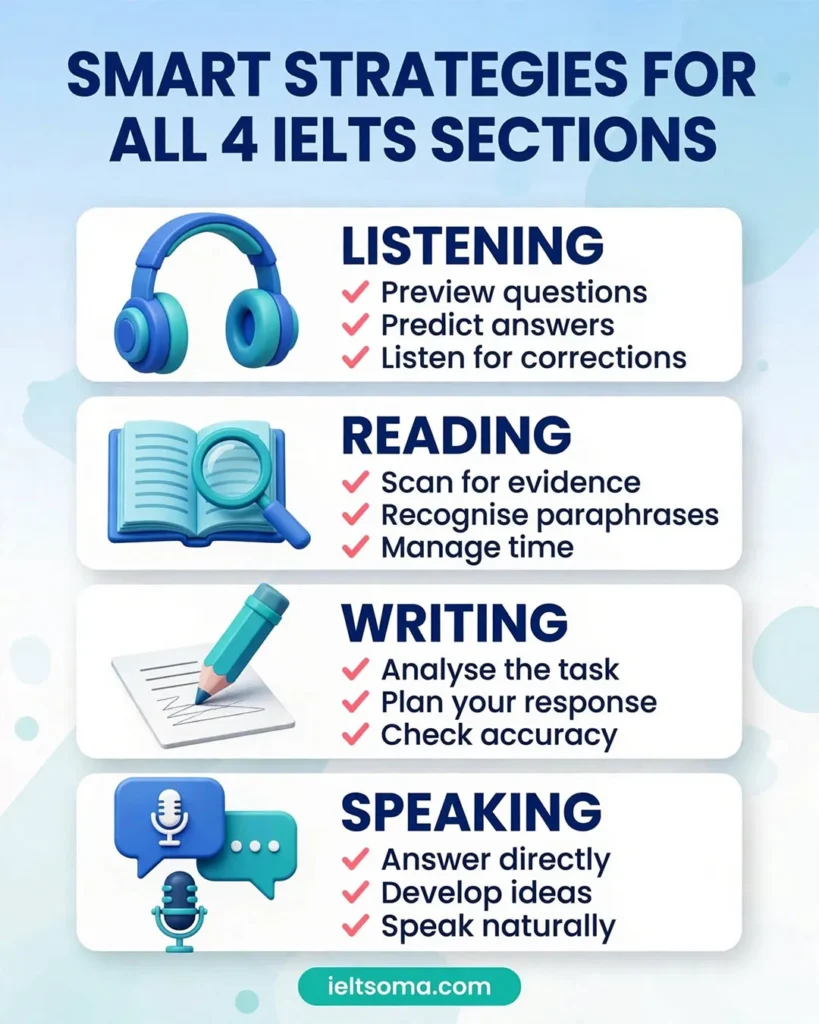
5. IELTS Listening Strategies: Predict, Listen and Verify
Listening requires you to process spoken information while keeping track of the questions. You cannot control the recording, so preparation and attention are essential.
Predict the type of answer
Before the recording begins, examine the words around each gap.
Consider this example:
The workshop will take place on ______.
You can predict that the answer is likely to be a day, date or time.
Now consider:
Participants should bring their ______.
A noun describing an object or document is likely to complete the sentence.
Prediction helps you listen with a purpose. It does not mean guessing without evidence.
Watch for distractors
Speakers may mention one option before correcting or rejecting it.
For example:
We initially planned to meet on Tuesday, but the room was unavailable, so the meeting has been moved to Thursday.
If the question asks for the final meeting day, the answer is Thursday, not Tuesday.
Listen for changes, corrections, contrasts and expressions such as “actually”, “instead”, “but” and “in the end”.
Check spelling and word limits
When entering answers, check spelling, singular and plural forms, and whether the answer fits grammatically into the sentence.
If the recording mentions “fifteen students” but the question requires a number, follow the answer format indicated by the task.
For computer-delivered tests, practise using the interface and managing the remaining time. Do not assume that a transfer-time arrangement from one test format applies to another; check the current instructions for your test.
6. IELTS Reading Strategies: Find Evidence, Not Just Keywords
A common mistake in IELTS Reading is choosing an answer because it contains words similar to those in the passage.
IELTS questions often paraphrase the information. You may see “reduce costs” in a question while the passage says “spend less money”. The wording changes, but the meaning is similar.
Use a targeted reading process
- Read the question carefully.
- Identify its key idea, names, dates or limiting words.
- Scan the passage for relevant information.
- Read the surrounding sentences closely.
- Compare the meaning with the answer options.
- Select the answer supported by the passage.
You do not need to understand every word in a passage before answering questions. Focus on the information relevant to the task.
Avoid common Reading traps
Pay particular attention to:
- Negatives: “not”, “never”, “rarely” and “only”.
- Comparisons: “more than”, “less likely” and “the most”.
- Qualifiers: “some”, “all”, “mainly” and “occasionally”.
- Paraphrases: different words expressing the same idea.
- Unsupported assumptions: statements that sound reasonable but are not confirmed by the text.
For True/False/Not Given questions, distinguish between information that contradicts the passage, information that agrees with it and information the passage does not establish. Do not use your personal knowledge to fill gaps in the text.
For Matching Headings questions, focus on the central idea of each paragraph rather than one interesting detail.
Expert tip: When uncertain, return to the passage and locate the evidence. Do not select an answer simply because it feels familiar.
7. IELTS Writing Strategies: Answer the Task Before Improving the Language
Strong vocabulary and complex grammar cannot compensate fully for a response that does not address the question. One of the most important IELTS test-taking strategies is to understand the task before you begin writing.
Analyse the question
For Writing Task 2, identify the topic, the instruction and every part you must address.
Suppose the question asks:
Some people believe that university education should be free for everyone. To what extent do you agree or disagree?
You need to present a clear position and support it. Merely describing the advantages and disadvantages of university education may not answer the question directly.
Spend a few minutes planning:
- Your main position or response.
- Two or three relevant supporting ideas.
- Examples or explanations that develop those ideas.
- A logical order for your paragraphs.
Follow the requirements of Task 1
In Academic Writing Task 1, select the main trends, differences, comparisons or stages. Include a clear overview where appropriate rather than describing every detail mechanically.
In General Training Writing Task 1, identify the purpose of the letter and address all the bullet points. Use a tone suitable for the recipient and situation.
Leave time to review
Check whether you have answered every part of the question, developed your ideas clearly and used appropriate paragraphing.
Look for repeated words, subject–verb agreement errors, incorrect verb forms, punctuation problems and spelling mistakes.
Do not spend the final minutes replacing every ordinary word with an impressive synonym. Accurate and relevant language is more valuable than vocabulary that sounds sophisticated but does not fit the context.
8. IELTS Speaking Strategies: Communicate, Do Not Perform
The Speaking test assesses your ability to communicate in English through fluency and coherence, lexical resource, grammatical range and accuracy, and pronunciation.
You do not need to sound like a native speaker or produce a memorised speech. You need to express your ideas clearly and respond appropriately.
Answer directly and develop your ideas
For a question such as “Do you enjoy cooking?”, a one-word answer gives little opportunity to demonstrate your speaking ability.
A more developed answer might be:
“Yes, I enjoy cooking, especially at weekends. It helps me relax after a busy week, and I like experimenting with simple recipes. Recently, I learned how to make a vegetable curry that my family really enjoyed.”
The response answers the question, gives a reason and adds an example. It is developed without becoming unnecessarily long.
Use your preparation time wisely
In Part 2, you have one minute to prepare. Write brief notes rather than full sentences.
If the topic asks you to describe a memorable journey, your notes might cover:
- Where you went.
- Who travelled with you.
- What happened.
- Why you remember it.
Use the notes to create a logical sequence. Do not try to memorise a complete speech.
Handle difficult questions naturally
If you need a moment to think, pause briefly and organise your answer. You can use natural expressions such as “I haven’t thought about that before, but I would say…” when they genuinely reflect your response.
If you do not know a particular word, explain the idea in simpler language. Avoid repeatedly using fillers such as “umm”, “you know” and “like” while searching for ideas.
Most importantly, answer the question the examiner actually asks. Do not force a prepared story into an unrelated topic.
9. Do Not Let One Difficult Question Damage Your Performance
Some questions will feel harder than others. That does not mean you are performing badly.
A common mistake is to become frustrated after missing a Listening answer or spending too long on a Reading question. The resulting loss of concentration can affect several questions that follow.
Use this recovery method:
- Recognise that the question is difficult.
- Make the best evidence-based choice you can, where appropriate.
- Move to the next question when necessary.
- Refocus on the information currently being tested.
- Return to an unanswered question if time and the test interface permit.
For example, if you cannot identify the answer to Reading Question 18, do not allow it to consume five minutes while Questions 19–25 remain unfinished.
If there is no penalty for an incorrect response in a particular question type, leaving an answer blank may waste an opportunity to earn a mark. Follow the task instructions and make an informed attempt when appropriate.
The key is to prevent one mistake from becoming a chain of mistakes.
10. Check Your Answers for Preventable Errors
The final minutes of a test can be valuable, but only if you use them strategically.
In Listening and Reading
Check that you have answered every question and followed the required answer format. Review spelling, word limits and whether you have selected the correct number of options.
For computer-delivered tests, confirm that your answers appear in the intended fields. Follow the on-screen instructions for completing and submitting the test.
In Writing
Prioritise errors that could affect meaning or accuracy:
- Missing words or incomplete sentences.
- Incorrect verb forms and subject–verb agreement.
- Spelling and punctuation.
- Repeated vocabulary.
- Paragraphs that do not support your main position.
- Missing elements of the task.
Avoid rewriting entire paragraphs unless a significant problem requires it.
In Speaking
You cannot go back and edit spoken answers as you would a written response. Instead, concentrate on clear communication throughout the interview. If you notice that you have made a small mistake, correct yourself naturally when appropriate and continue.
Do not let a minor grammatical error distract you from the next question.
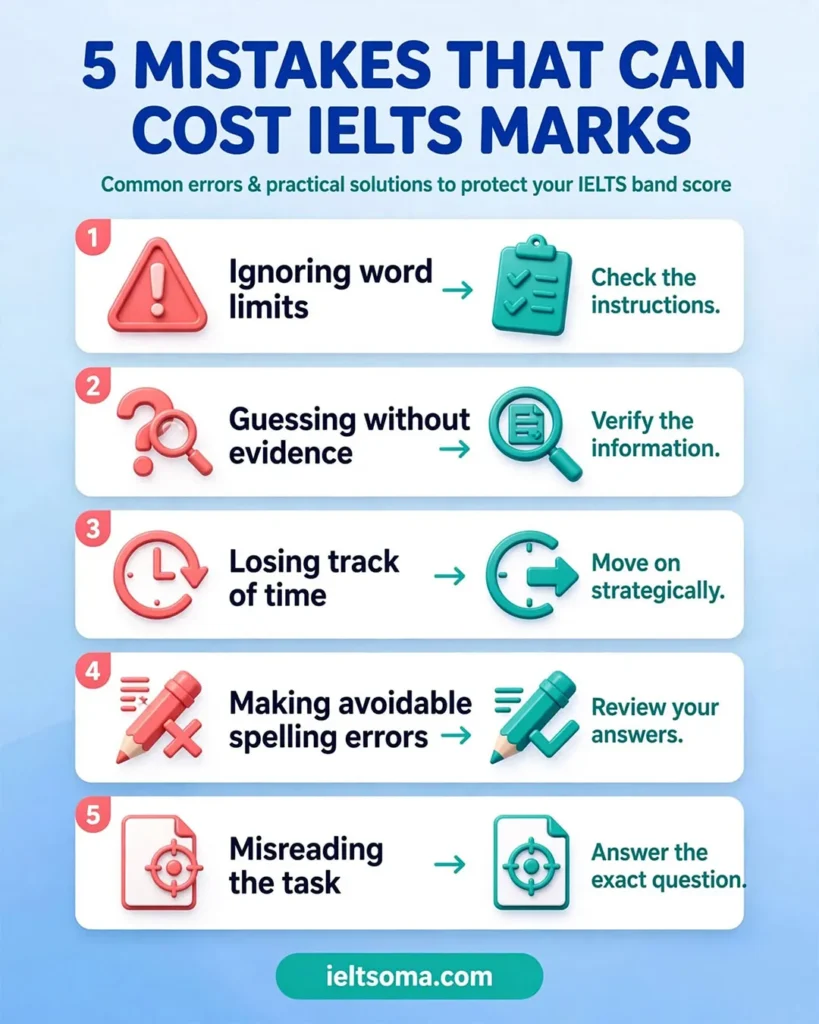
11. Avoid These Common IELTS Exam Mistakes
Even well-prepared candidates can lose marks through habits that are easy to change.
| Common mistake | Better strategy |
|---|---|
| Ignoring the word limit | Check the instructions before completing each answer |
| Choosing an answer based on familiar wording | Verify the meaning and evidence |
| Spending too long on one question | Set a reasonable limit and move on |
| Memorising complete Speaking answers | Practise flexible ideas and natural responses |
| Using complicated vocabulary unnecessarily | Choose precise, appropriate words |
| Writing an essay without analyzing the prompt | Identify every requirement before planning |
| Ignoring spelling and grammar | Reserve time for a focused final check |
| Panicking after one mistake | Reset your attention and continue |
| Practising without a timer | Complete realistic timed tests |
| Reviewing only your score | Analyse why each incorrect answer occurred |
A useful habit is to keep an error log during preparation. Record the mistake, its cause and the action you will take to prevent it next time.
For example:
Mistake: I selected the first date mentioned in a Listening recording.
Cause: I stopped listening after hearing a familiar detail.
Correction: I will listen for corrections and confirm the speaker’s final decision.
This approach turns practice into measurable improvement.
12. Follow a Simple Strategy on Exam Day
A reliable routine reduces the number of decisions you must make under pressure.
Before the test
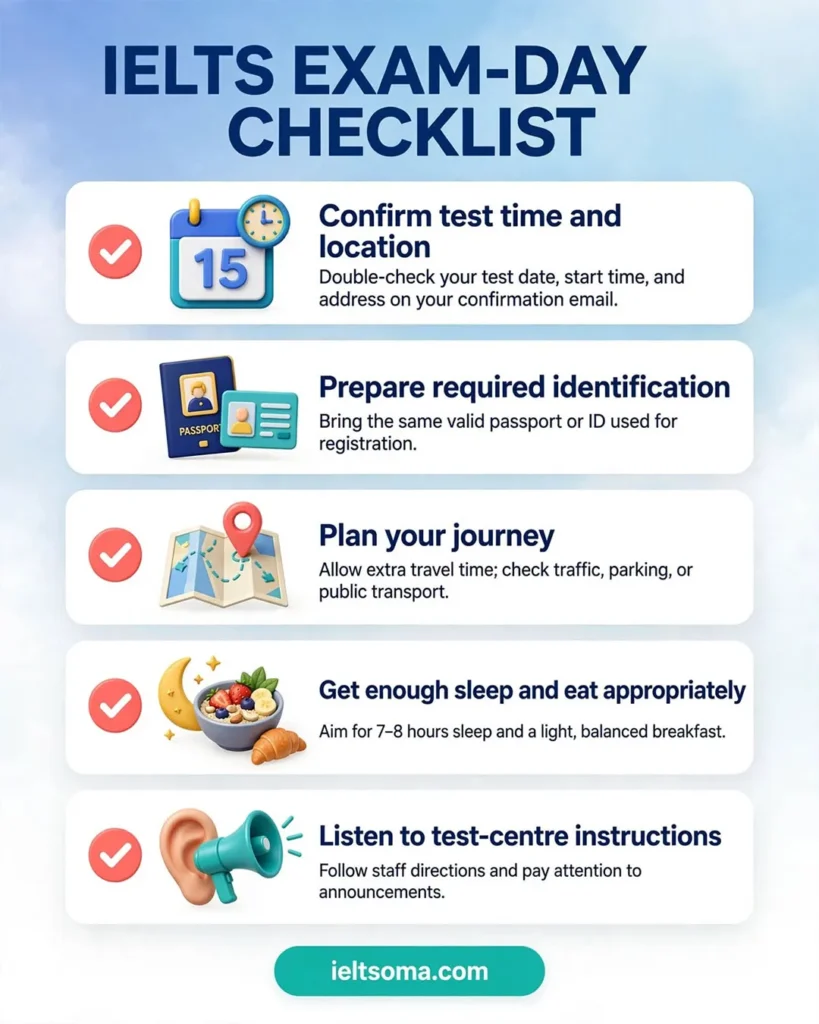
- Confirm the date, location and identification requirements.
- Prepare the items permitted by your test centre.
- Eat appropriately and get sufficient rest.
- Arrive early enough to complete the required procedures.
- Listen carefully to the supervisor’s instructions.
During the test
- Read the instructions before answering.
- Use preparation time to preview questions.
- Keep track of the time without rushing.
- Follow the task requirements exactly.
- Move on when a question begins consuming too much time.
- Maintain concentration even after an uncertain answer.
Before finishing
- Check unanswered questions where time permits.
- Review word limits and answer formats.
- Correct obvious spelling and grammar errors.
- Make sure your Writing response addresses the task.
- Follow the instructions for completing the test.
You do not need a complicated system. You need a consistent approach that protects your attention and helps you use your English ability effectively.
Frequently Asked Questions About IELTS Test-Taking Strategies
1. What are the best IELTS test-taking strategies for a higher band score?
The most useful strategies include practicing under timed conditions, reading instructions carefully, predicting information in Listening, locating evidence in Reading, planning relevant Writing responses and answering Speaking questions naturally. Review your mistakes regularly to identify which skills need improvement.
2. How can I avoid losing marks in the IELTS test?
Follow the word limits, answer the exact question, check spelling and grammar, and avoid unsupported guesses. In Reading, use evidence from the passage. In Listening, listen for corrections and changes in meaning. In Writing, address every part of the task and manage your time carefully.
3. Should I answer difficult IELTS questions first or skip them?
If a question is taking too long, move on when the test format permits and return later if possible. Do not sacrifice several easier questions to solve one difficult question. In Listening, the recording continues, so refocus on the next question rather than trying to recover missed information.
4. How should I divide my time in IELTS Reading?
A reasonable starting point is approximately 20 minutes per passage, although the best allocation depends on the passage and question types. Monitor your progress and avoid spending too long on a single question. Remember that the entire Reading test lasts 60 minutes.
5. Can memorized answers improve my IELTS Speaking score?
Memorizing complete answers is risky because the examiner’s questions may differ from the material you have prepared. Memorized responses can sound unnatural or fail to answer the actual question. Practice organizing ideas, giving relevant examples and explaining opinions instead.
6. Is IELTS Academic more difficult than IELTS General Training?
The tests serve different purposes and have different Reading and Writing content. Listening and Speaking are the same for both test types. Neither should be treated as universally easier; the appropriate test depends on your requirements, and your performance depends on your English proficiency and preparation.
7. What should I do if I panic during IELTS?
Take a brief, controlled breath, relax your shoulders and return your attention to the current task. Focus on the next question rather than worrying about a previous mistake. Practicing full tests under realistic conditions can also help you become more comfortable with exam pressure.
8. How many practice tests should I complete before IELTS?
There is no single ideal number. Complete enough full practice tests to become familiar with the format, manage the timing and identify recurring mistakes. Combine them with focused practice in weaker areas. Carefully reviewing five tests may teach you more than completing ten tests without analyzing your errors.
Final Advice: Make Every Answer Count
Successful IELTS preparation is not just about learning more English. It is also about applying your skills under timed conditions, understanding what each task requires and avoiding mistakes that can be prevented.
Use these IELTS test-taking strategies consistently during practice. Learn to recognise paraphrases, follow instructions, manage your time and recover quickly when a question does not go as planned.
Most importantly, use every practice test to learn something specific about your performance. When you understand why you lose marks, you can build a more effective preparation plan and approach the real exam with greater confidence.
Futher Reading: